Cut the Loop
Read the transcript of “Cut the Loop”
Film transcript: Cut the Loop
What happens to a photoreceptor if you cut its calcium feedback? Calcium enters through the open channels. An exchanger pumps it out all the time. Predict. Light closes the channels, and pumping goes on. Which way does calcium move?
Calcium falls. Entry drops, while pumping continues. Two main calcium sensors answer. First, the GCAPs speed cGMP synthesis, up to about twentyfold. More cGMP reopens channels. This is the strongest of the calcium feedbacks. Second, recoverin lets go of GRK1. That kinase switches off active pigment, so pigment shuts off sooner. One feedback does two jobs. On a steady background, it reopens channels. That keeps current in reserve. During each new flash, it pushes against the change. Each photon closes less current, for less time. Now cut the loop. Mendez and colleagues studied mouse rods lacking both GCAPs. Predict. In darkness, is a single photon's response bigger or smaller?
On a background, does the rod fail sooner or later? In darkness, about five times bigger. Without the GCAPs, cGMP is restored more slowly, so responses recover far more slowly. On a background, adaptation was severely compromised. In cones lacking the GCAPs and recoverin, the fitted half-sensitivity point sat at about a quarter of normal. That shift was not statistically significant. But their sensitivity fell more steeply as the background brightened, and that difference was significant. So removing the feedback makes rod responses larger in the dark, and adaptation worse on a background. In darkness, only the trimming of each response can show.
On a background, the reserve comes into play too. Now the arithmetic. Take a small, brief test flash of fixed duration. Its extra intensity is contrast times background, and its photon count is that times the duration. Its peak response is about sensitivity times that photon count. Multiply sensitivity by background. For normal cones, the product climbs to a ceiling. On bright backgrounds, contrast responses hold.
For the knockout-cone fit, well above the half-sensitivity background, the product falls about threefold for each tenfold brightening. A fall steeper than Weber's rule fits a cell running short of current. But the slope alone cannot measure the current. Some adaptation survives the cut. What supplies it is still unresolved. Rods in bright light raise the same question. On a very bright background, mouse rod-driven responses dip at first. Then they recover with continued exposure. A model suggests that gain changes and pigment bleaching help. So in these mice, rods do not simply switch off in bright light. The takeaway. The feedback trims each response and keeps current in reserve.
Cut it, and the cell runs short sooner.
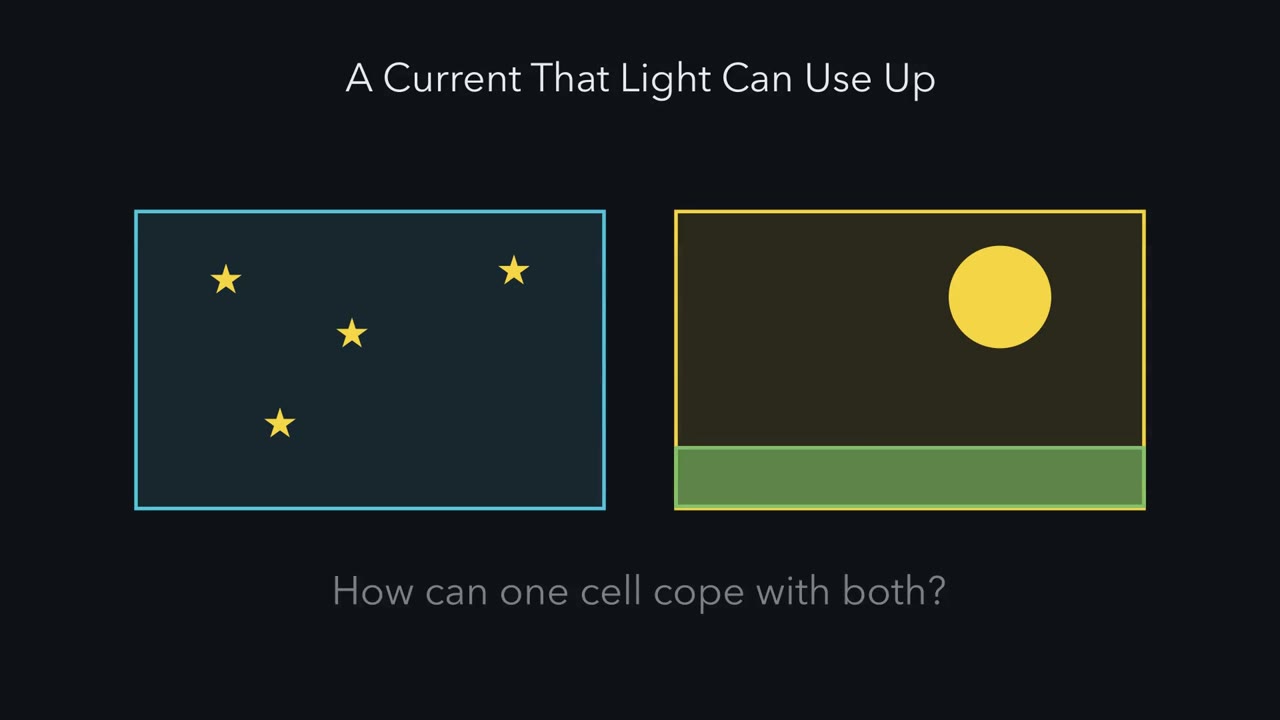
Delete the GCAPs, proteins that turn a rod's gain down, and its response to a single photon becomes about five times larger. Yet cones lacking the GCAPs and recoverin lose sensitivity more steeply than normal cones as a steady background brightens. How can removing gain control make a cell adapt worse in the light?
Continue in the lesson: Calcium Feedback Sets Photoreceptor Gain, and When Photoreceptors Die →
3:44 · Free, with captions and a transcript. The lesson has the full text, the questions and the sources.
More films from this lesson
How this film was made. Narration: an AI narrator voice (Kokoro, af_heart) reading narration written from this lesson's text. Animation: AI-generated in code (Manim) by Claude, a schematic with no drawn molecular structures. Captions come from the narration script. See something wrong? Report it.