Press play to start at .
The Bean and the Red Cell
From the film
- A mature red blood cell has no nucleus and no mitochondria, and gets its NADPH mainly from the pentose phosphate pathway.
- Glutathione reductase spends that NADPH to restore reduced glutathione, so the red cell's whole glutathione cycle leans on G6PD.
- G6PD deficiency affects roughly 400 million people; the gene is on the X chromosome, so males are affected more often.
- Fava beans, certain antimalarial or sulfa drugs, or infection can then lead to clumped hemoglobin (Heinz bodies), lost red cells and a hemolytic crisis.
- The trait is thought to persist because it offers some protection against malaria, though how strong that protection is still differs between studies.
Read the transcript of “The Bean and the Red Cell”
Film transcript: The Bean and the Red Cell
Tap a sentence to play from there.
- 0:00 Last time, glutathione took the oxidant hits, and NADPH from this pathway recharged it. So why can a plate of fava beans destroy someone's red blood cells?
- 0:15 Here is a mature red blood cell.
- 0:18 It has no nucleus and no mitochondria.
- 0:22 It needs little ribose.
- 0:24 What it needs is NADPH, and it gets it mainly from this pathway.
- 0:29 Inside, glutathione peroxidase spends reduced glutathione to neutralize peroxides.
- 0:37 Glutathione reductase then spends NADPH to restore it.
- 0:42 The cycle turns as long as NADPH keeps coming.
- 0:47 So the red cell's whole glutathione cycle leans on one enzyme.
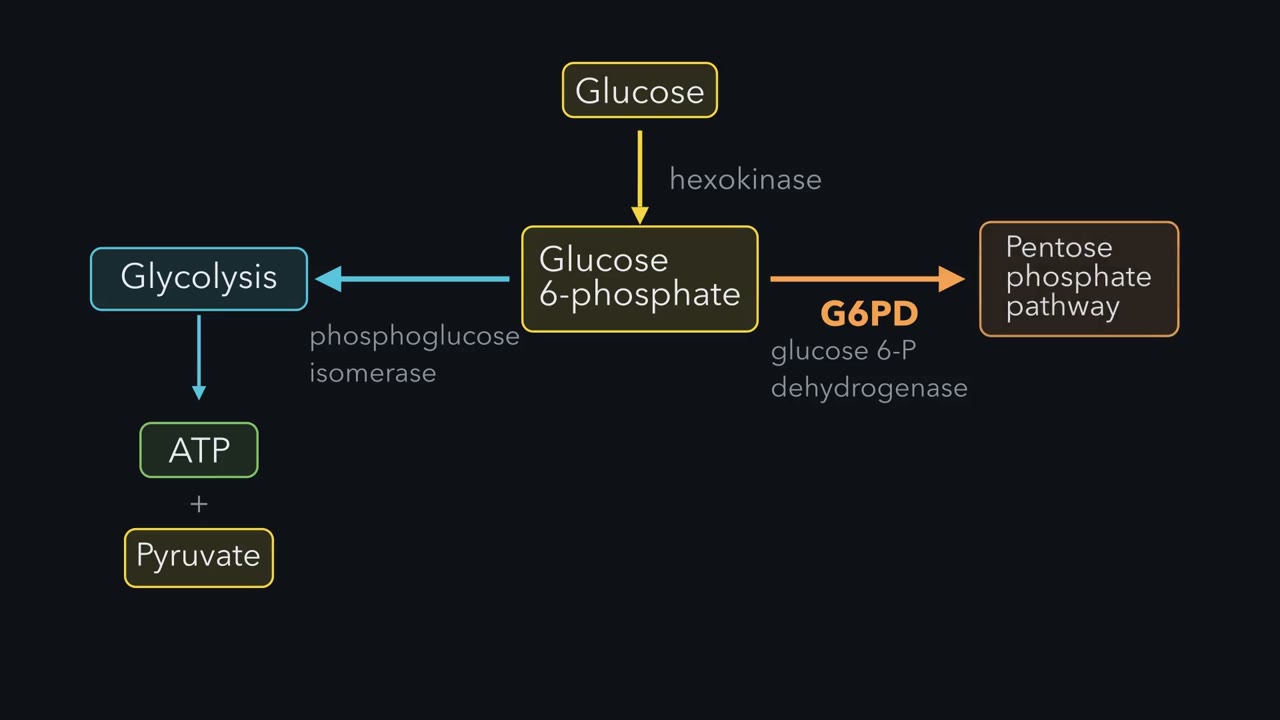
- 0:52 It is G6PD, the committed first step of this pathway.
- 0:57 G6PD deficiency weakens that step.
- 1:01 It is the most common human enzyme deficiency, in roughly 400 million people.
- 1:08 The gene sits on the X chromosome, so males are affected more often.
- 1:13 Its many variants differ in severity.
- 1:16 Then a trigger arrives: fava beans, certain antimalarial or sulfa drugs, or an infection. Each pushes oxidative stress past what a weakened cell can handle.
- 1:28 Less NADPH means less reduced glutathione.
- 1:33 Reactive oxygen builds up.
- 1:36 Hemoglobin oxidizes and clumps together.
- 1:40 Those clumps are called Heinz bodies.
- 1:42 The damaged cells burst in the circulation, or the spleen pulls them out.
- 1:48 The result is a hemolytic crisis, and a bean started it.
- 1:52 Read the chain from start to finish.
- 1:56 Weak G6PD. Less NADPH.
- 2:01 Less reduced glutathione.
- 2:03 More reactive oxygen.
- 2:06 Clumped hemoglobin.
- 2:09 Lost cells.
- 2:10 Now a puzzle. A trait this dangerous affects roughly 400 million people.
- 2:18 What could keep it so common?
- 2:25 It is thought to persist because it offers some protection against malaria.
- 2:30 Deficient red cells seem to be a poorer home for the parasite, Plasmodium falciparum. Where the trait is common broadly overlaps malaria's historical range.
- 2:42 That makes it a balanced polymorphism, like sickle-cell trait.
- 2:47 How strong the protection is, and in whom, still differs between studies.
- 2:52 It is also why doctors screen for it before prescribing certain oxidant drugs.
- 2:58 So one weak step cuts both ways.
- 3:02 It leaves a red cell exposed to a bean, and may leave it a poorer home for a parasite.
- 3:08 Either way, the red cell's antioxidant shield hangs on a single step.
- 3:14 Weaken G6PD, add an oxidant, and the whole chain gives way.
Pentose phosphate path: the same idea, other levels
A level is a place to start, not a rank. If this loses you, the rung below teaches the same idea, told more simply.
College, upper level · the level you chose
The Pentose Phosphate Pathway: NADPH and Five-Carbon Sugars · this lesson
Glucose-6-phosphate yields 2 NADPH per turn; G6PD deficiency breaks red cells.
Biochemistry · about 27 min · film 3:56 · 3 practice questions
Next door
- Nucleotide metabolism: Too Costly to Throw Away · 2:58 The five-carbon sugar it makes is the backbone of every nucleotide a cell builds.
- Making fat: The carbon fatty acid synthesis throws away · 3:21 Building fat needs NADPH, and this pathway supplies much of it.
- Red blood cells: Blood Cells, Hematocrit and Clotting Red cells use this pathway as their only NADPH source, to protect themselves from oxygen damage.
- Antimetabolite drugs: Nucleotide Metabolism: Build It, Recycle It, or Pay in Uric Acid Fast-dividing cells need many nucleotides, which is why drugs that block their supply slow cancer growth.
More films from this lesson
Continue in the lesson: The Pentose Phosphate Pathway: NADPH and Five-Carbon Sugars →
Free, with captions and a transcript. The lesson has the full text, the questions and the sources.
How this film was made. Narration: an AI narrator voice (Kokoro, af_heart) reading narration written from this lesson's text. Animation: AI-generated in code (Manim) by Claude, a schematic with no drawn molecular structures. Captions come from the narration script. See something wrong? Report it.