Films · Developmental Neuroscience
A Badge Only You Wear
Read the transcript of “A Badge Only You Wear”
Film transcript: A Badge Only You Wear
How does a neuron keep its own branches from tangling, while still overlapping its neighbours? Take one neuron's arbor. Its branches often spread evenly, without crossing or bundling. This is self-avoidance. Sister branches from the same cell touch, then move apart.
Yet fly sensory neurons share the body wall with other classes, and their dendrites overlap. At every contact, a branch must ask: is this me, or someone else? Predict. A protein binds only identical copies, and binding makes branches pull apart. What must it be like?
Every branch of one neuron must carry the same version, so sister branches always match. Neighbouring neurons must carry different versions, so their branches seldom match. The fly has such a protein, from one gene, Dscam1. It comes in many isoforms.
Exons are the stretches of a gene kept in its messenger RNA. Four of Dscam1's exons come as clusters of alternatives. Each messenger RNA keeps one exon from each cluster. That gives 19,008 outer surfaces, and 38,016 isoforms in all. The fourth cluster builds the stretch that crosses the membrane, so it does not change the outer surface. Each isoform binds mainly to identical isoforms. But matched branches pull apart. Same means retreat. Remove Dscam1, and a neuron's own branches cross and bundle. Take a neuron that lacks Dscam1 and give it a single isoform, and its own branches spread apart again. Predict. Now give every neuron the same single isoform.
What happens between neighbours? Neighbours that carry the same single isoform cannot tell themselves from each other. The logic predicts they avoid each other. Flies whose Dscam1 could make only one outer surface had severely disorganised circuits. Which isoform a neuron carries matters little. Differing from its neighbours is what matters.
Why thousands? Picture each neuron drawing about twenty badges from a bowl. From a small bowl, a neighbour carries many of your badges. From a huge bowl, a neighbour carries almost none. In the huge bowl, sister branches match completely and a neighbour only slightly. Flies need thousands of isoforms to wire normally. Mouse DSCAM is not spliced this way. Instead, starburst amacrine cells use gamma protocadherins, adhesion proteins of the cadherin family. Without them, each cell's own dendrites cross and clump. In starburst cells lacking the protocadherins, give every cell the same single isoform. Each arbor separates, but neighbours avoid each other too.
With only about 58 genes, recognition is thought to compare the whole combination, not single isoforms. Takeaway: a label unique to one cell, read as retreat, keeps that cell's own branches apart.
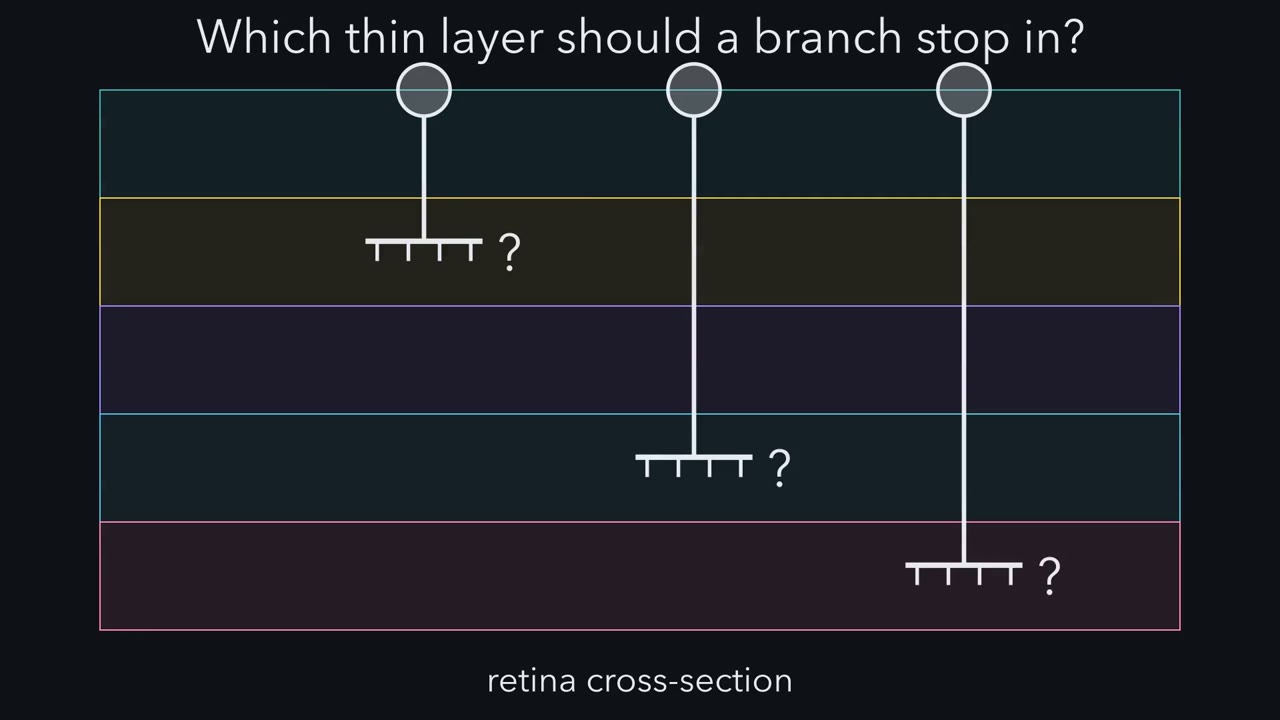
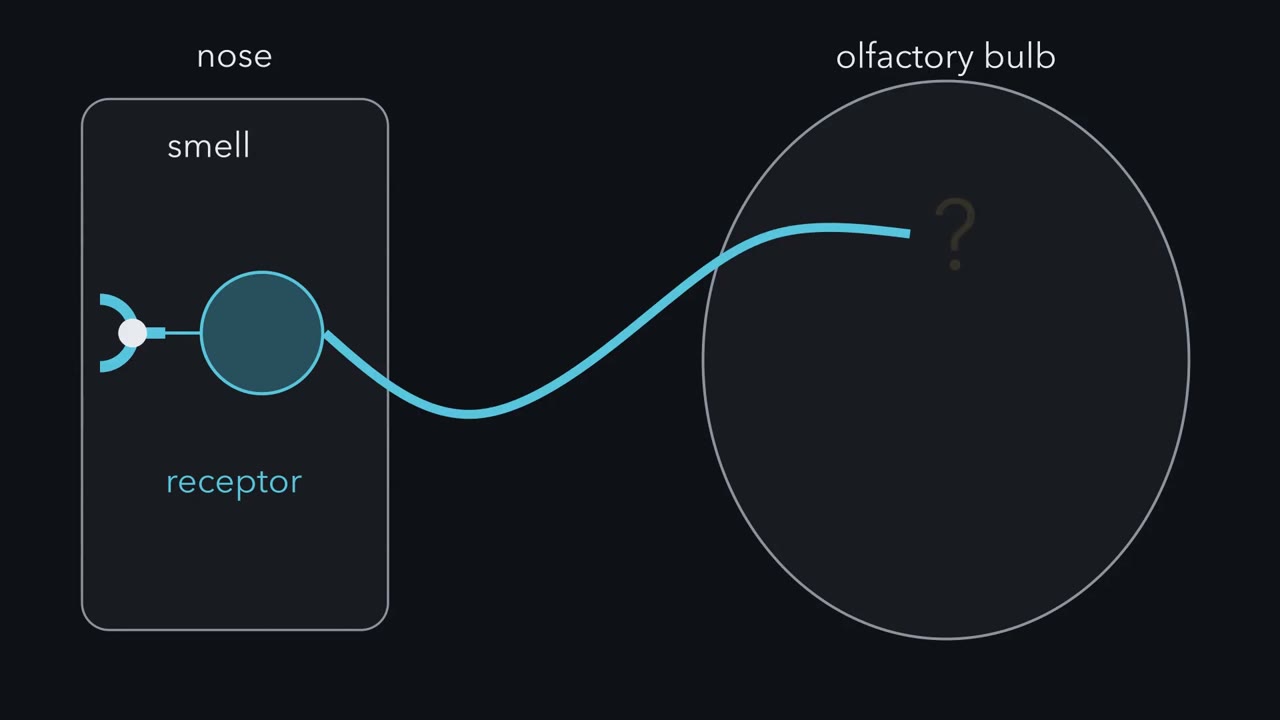
How does a neuron stop in the right layer, find the right partner and keep its own branches from tangling? One fly gene that can make tens of thousands of different surface proteins is part of the answer.
Continue in the lesson: Choosing a Partner: Layers, Self-Avoidance and Smell →
3:46 · Free, with captions and a transcript. The lesson has the full text, the questions and the sources.
More films from this lesson
How this film was made. Narration: an AI narrator voice (Kokoro, af_heart) reading narration written from this lesson's text. Animation: AI-generated in code (Manim) by Claude, a schematic with no drawn molecular structures. Captions come from the narration script. See something wrong? Report it.