How Earth Got Its Oxygen
Read the transcript of “How Earth Got Its Oxygen”
Film transcript: How Earth Got Its Oxygen
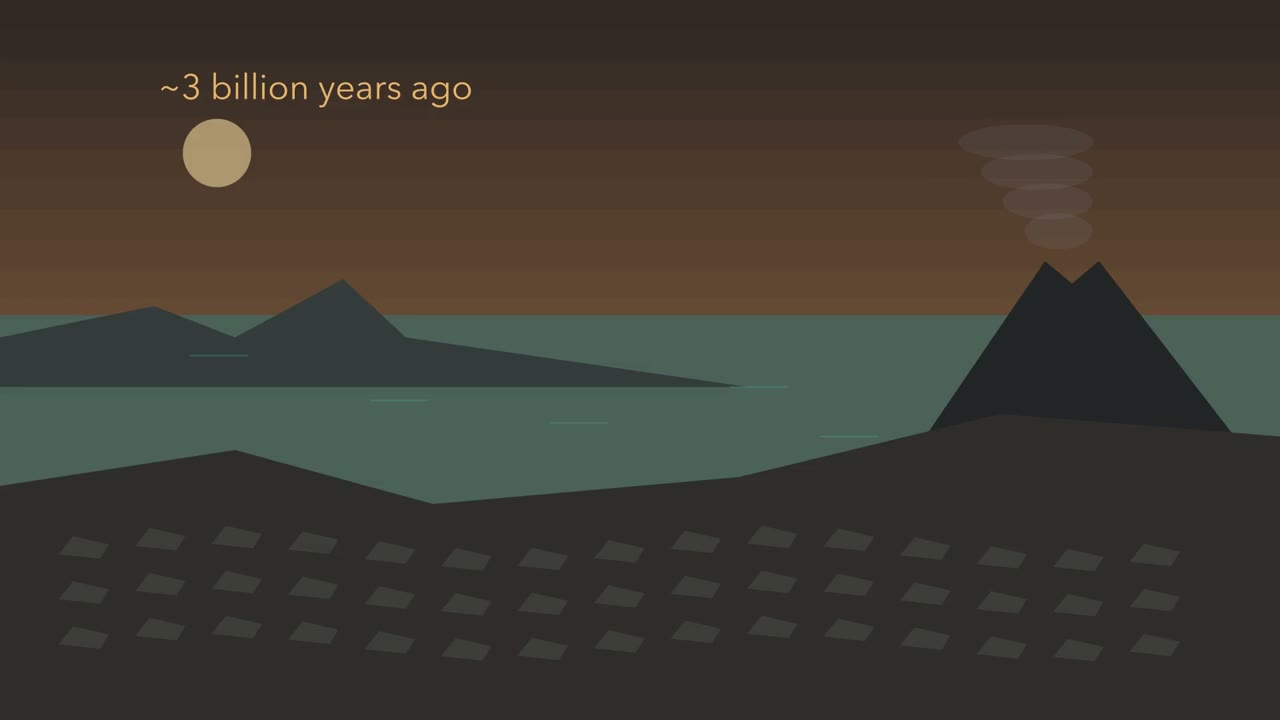
The oxygen in your next breath is, in part, made of leftovers. What it was left over from is the story. Rewind about 3 billion years. Watch the gauge. The air holds almost no oxygen. Something had to fill this sky. And something held it back.
Nobody saw this world, so we rebuild it from ancient rocks. The sea held dissolved iron. That iron had electrons to give. But with little oxygen to take them, much of that iron stayed dissolved. Life was already here, and all of it was microbial.
Many of these cells likely made energy without oxygen, by fermenting or by making methane. Remember them. They come back near the end. Then came a new trick. Water holds its electrons tightly. Cyanobacteria learned to pull them out, powered by sunlight. They kept the electrons to build their own food. The waste was oxygen gas, and they let it go. In shallow seas, these cells spread as sticky mats. So here is a puzzle. The mats were releasing oxygen. Why did the air not fill with it right away?
Because oxygen had many other places to go. Oxygen strongly pulls in electrons. Each oxygen molecule can take four. And the sea held iron with electrons to give. So iron handed its electrons to oxygen, formed rust-like minerals, and sank. Layer by layer, iron and silica built striped rock on the sea floor. These are banded iron formations, and much of the iron we mine today comes from them. Some layers may be the work of microbes that rust iron without any oxygen. Iron was not the only taker. Volcanic gases, methane, and minerals on land all consumed oxygen too. As an analogy, picture a bathtub. The mats are the tap. Every one of those takers is an open drain.
Here is the idea to hold on to. Making oxygen is only half of the story. The air keeps only the oxygen that nothing else takes first. So when did the tap turn on? Cyanobacteria most likely arose well before oxygen built up. By how long is debated. Some rocks hint at brief whiffs of oxygen before the lasting rise. Then came the change. Between about 2.4 and 2.1 billion years ago, oxygen rose, wavered, and finally stayed. In bathtub terms, more was now arriving than the drains could take. Why the balance tipped then is still debated. Geologists call this the Great Oxygenation Event. But the tub was nowhere near full. Oxygen stayed far below today's level for a very long time.
Now remember the old microbes. An oxygen molecule that is only partly filled with electrons can damage DNA and proteins. For many of those microbes, oxygen was toxic. So what happened to them? Was there a mass die-off? A mass die-off is often claimed, but the evidence is thin.
Microbes that live without oxygen are called anaerobes. They clearly survived, in mud, deep water and other airless places. They thrive there still, including in your own gut. The oxygen that was left over did not end the old world of life. It pushed it into the shadows. Now run the clock forward. Oxygen stayed low for well over a billion years. Then, much later, it rose again, toward the level you breathe today. Take that breath again. It began as waste. And what reaches your lungs is what the rest of the planet left behind.
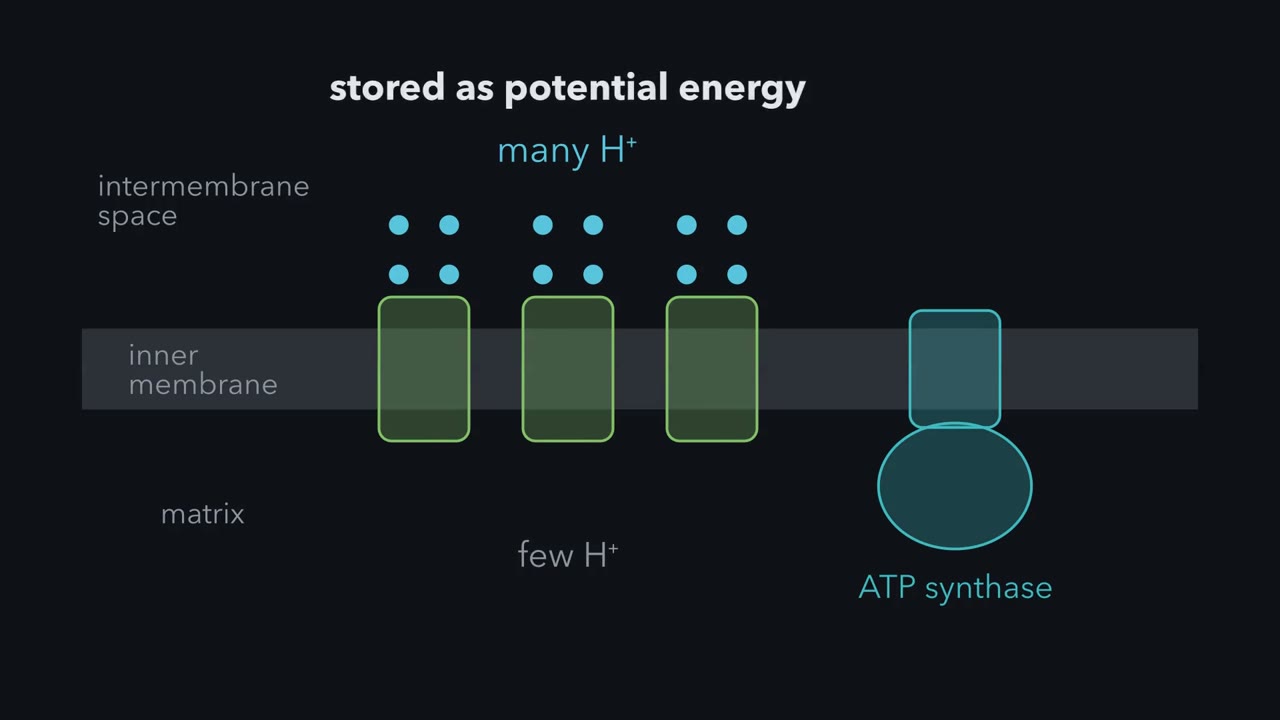
Electron flow and ATP synthesis are two separate machines linked by one thing: the proton gradient.
Continue in the lesson: Oxidative Phosphorylation: The Electron-Transport Chain →
4:43 · Free, with captions and a transcript. The lesson has the full text, the questions and the sources.
More films from this lesson
How this film was made. Narration: an AI narrator voice (Kokoro, af_heart) reading narration written from this lesson and the review literature. Animation: AI-generated in code (Manim) by Claude, a schematic with no drawn molecular structures. Captions come from the narration script. See something wrong? Report it.