Press play to start at .
Helix 12 and Tissue Helpers: Turning the Switch
From the film
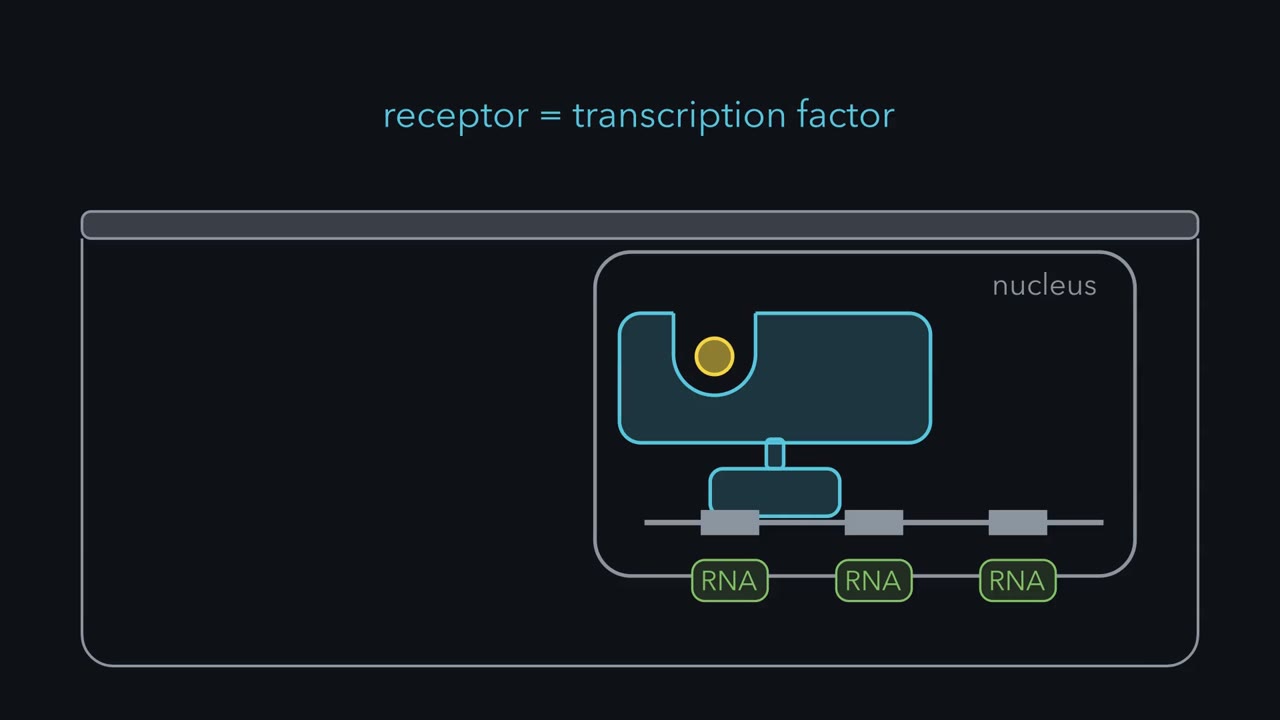
- Ligand shape and each cell's helpers decide whether genes turn on.
- An agonist such as estradiol lets helix 12 close over the pocket like a lid, completing the AF-2 groove where co-activators dock and loosen chromatin.
- A bulky antagonist such as 4-hydroxytamoxifen prevents helix 12 from closing, pushing it into the AF-2 groove so co-activators cannot bind there.
- Because AF-1 remains exposed on DNA, the cell's balance of co-activators and co-repressors can make one drug act differently across tissues—and building new mRNA and protein puts these responses on a scale of hours.
Read the transcript of “Helix 12 and Tissue Helpers: Turning the Switch”
Film transcript: Helix 12 and Tissue Helpers: Turning the Switch
Tap a sentence to play from there.
- 0:02 The first film showed one nuclear receptor binding both ligand and DNA.
- 0:09 How does a tiny molecule inside the pocket flip a gene from off to on?
- 0:14 And why can one drug block estrogen in breast tissue yet imitate it in the uterus?
- 0:20 Zoom into the hormone-binding domain, built from about 12 helices around a hydrophobic pocket.
- 0:28 Its last helix, helix 12, is the main moving part.
- 0:32 When an agonist like estradiol enters, it switches the receptor on.
- 0:38 Helix 12 folds shut across the mouth of the pocket like a lid.
- 0:43 Closed like that, helix 12 completes a shallow surface groove called AF-2.
- 0:48 Co-activators carry a short helix that fits it.
- 0:53 Docked co-activators bring enzymes that add acetyl tags to histones, the spools DNA wraps around. The DNA loosens, and RNA polymerase starts copying the gene.
- 1:06 An antagonist fills the same pocket without switching the receptor on.
- 1:12 The liver converts the breast-cancer drug tamoxifen into tighter-binding forms like 4-hydroxytamoxifen.
- 1:20 It fits the pocket, but one long side chain sticks out of the opening.
- 1:25 That protruding side chain sits right where helix 12 wants to fold shut.
- 1:31 Notice the nearby notch where co-activators dock.
- 1:35 If helix 12 cannot close, what happens to that groove?
- 1:44 The receptor's own helix takes the groove, because helix 12 cannot close as a lid.
- 1:51 Instead it swings around and lies inside the co-activator groove itself.
- 1:56 That turns the lid into a plug.
- 1:59 With the AF-2 groove occupied, co-activators cannot bind there, so breast cells keep the gene off.
- 2:07 Yet tamoxifen still lets the receptor pair on DNA, leaving a second switching surface exposed. That front-end surface, AF-1, does not depend on helix 12.
- 2:20 So the outcome can depend on the helper proteins each tissue makes.
- 2:25 Cells rich in co-activators that work through AF-1 can read the same drug as on.
- 2:31 That helps explain why tamoxifen opposes estrogen in breast tissue yet imitates it in uterus and bone.
- 2:39 Either way, the receptor works through new RNA and protein, unlike fast cyclic AMP relays. The first new messenger RNA appears within tens of minutes, and protein changes build over hours.
- 2:55 In return, those new proteins remain after the hormone clears, and one receptor can reset many genes together.
- 3:03 A drug is not simply on or off by itself.
- 3:07 Ligand shape and each cell's helpers decide whether genes turn on.
Nuclear receptors: the same idea, other levels
A level is a place to start, not a rank. If this loses you, the rung below teaches the same idea, told more simply.
Graduate · the level you chose
Nuclear Receptors: Receptors That Are Transcription Factors · this lesson
Hormone enters, receptor reads DNA: helix 12 and tamoxifen's two faces.
Cell Signaling · about 18 min · film 3:21 · 4 practice questions
Next door
- Cholesterol: The cholesterol gauge · 3:15 · College: going further Steroid hormones are made from cholesterol, and they can cross the membrane because they are oily.
- Thyroid hormone: Tissues Decide What T4 Becomes · 2:26 · College: going further T3 acts by entering the nucleus and binding a receptor that grips DNA.
- Retinoic acid: A Tap at the Back, a Drain at the Front · 3:02 Retinoic acid works through a nuclear receptor to tell embryo cells where they lie along the body axis.
More films from this lesson
Continue in the lesson: Nuclear Receptors: Receptors That Are Transcription Factors →
Free, with captions and a transcript. The lesson has the full text, the questions and the sources.
How this film was made. Narration: an AI narrator voice (Kokoro, af_heart) reading narration written from this lesson's text. Animation: AI-generated in code (Manim) by Claude, a schematic with no drawn molecular structures. Captions come from the narration script. See something wrong? Report it.