Settled and Argued
Read the transcript of “Settled and Argued”
Film transcript: Settled and Argued
Astrocytes clear potassium and glutamate. Do they also send fast signals of their own? Start with what is settled. Glutamate follows the same rule as potassium, even more sharply. Between releases, transporters keep outside glutamate very low. So each release makes a large, brief rise near the synapse. Most of the glutamate transporter GLT-1 sits in astrocytes, with a smaller pool in terminals. Deleting GLT-1 from astrocytes in mice caused seizures and early death. Now the open question. Do astrocytes also release glutamate that acts quickly on synapses? This is called gliotransmission. Astrocytes show calcium signals. In principle, a calcium rise could trigger release, as it does in a terminal.
One test deleted a receptor that releases stored calcium, the IP3 receptor type 2. Hippocampal transmission did not change. Does that prove astrocytes never release glutamate onto synapses? No. In adult mice, astrocytes lacking that receptor still showed calcium fluctuations, mostly in their processes. So the null result cannot exclude effects driven by the calcium that remains. A later study found a subgroup of adult mouse hippocampal astrocytes with synaptic-like release machinery. Deleting a vesicular glutamate transporter from astrocytes suppressed the glutamate hotspots linked to that subgroup. That is positive evidence, but in one subgroup and one species.
Neither study refutes the other. They used different manipulations and asked different questions. So keep two lists. That astrocytes clear potassium and glutamate is settled. Fast signalling by astrocytes is still argued. Your design problem is to test it in one group of adult mouse astrocytes.
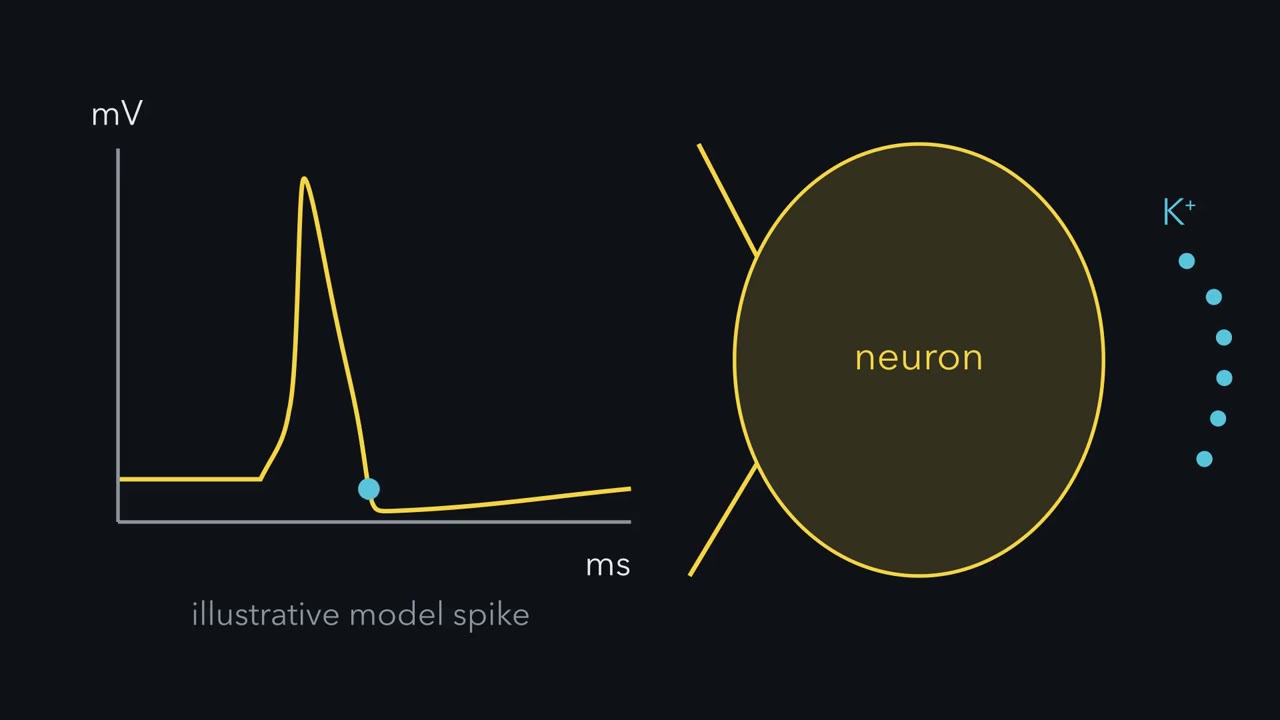
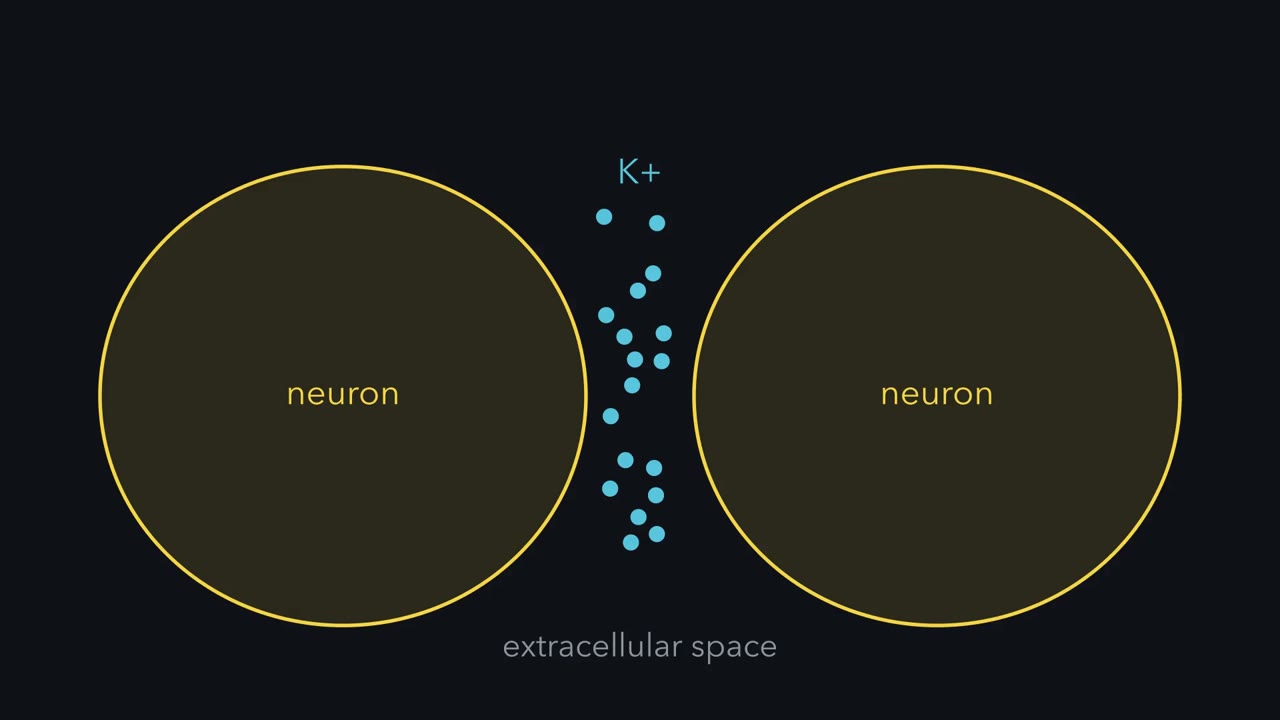
Let potassium pile up outside neurons during seizure-like firing and E_K can move by more than 30 mV. Who cleans it up?
Continue in the lesson: Neurons and Glia at Work →
2:18 · Free, with captions and a transcript. The lesson has the full text, the questions and the sources.
More films from this lesson
How this film was made. Narration: an AI narrator voice (Kokoro, af_heart) reading narration written from this lesson's text. Animation: AI-generated in code (Manim) by Claude, a schematic with no drawn molecular structures. Captions come from the narration script. See something wrong? Report it.