Who Puts the Potassium Back
Read the transcript of “Who Puts the Potassium Back”
Film transcript: Who Puts the Potassium Back
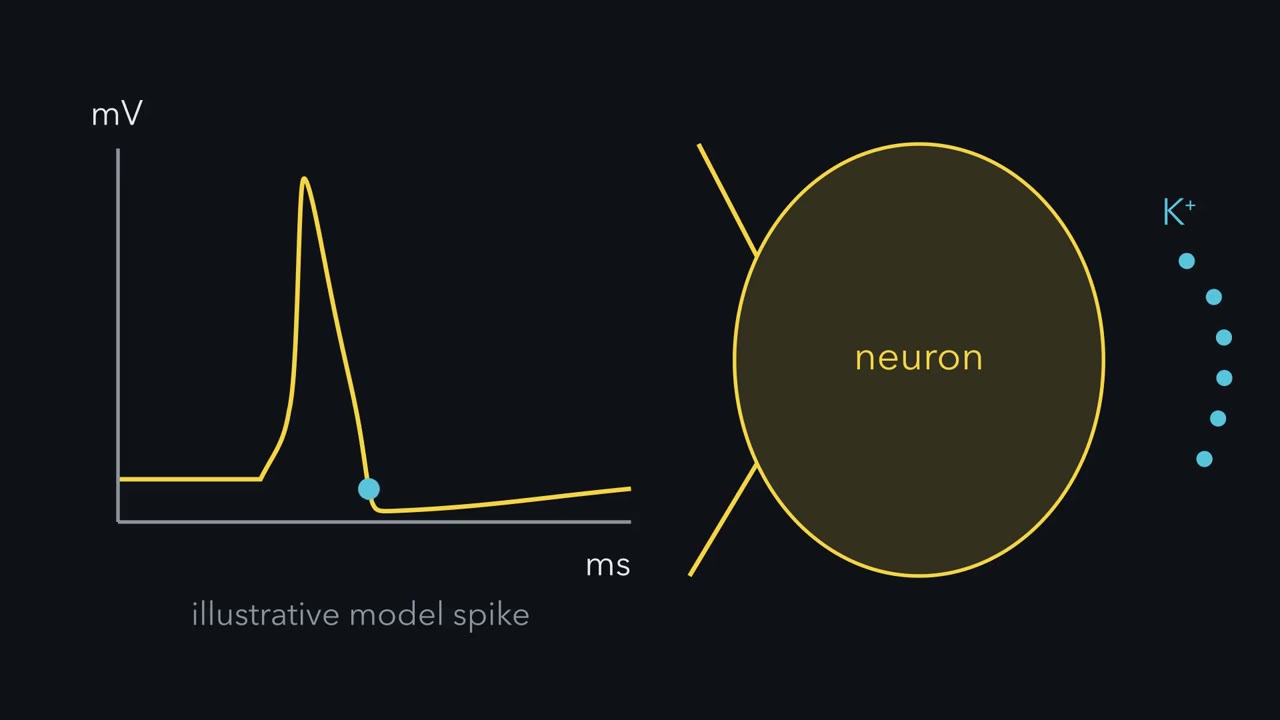
Something has to clear the potassium from the space outside neurons. Who does it, and how? In 1966, Stephen Kuffler, John Nicholls and Richard Orkand recorded from glial cells. They worked in the optic nerve of an amphibian, the mudpuppy Read the record first. The glial cell's voltage sits steady and very negative. Then the neighbouring axons fire a train of impulses. The glial cell slowly depolarizes. Longer and faster trains depolarize it more. When the axons stop, it recovers over seconds. What is the glial cell sensing?
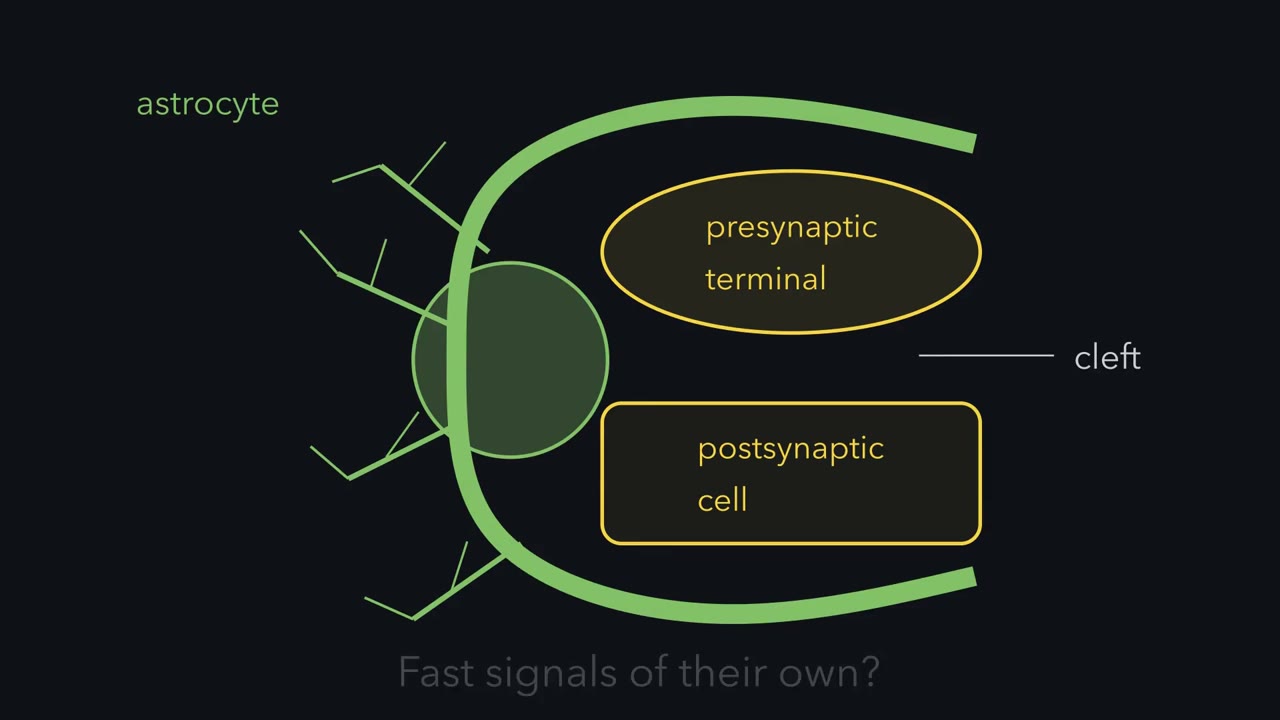
Potassium. Changing the potassium in the bath moved the glial voltage as a potassium electrode's would. So the glia were sensing the potassium the axons released as it built up. Astrocytes are joined by gap junctions, channels that link the insides of neighbouring cells. Their membranes are almost purely permeable to potassium. In this simplified, strongly coupled network, the astrocytes stay at nearly the same voltage. What differs from place to place is the local E_K, set by the local potassium. Now let one spot fire hard. There, the local E_K is more positive than the network's voltage. So potassium flows in. In this model it enters through the potassium channel Kir4.1.
That entry depolarizes the network slightly. Where potassium is still low, potassium now flows out. Entry and exit happen at the same time, as one loop of current. This is spatial buffering. It moves potassium from where it is high to where it is low. On balance, the potassium stays outside, only spread thinner. Putting it back inside cells is a separate job. Sodium-potassium pumps in astrocytes and neurons take potassium up. How much each mechanism contributes is still debated. Ken McCarthy's laboratory deleted Kir4.1 from glia in mice. In hippocampal slices, astrocytes lacking the channel took up potassium poorly. What else might fail when this potassium channel is gone?
Glutamate uptake. That does not mean the channel carries glutamate. Glutamate transport depends on the astrocyte's voltage. And Kir4.1 helps hold that voltage negative. One limit. The deletion began in development, and it also reached oligodendrocytes. So the result cannot be pinned on mature astrocytes alone. So astrocytes sense the potassium that firing releases. They spread it through their network, and pumps take it back inside cells.
Let potassium pile up outside neurons during seizure-like firing and E_K can move by more than 30 mV. Who cleans it up?
Continue in the lesson: Neurons and Glia at Work →
3:13 · Free, with captions and a transcript. The lesson has the full text, the questions and the sources.
More films from this lesson
How this film was made. Narration: an AI narrator voice (Kokoro, af_heart) reading narration written from this lesson's text. Animation: AI-generated in code (Manim) by Claude, a schematic with no drawn molecular structures. Captions come from the narration script. See something wrong? Report it.