Films · Developmental Neuroscience
A Dial With a Ceiling
Read the transcript of “A Dial With a Ceiling”
Film transcript: A Dial With a Ceiling
The extra leg enlarged the target. Suppose it doubled the support. Could the survivors double too? Twice 12,000 is 24,000. But only about 20,000 were present at the peak. If no new neurons join afterwards, no target can rescue more than that. That is the ceiling. And the real rise was well below it. In embryos with vigorously moving grafts, survivors rose by a tenth to over a quarter.
So the target turns a dial. More target, fewer deaths, up to the ceiling. Why did it turn so little? The experiment cannot tell. The graft may be only partly innervated. Activity at the muscle also matters. In chick embryos, paralysing the muscle with curare rescues many motor neurons that would otherwise die. Is every developmental death the target's doing? One test adds cells instead of target. Derek Southwell and colleagues transplanted precursors of cortical interneurons into host mice, across a 200-fold range of doses. Predict. Take a toy model, where the host can support only 1,000 transplanted cells. What fraction dies as the dose rises?
In the toy model, none die until the dose passes 1,000. Then the fraction climbs, to 95%. percent. The real result was different. About the same fraction died at every dose tested. the cells died at their own age, not the host's. They carried their own clock. Later work showed that, during this window, circuit activity can tune how many survive.
The chick has another case, in the neck-level, or cervical, cord. Around day 4 to 5, a wave of cervical motor neurons dies, before the later death that follows target contact. A bigger target did not change this early wave. Nor did paralysis, or the trophic factors tested. Drugs that block RNA or protein synthesis reduced it. So it needs new RNA and protein, an active program. Moved to another level of the cord, the cervical tube still lost its neurons on schedule.
So, make too many, then let the target keep what it can support. That holds for many peripheral neurons, and for motor neurons at their muscles. Takeaway: in the limb, the target helps set survival, like a dial with a ceiling. Count across time, and you can see it.
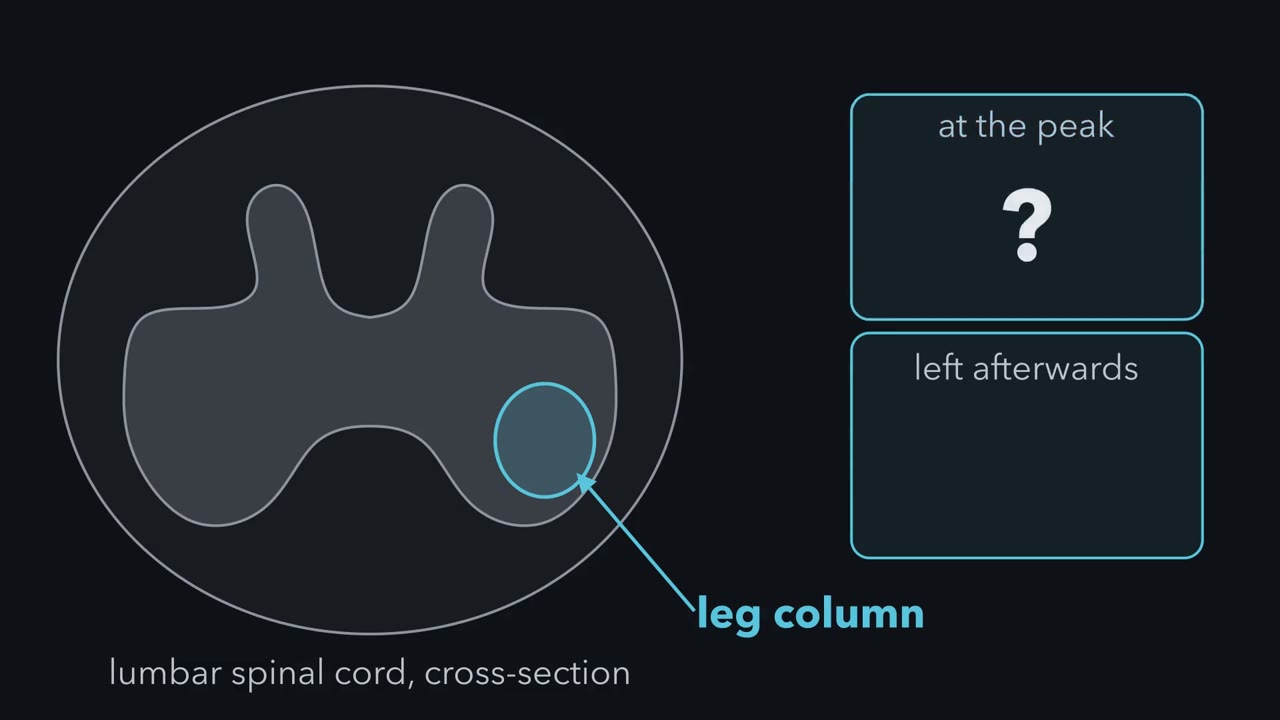
In Hamburger's raw counts, a chick embryo has just over 20,000 motor neurons in the column that serves its leg at the peak, and about 40% of them die over the next three days. Nothing is wrong with the embryo. How could anyone tell those neurons died, and what decides how many stay?
Continue in the lesson: Too Many Neurons: Naturally Occurring Cell Death →
3:05 · Free, with captions and a transcript. The lesson has the full text, the questions and the sources.
More films from this lesson

How this film was made. Narration: an AI narrator voice (Kokoro, af_heart) reading narration written from this lesson's text. Animation: AI-generated in code (Manim) by Claude, a schematic with no drawn molecular structures. Captions come from the narration script. See something wrong? Report it.