Films · Developmental Neuroscience
Which Inputs Lose?
Read the transcript of “Which Inputs Lose?”
Film transcript: Which Inputs Lose?
In a newborn mouse brain, some connections will be lost. Which ones, and what carries them away? Start in the visual thalamus, the relay where axons from the eye end. In a newborn mouse, inputs from the two eyes overlap there. Over roughly the first week and a half, the two eyes' inputs sort into separate territories. Each side ends up mostly the territory of the opposite eye. The eye on the same side keeps a small patch. One relay neuron starts with many retinal inputs, and ends with only a few. Inputs that lose are removed. So, which inputs lose? And what carries them away? The sorting is driven partly by spontaneous waves of activity. They sweep the young retina before the eyes open.
Predict. If activity biases the outcome, which inputs should lose more often: the busier ones, or the quieter ones? In this circuit, experiments that change one eye's activity point to the quieter ones. Later, an experiment that silences one eye tests whether microglia follow.
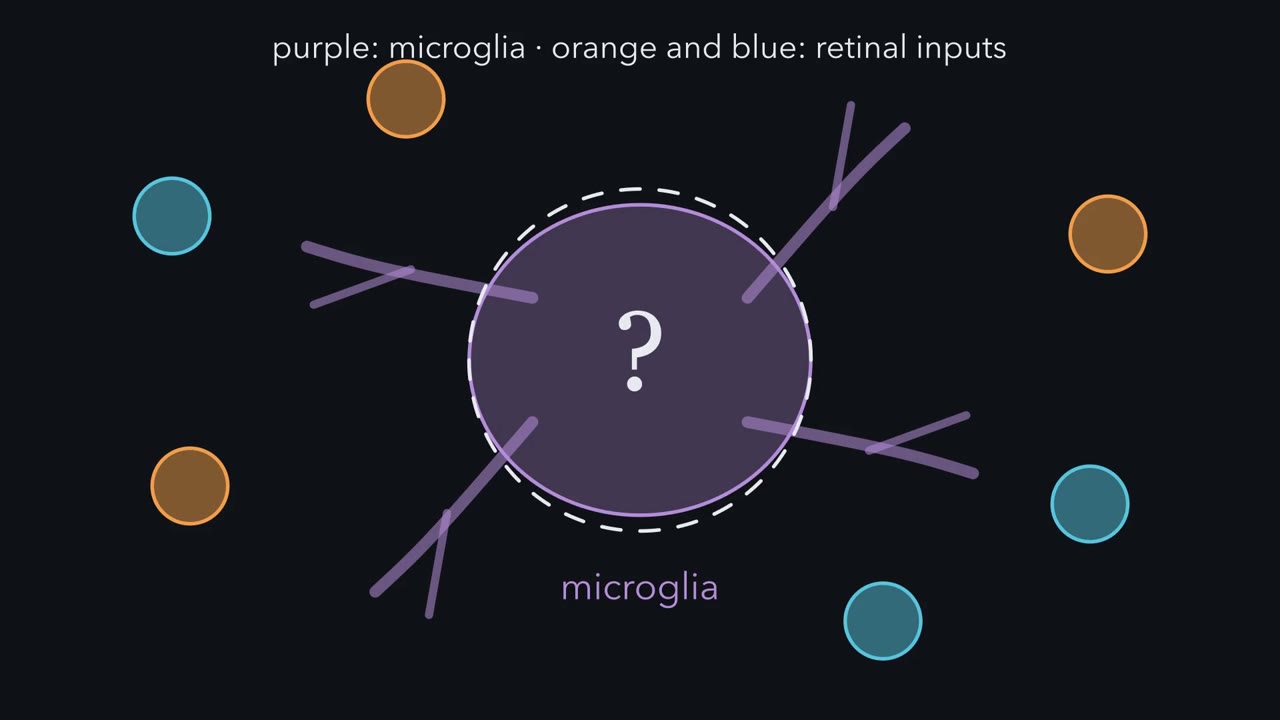
For the second question, the obvious suspects are microglia, the brain's resident immune cells and its main phagocytes. Here is the one idea to carry through. Relative activity biases which retinal inputs lose, and microglia take relatively more from the quieter eye. Complement helps them eat part of that.
The rule has a scope. This is the mouse visual thalamus, in the first week and a half after birth. Complement is needed for normal sorting. These studies did not show that it carries the activity information. And part means part. Some eating goes on without complement's receptor. Astrocytes eat synapses too.
So keep the two findings side by side. How activity and complement connect is still open.
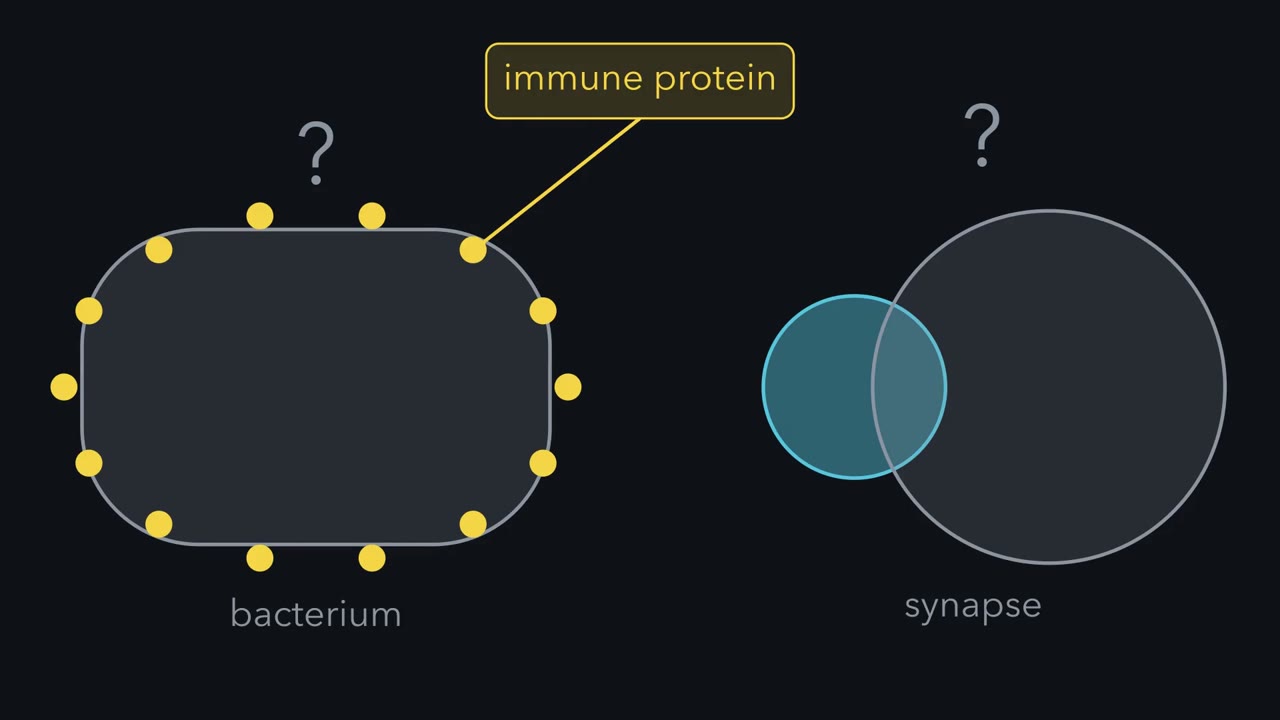
Why can a developing neuron make the first protein of an immune cascade that marks bacteria for destruction?
Continue in the lesson: Microglia and Complement Prune Synapses →
2:22 · Free, with captions and a transcript. The lesson has the full text, the questions and the sources.
More films from this lesson
How this film was made. Narration: an AI narrator voice (Kokoro, af_heart) reading narration written from this lesson's text. Animation: AI-generated in code (Manim) by Claude, a schematic with no drawn molecular structures. Captions come from the narration script. See something wrong? Report it.