A Brief Current That Holds a Press
Read the transcript of “A Brief Current That Holds a Press”
Film transcript: A Brief Current That Holds a Press
If the Merkel cell holds the press, you might expect its own current to last. Does it? In cultured Merkel cells from mouse pups, pressing evokes a tall, brief current. It inactivates within milliseconds, then settles to a small steady current. The steady part is only about one twentieth of the peak. So how can a mostly brief current hold a press? Compare charge, not peaks. Charge is the area under the current trace. Predict. Suppose the steady part lasts through a one-second hold. Which part brings in more charge: the tall peak, or the steady part?
The small steady part, by far. In this thought experiment, it carries nearly nine tenths of the charge. The peak's charge is all in within tens of milliseconds. A steady current keeps adding charge for as long as it flows. Peaks mislead about holds. But the membrane leaks, so the brief charge drains away. A steady current holds the cell depolarized while it flows. The authors proposed that voltage-gated calcium channels amplify it. That is a proposal, not proven. There is a second clue, in the timing of the afferent's spikes. Irregularity can be measured. Divide the standard deviation of the gaps between spikes by their mean. Predict. In a noise-free integrate-and-fire model with a fixed threshold and reset, a steady current above threshold makes it fire like a metronome.
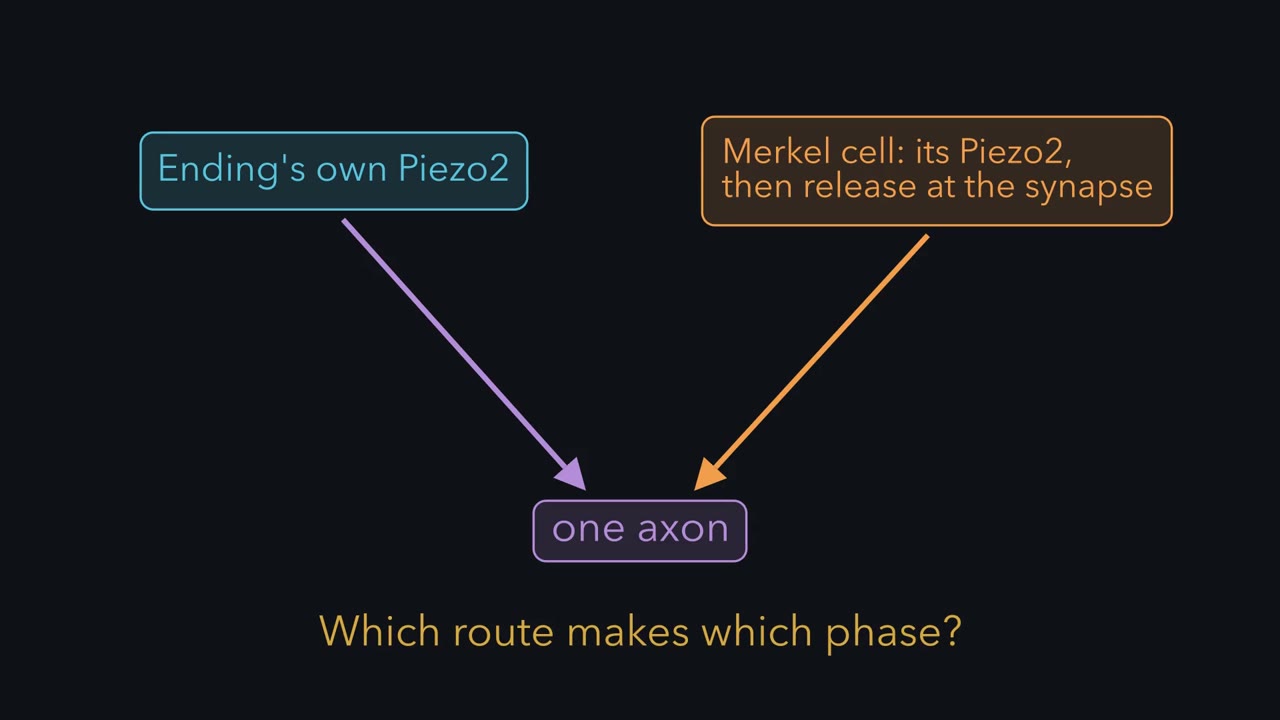
What could randomly timed packets of transmitter do instead? One possible result is irregular firing, depending on the timing and size of the packets. And light on the Merkel cells gave an irregular hold. That is a clue, not proof. A branched ending with several spike sites could add irregularity of its own. So what crosses that synapse? That is still argued. In mouse touch domes, the evidence points toward noradrenaline on beta β2 receptors. The channel it opens is unknown. In rodent whiskers, fast synaptic currents were attributed to proton-gated ASIC channels instead. Neither account is settled, and neither is refuted. Keep the idea. The ending feels the change.
The Merkel cell holds the press. How it signals is still open.
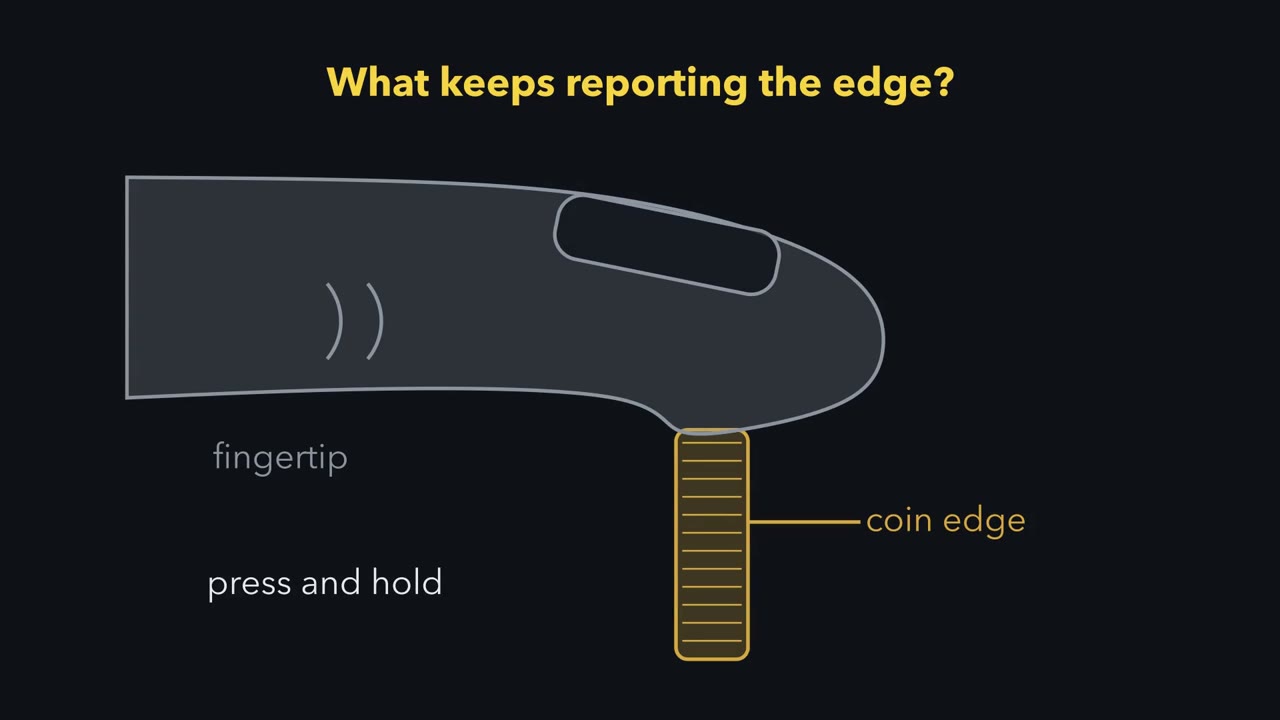
A skin cell that is not a neuron helps a nerve keep firing for as long as you press. How does it hold the press, and what does it tell the nerve?
Continue in the lesson: Merkel Cells: Touch Receptors That Are Not Neurons →
2:48 · Free, with captions and a transcript. The lesson has the full text, the questions and the sources.
More films from this lesson
How this film was made. Narration: an AI narrator voice (Kokoro, af_heart) reading narration written from this lesson's text. Animation: AI-generated in code (Manim) by Claude, a schematic with no drawn molecular structures. Captions come from the narration script. See something wrong? Report it.