Needed Is Not Stored
Read the transcript of “Needed Is Not Stored”
Film transcript: Needed Is Not Stored
If damage to a structure wipes out a memory, was the memory stored there? In rabbits, a tone is paired with a puff of air to the eye. After training, the tone alone closes the eyelid before the puff. The puff itself always triggers a reflex blink. In 1982, Thompson's laboratory removed the lateral cerebellum on the same side as the trained eye. The learned response to the tone was abolished.
Was the eyelid simply paralysed? If so, what would happen to the reflex blink to the puff? It would fail too. But the reflex blink survived, so the eyelid could still move. the other eye could still be conditioned. So the rabbits could still hear the tone, and still learn. With these controls, the lost response is good evidence that the cerebellum is needed for it. But needed for what? A lost response cannot tell a lost store from a cut output route. A later experiment silenced the output route with a drug, only during training. No learned response appeared. Once the drug wore off, it was there. The rabbits had learned. H.M.'s brain raises a second limit: which structure was needed?
After his death in 2008, it was cut into thousands of thin sections and rebuilt in three dimensions. The operation had taken the front of the hippocampus, most of the amygdala, and nearly all the entorhinal cortex. But the back of the hippocampus remained on both sides, with neurons still present.
The entorhinal cortex is the main cortical route into the hippocampus. What remained may have been largely cut off. The authors offered that as a model. Living cells in a section do not prove they were connected or working. So his amnesia followed a medial temporal lesion on both sides. His case alone cannot assign it to one structure. Crossed failures show that the damaged tissue is needed for a task. They do not tell you where memories live.
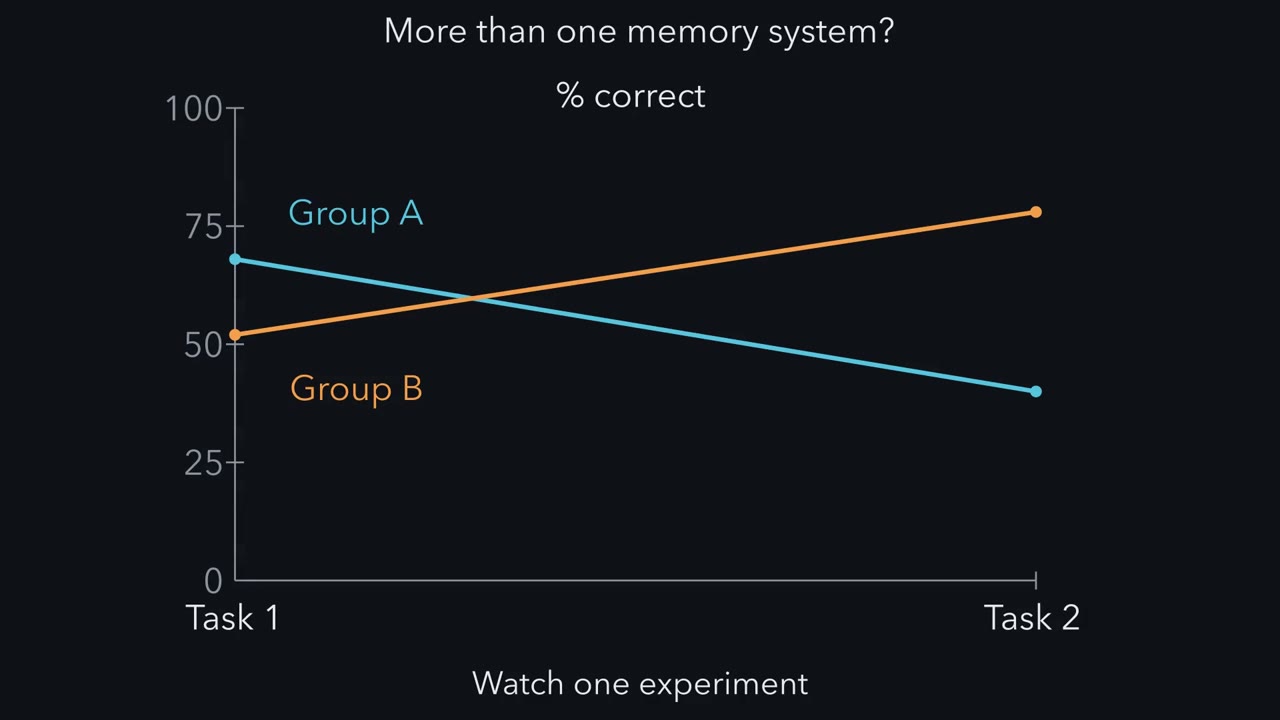
H.M. got better at mirror drawing over three days and did not remember ever having done it. What kind of memory improved?
Continue in the lesson: Memory Systems →
2:24 · Free, with captions and a transcript. The lesson has the full text, the questions and the sources.
More films from this lesson
How this film was made. Narration: an AI narrator voice (Kokoro, af_heart) reading narration written from this lesson's text. Animation: AI-generated in code (Manim) by Claude, a schematic with no drawn molecular structures. Captions come from the narration script. See something wrong? Report it.