Two Ways of Remembering
Read the transcript of “Two Ways of Remembering”
Film transcript: Two Ways of Remembering
Can a man get better at something every day, and never remember doing it? One patient did. In 1953, a surgeon removed tissue from the inner part of both temporal lobes of a young man. Afterwards, the patient known as H.M. forgot new events within minutes, as soon as his attention moved on. Brenda Milner gave him a mirror-drawing task. He traced between two outlines of a star, seeing his hand only in a mirror. Across three days of practice, he improved, much as other people do. Yet he did not remember having done the task before. His drawing improved, so something kept a record of the practice. Why could he not tell anyone about it?
The record showed up only in how well he drew. It was not something he could recall and report. So there were two ways of remembering, and the operation badly damaged only one. Memory you can bring to mind and state is declarative. It covers events, and facts about the world. H.M. could almost never form new declarative memories. Memory expressed in performance is nondeclarative: skills, habits, priming and simple conditioning. He kept his skill learning. Working memory holds a few items for seconds, like a phone number while you dial. His was normal. Now a worry. Perhaps recall tests are simply harder, and any brain damage hurts hard tasks first.
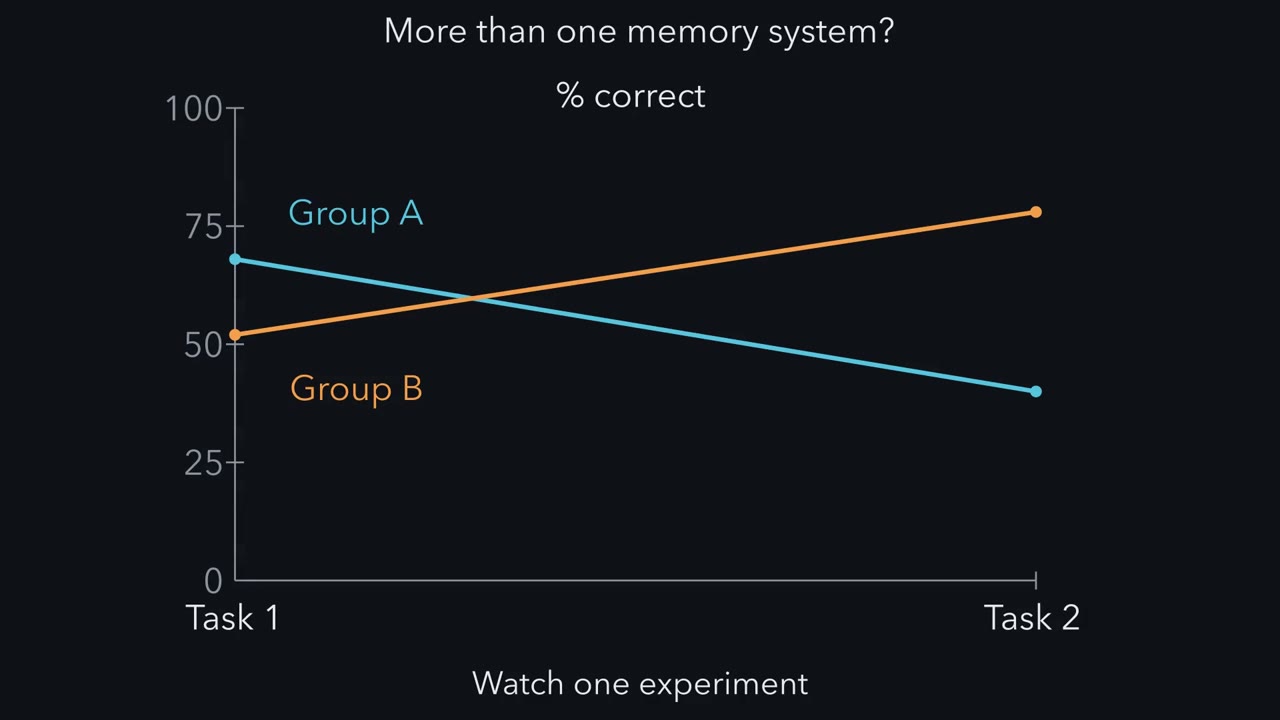
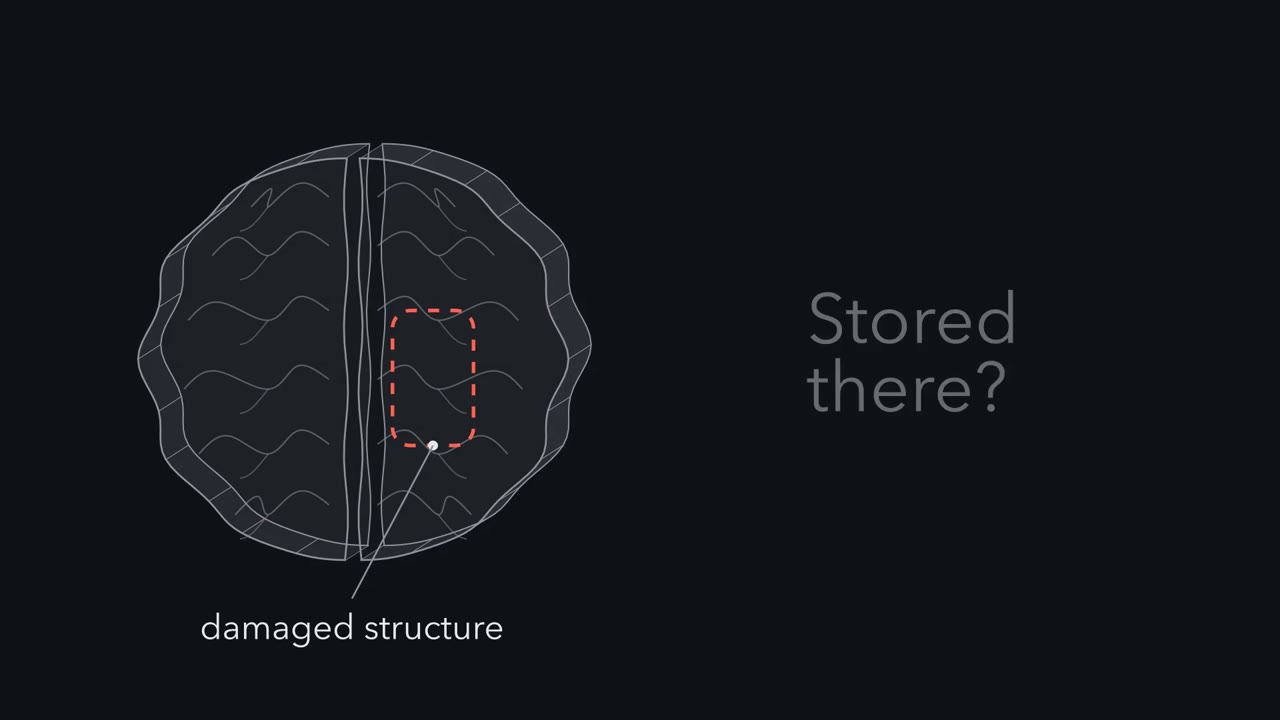
What second result would rule out the idea that the failed task was just harder? A patient with damage somewhere else, who fails the task H.M. passed, and passes the task he failed. Here is the one idea of this lesson. Memory systems are told apart by crossed failures. Damage to one structure impairs task A but spares task B. Damage elsewhere does the reverse. Then weakening one shared capacity cannot explain both. The tasks rely, at least partly, on separable processes. That crossing is a double dissociation. It shows each structure is needed for its task in that experiment, not that the memory is stored there. Needed, not stored. That is the key to reading every lesion study.
H.M. got better at mirror drawing over three days and did not remember ever having done it. What kind of memory improved?
Continue in the lesson: Memory Systems →
2:47 · Free, with captions and a transcript. The lesson has the full text, the questions and the sources.
More films from this lesson
How this film was made. Narration: an AI narrator voice (Kokoro, af_heart) reading narration written from this lesson's text. Animation: AI-generated in code (Manim) by Claude, a schematic with no drawn molecular structures. Captions come from the narration script. See something wrong? Report it.