Lines That Cross
Read the transcript of “Lines That Cross”
Film transcript: Lines That Cross
Can two lines that cross show that memory has more than one system? Watch one experiment. In 1996, Knowlton, Mangels and Squire gave people a weather-prediction task. Cue cards appeared, and the person guessed one of two outcomes. Each card predicted it only with some probability. No single trial is decisive, so the task is learned gradually, from feedback. Afterwards, a questionnaire asked about the training sessions themselves. Three groups took part: controls, amnesic patients, and patients with Parkinson's disease, whose striatum loses dopamine input. Over the first fifty trials, controls and amnesic patients learned the classification together.
The Parkinson's patients failed to learn it. Take the simplest difficulty model: one common capacity. Suppose the questionnaire is simply the harder task. The Parkinson's patients failed the easier one. How should they do on the questionnaire?
On that model, they should fail it too. Instead, they remembered the training. The amnesic patients had severely impaired memory for the training. Yet they learned the classification. So no single order of difficulty fits both groups. Each group does far worse on the task the other does well, and the lines cross. These are group averages, so the crossing argues against the simplest difficulty account rather than ruling out every single-capacity one. Now, a trap. Some answers are right by guessing. In this illustrative design, guessing alone gets half right on the two-choice task. On a four-choice questionnaire, it gets a quarter.
So measure each score up from that baseline, as a share of the controls' gain above it. An invented bar that looks like half of normal shrinks to about a quarter. The correction changes how big a loss looks. As long as controls beat chance, it cannot change which group is higher. So the crossing stays. Parkinson's disease damages more than the striatum. So this crossing supports separable learning processes, without pinning each to one structure. Now a second crossing, in three patients. A signal was paired with an aversive stimulus. Did a sweat response appear? Could the patient report the pairing? A patient with damage to both amygdalae could report the pairing, but showed no conditioned response.
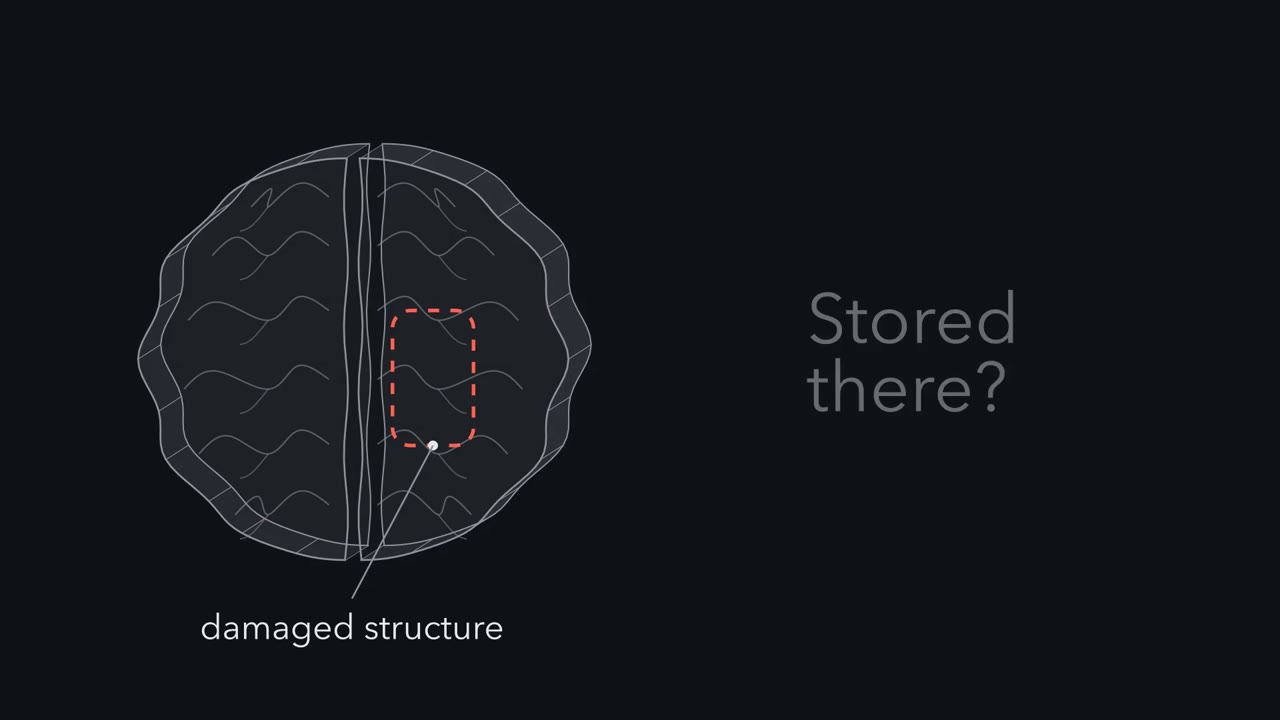
A patient with damage to both hippocampi showed the reverse. Predict the third patient, with damage to both structures. That patient learned neither. Two crossings. In these studies, new memory that could be reported and memory shown in performance depended on different structures.
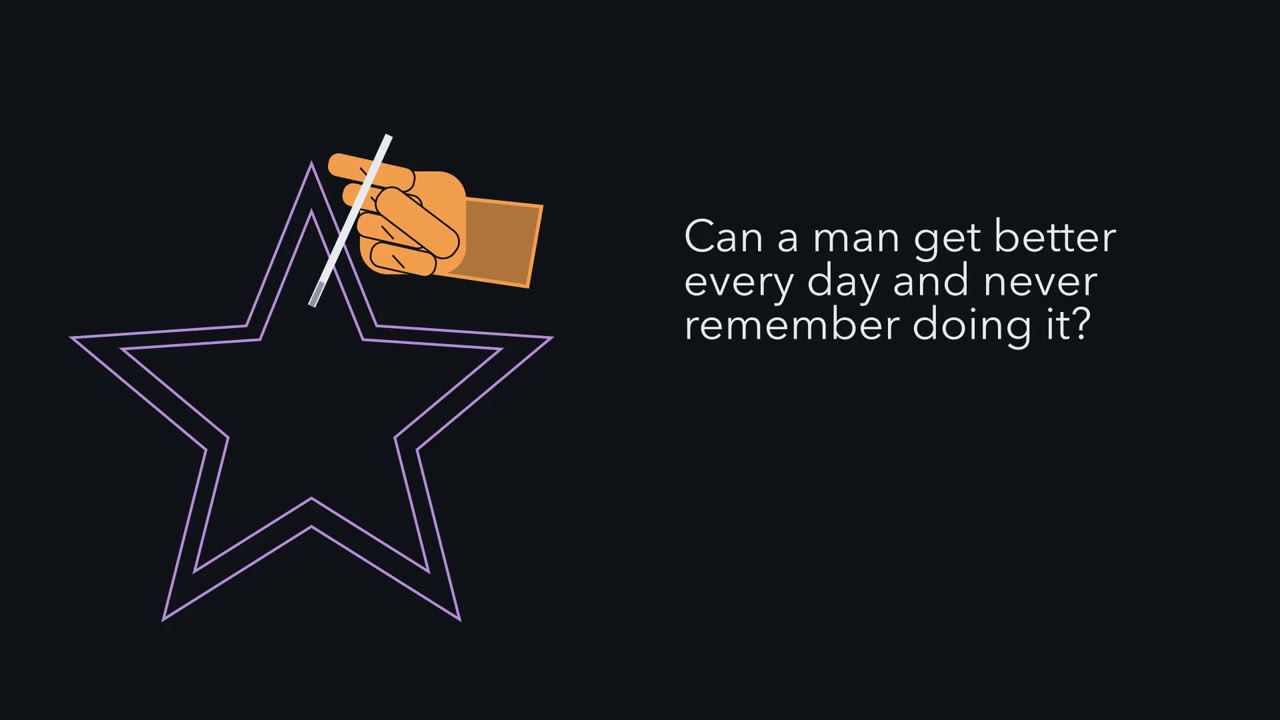
H.M. got better at mirror drawing over three days and did not remember ever having done it. What kind of memory improved?
Continue in the lesson: Memory Systems →
3:23 · Free, with captions and a transcript. The lesson has the full text, the questions and the sources.
More films from this lesson
How this film was made. Narration: an AI narrator voice (Kokoro, af_heart) reading narration written from this lesson's text. Animation: AI-generated in code (Manim) by Claude, a schematic with no drawn molecular structures. Captions come from the narration script. See something wrong? Report it.