Films · Developmental Neuroscience
Started, Then Lost
Read the transcript of “Started, Then Lost”
Film transcript: Started, Then Lost
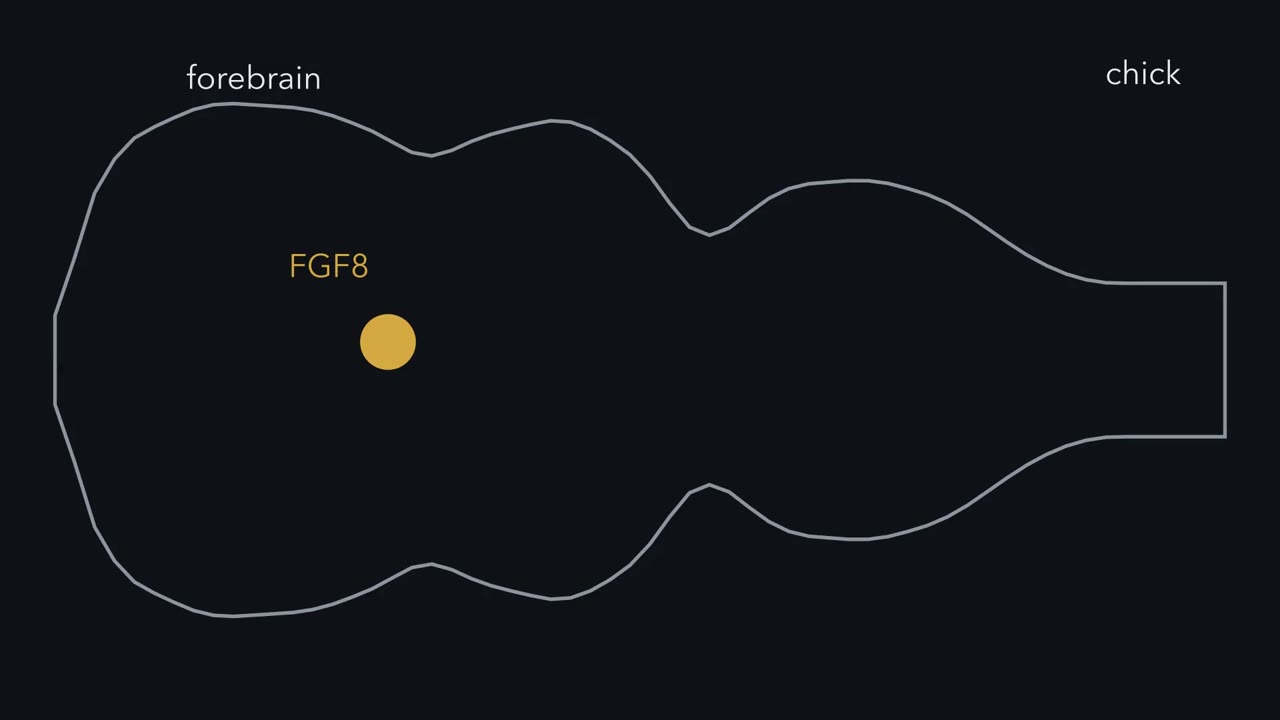
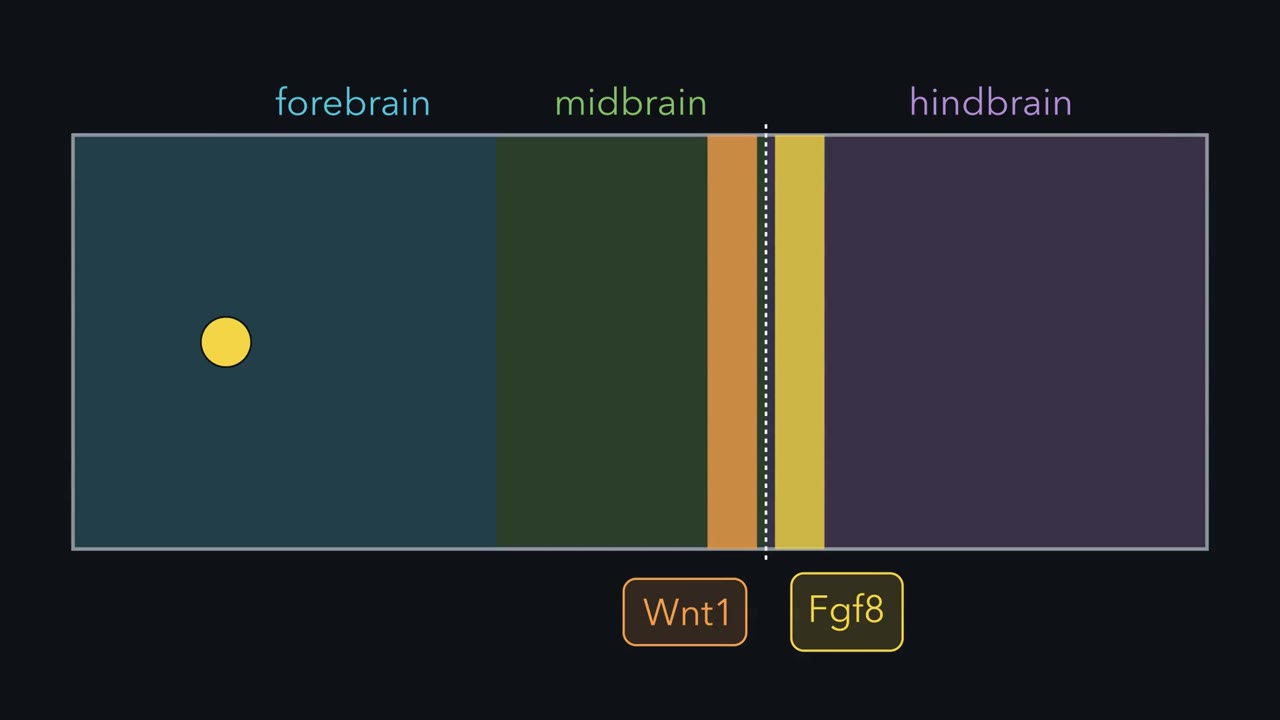
Adding the source is half the case. What happens if you take it away? In the mouse, gene targeting can remove one gene. The change is made in embryonic stem cells. Wnt1 is made in a ring just in front of the line. Mice lacking it lose most of the midbrain and much of the cerebellum. Predict. In these mice, does Engrailed never come on? Or does it come on, and then fade?
Engrailed comes on. Then it is lost, and the tissue disappears. Wnt1 is needed to keep Engrailed on, not to turn it on. Call this signature started, then lost. So supplying Engrailed should help. In 1996, Danielian and McMahon made En1 from Wnt1's own control elements, in the mutants. Early development of the region was restored. A signal keeps a transcription factor on. The transcription factor keeps the territory. FGF8 gives the same signature. In acerebellar, a zebrafish FGF8 mutant, boundary genes switch on, and then fade. Mice that lose FGF8 early from the region lack midbrain and cerebellum. Milder reductions spare part of both.
In these two mutants, the program does not fail to start. It fails to last. So the signals are needed to keep the program running. In the standard model, built on other experiments too, the transcription factors help keep the signals on. Remove a key part, and the rest fade. So the source has been tested three ways. Move it, add it, and take it away. Takeaway: a line becomes a source. It must stay on long enough for each part. Remove it too early, and parts are lost or changed.
How does one protein on a bead make a second midbrain grow, built back to front?
Continue in the lesson: Local Organizers: The Midbrain-Hindbrain Boundary →
2:12 · Free, with captions and a transcript. The lesson has the full text, the questions and the sources.
More films from this lesson
How this film was made. Narration: an AI narrator voice (Kokoro, af_heart) reading narration written from this lesson's text. Animation: AI-generated in code (Manim) by Claude, a schematic with no drawn molecular structures. Captions come from the narration script. See something wrong? Report it.