Films · Developmental Neuroscience
One Bead Builds a Midbrain
Read the transcript of “One Bead Builds a Midbrain”
Film transcript: One Bead Builds a Midbrain
Is the line really a source? Add it somewhere new, and watch what the neighbours do. A factor is sufficient if adding it where it is normally absent produces the structure. First, tissue. Alvarado-Mallart's group often grafted quail brain into chick embryos, since quail cells look different under the microscope. In 1991, Martínez, Wassef and Alvarado-Mallart moved tissue from just behind the junction into the forebrain. Forebrain cells next to the graft turned on Engrailed. Later they developed as midbrain. The junction could instruct its neighbours.
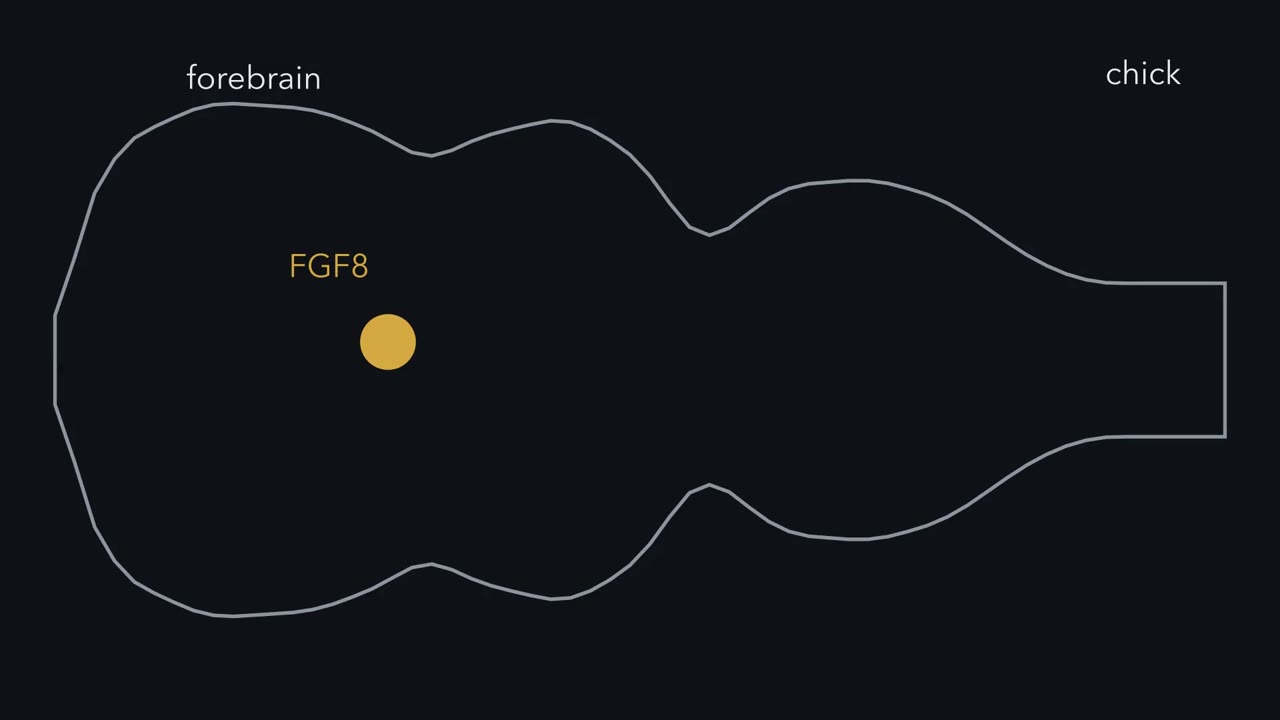
What was the message? In 1996, Crossley, Martínez and Gail Martin soaked beads in FGF8. They placed them in the diencephalon, the back of the forebrain. An extra midbrain formed. Predict. The real midbrain still has its own isthmus behind it. Which way will the new midbrain face?
It was built in reverse, a mirror image. Parts that normally lie nearest the isthmus formed nearest the bead. One source is enough to reverse the order. Here is a toy model, with made-up numbers, with a second source behind it: the bead and the real isthmus send out the same signal. A cell cannot tell which source a molecule came from. It gets the sum. The sum falls from the bead to the midpoint, then rises toward the real isthmus. In a normal midbrain, cells near the isthmus get the most signal, and they build the back parts. Cells next to the bead get a lot too. So they build back parts as well. Farther from the bead, the signal falls, so the parts run toward front of midbrain.
Between the bead and the midpoint, the order runs the wrong way round. One caution. The tissue around the bead switched on Engrailed-2, and in later bead experiments its own FGF8 and Wnt1. That induced organizer probably helped pattern the midbrain too. Predict. In the 1996 experiment, the bead made midbrain. But FGF8 normally comes from the side that builds cerebellum. Why midbrain?
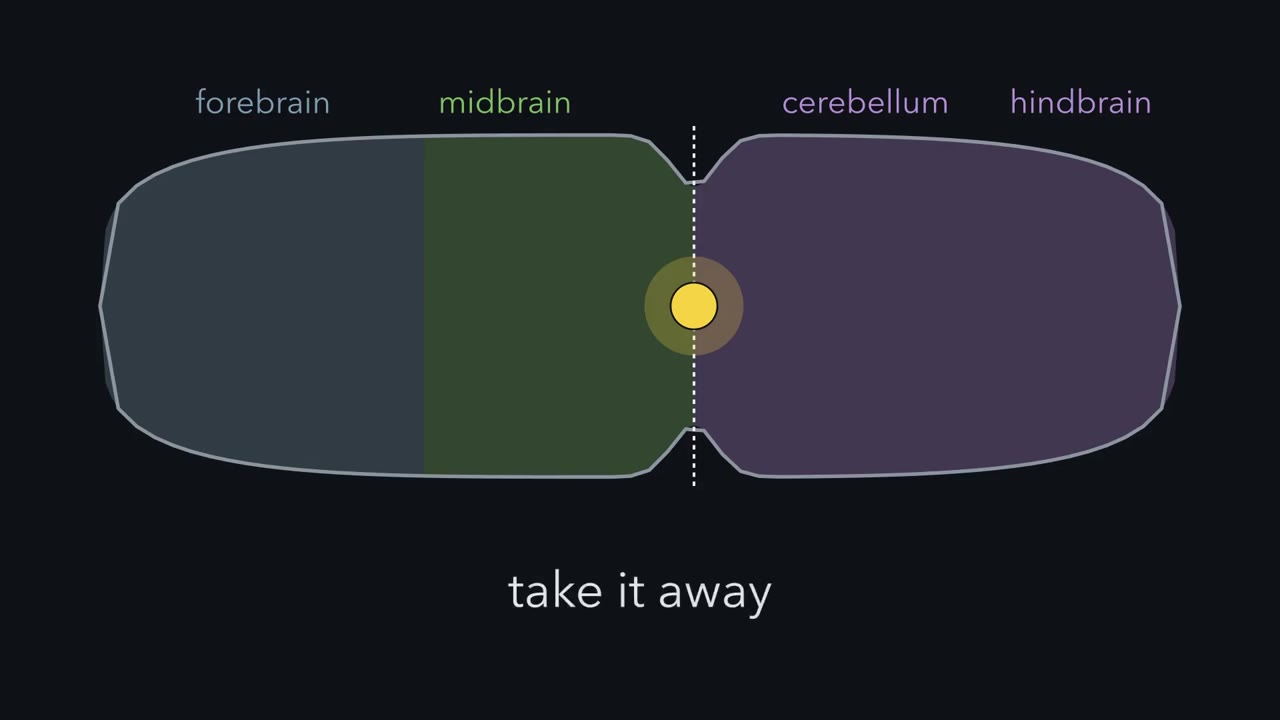
The diencephalon is forebrain, so its cells carry Otx2 and can respond. At this dose, the response was midbrain. Whether the response is midbrain or cerebellum also depends on the strength and duration of FGF8. With a strong or lasting source, the rule bends. In later bead experiments, FGF8 switched Otx2 off and Gbx2 on. Then isthmus and cerebellum-like tissue formed. Takeaway: the line is a source. The signal tells a cell which part. The repressor sets which region it can become.
How does one protein on a bead make a second midbrain grow, built back to front?
Continue in the lesson: Local Organizers: The Midbrain-Hindbrain Boundary →
3:20 · Free, with captions and a transcript. The lesson has the full text, the questions and the sources.
More films from this lesson
How this film was made. Narration: an AI narrator voice (Kokoro, af_heart) reading narration written from this lesson's text. Animation: AI-generated in code (Manim) by Claude, a schematic with no drawn molecular structures. Captions come from the narration script. See something wrong? Report it.