How Many Mice?
Read the transcript of “How Many Mice?”
Film transcript: How Many Mice?
300 units, recorded from 3 mice. How many samples is that? Units recorded from one mouse share that mouse: its genes and its drug dose. Units recorded in one session also share that day's alertness, and one probe track. If that mouse or session is unusual, its units tend to shift together. Take a small invented dataset. Two mice. Mouse A gave four units, and mouse B gave two. Pool every unit, and mouse A counts twice as much, only because it gave more units. Average within each mouse first, and each animal counts once. The animal mean comes out lower.
For a claim about mice, the sample is 2, not 24. Now a harder test. Suppose a drug does nothing at all, on average. Record 100 units from each of 3 mice. Treat all 300 as independent. How often will a standard test call the drug effect significant?
In a simulation with invented numbers, about 7 times in 10. The same test on the 3 mouse averages was significant only about 5 times in 100. That is the false-alarm rate the test is built to give, when its assumptions hold. Counting units as independent made the error bars far too narrow. This is called pseudoreplication. Are more units worthless, then? No. They average out the noise between units within each mouse. But no number of units averages out the differences between mice. The error stops shrinking at a floor. With the spread between mice held fixed, only more mice lower the floor.
So report every level, and say which level your question is about. Each of these numbers is a step from your claim. Count your sample at the level of the claim. And none of this shows that a pathway is needed. That takes a manipulation.
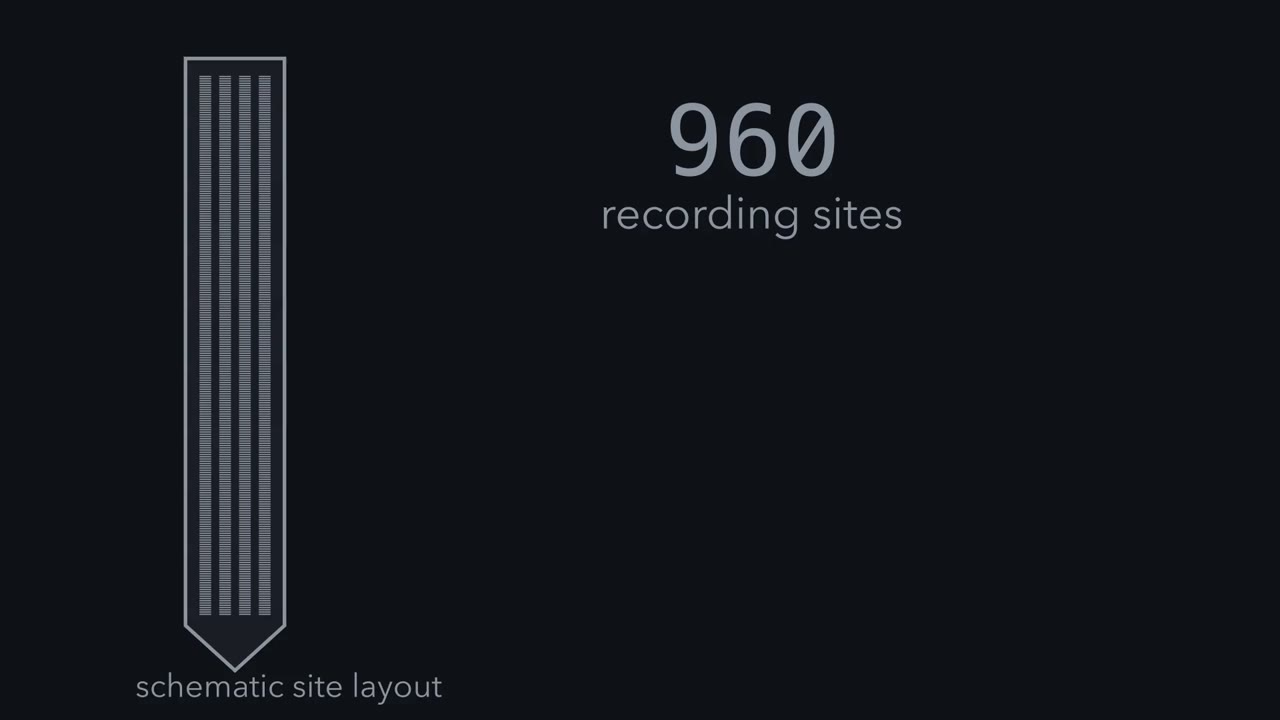
A probe with 960 recording sites does not record one neuron per site. What does it record?
Continue in the lesson: Recording Many Neurons: Imaging, Arrays and Atlases →
2:23 · Free, with captions and a transcript. The lesson has the full text, the questions and the sources.
More films from this lesson
How this film was made. Narration: an AI narrator voice (Kokoro, af_heart) reading narration written from this lesson's text. Animation: AI-generated in code (Manim) by Claude, a schematic with no drawn molecular structures. Captions come from the narration script. See something wrong? Report it.