Acting Before the Blood Changes
Read the transcript of “Acting Before the Blood Changes”
Film transcript: Acting Before the Blood Changes
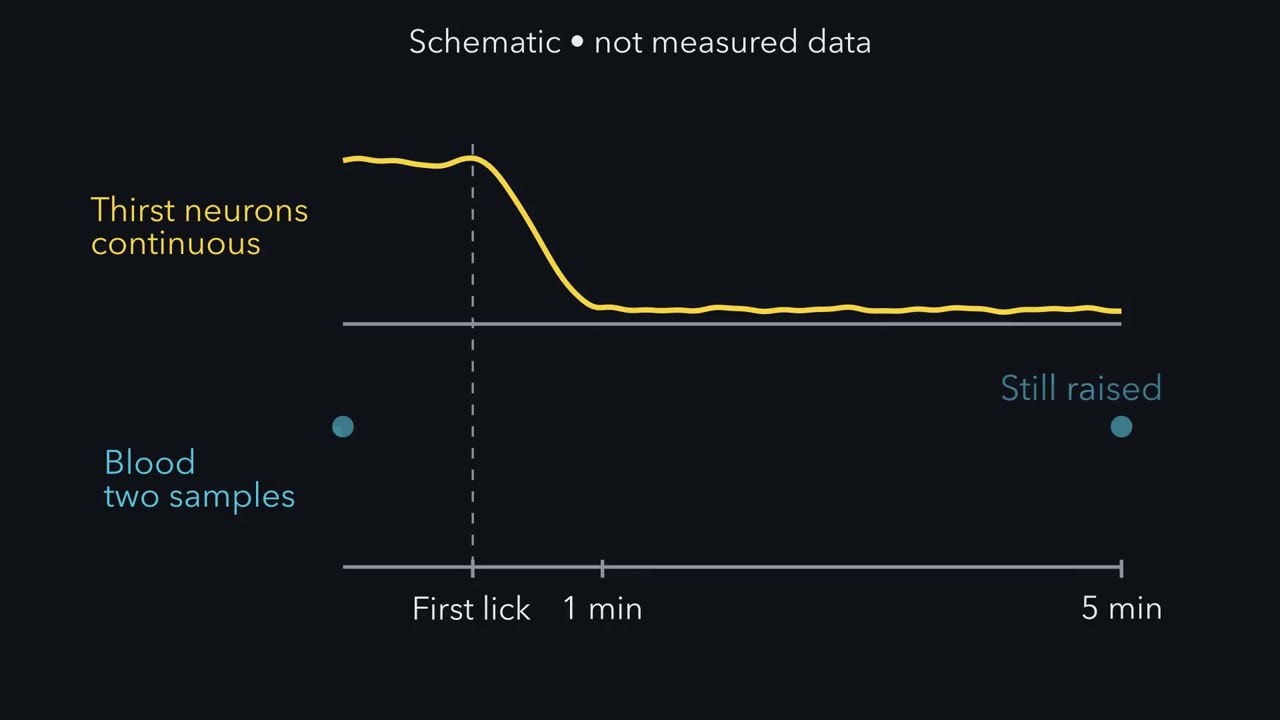
Back to the thirsty mouse. Its thirst neurons go quiet within a minute. No change in the blood has been detected. So what has changed? Researchers recorded subfornical organ neurons in awake mice, using an optical fibre and a calcium indicator.
Picture the neurons and the blood on one time axis. A line marks when water arrives. The neurons' activity starts to fall at the first lick. Within a minute, it is down. The blood was sampled, not traced. Plasma osmolality was still raised five minutes after water access. What could turn the neurons down? The sight of water? The licking? Or the water itself?
Seeing water it could not reach did not lower the activity. Licking an empty bottle did not either. So it is something that comes with fluid going in. Drinking concentrated saline lowers it at first, like water. After about a minute, the fall reverses. A fast signal counts fluid going in. A slower one reports what the fluid contains. Next, bypass the mouth. Put water straight into the stomach. In dehydrated mice, the activity falls in about two minutes. Separate blood measurements found no detectable change in osmolarity, so the response comes first. Hypertonic saline in the stomach raises the activity instead. Then researchers used light to hold the neurons active.
Now water in the gut no longer brings its usual satiation. Suppose the brain read only the blood. How much would a thirsty animal drink? Too much, if it drinks faster than water is absorbed. Water reaches the blood gradually, so a blood-only brain keeps drinking.
So the estimate must count what is on its way. The brain can also learn. In trained mice, vasopressin neurons dipped when a water bowl arrived, before any drinking. So feedforward can sense fluid going in, or predict it from a learned cue. Keep the limits. This is population calcium, recorded in mice. It is not the feeling of thirst. Feedback reads the blood. Feedforward reads what is coming. The estimate is the blood, corrected for what is on its way.
A thirsty mouse quiets its thirst neurons within a minute of drinking, while its blood osmolality is still raised five minutes later.
Continue in the lesson: Autonomic Control and the Hypothalamus →
2:50 · Free, with captions and a transcript. The lesson has the full text, the questions and the sources.
More films from this lesson
How this film was made. Narration: an AI narrator voice (Kokoro, af_heart) reading narration written from this lesson's text. Animation: AI-generated in code (Manim) by Claude, a schematic with no drawn molecular structures. Captions come from the narration script. See something wrong? Report it.