Films · Developmental Neuroscience
Testing the Rule in Genes and Time
Read the transcript of “Testing the Rule in Genes and Time”
Film transcript: Testing the Rule in Genes and Time
A few genes have functional copies in humans, and not in chimpanzees. Do any of them change what progenitors do? No gene has been removed from a developing human brain. So each was tested in another system. First, ARHGAP11B. In embryonic mouse cortex, it increased basal progenitors. In marmoset fetuses, it enlarged the neocortex. In cultured human fetal slices, blocking it reduced basal progenitors. Next, NOTCH2NL, which raises Notch signalling. In mouse cortex, it kept progenitors dividing and delayed neurons. Deleted in human organoids, it made progenitors differentiate early. Both are consistent with more doubling. But the studies described here did not score division modes, so none shows which kind of division changed.
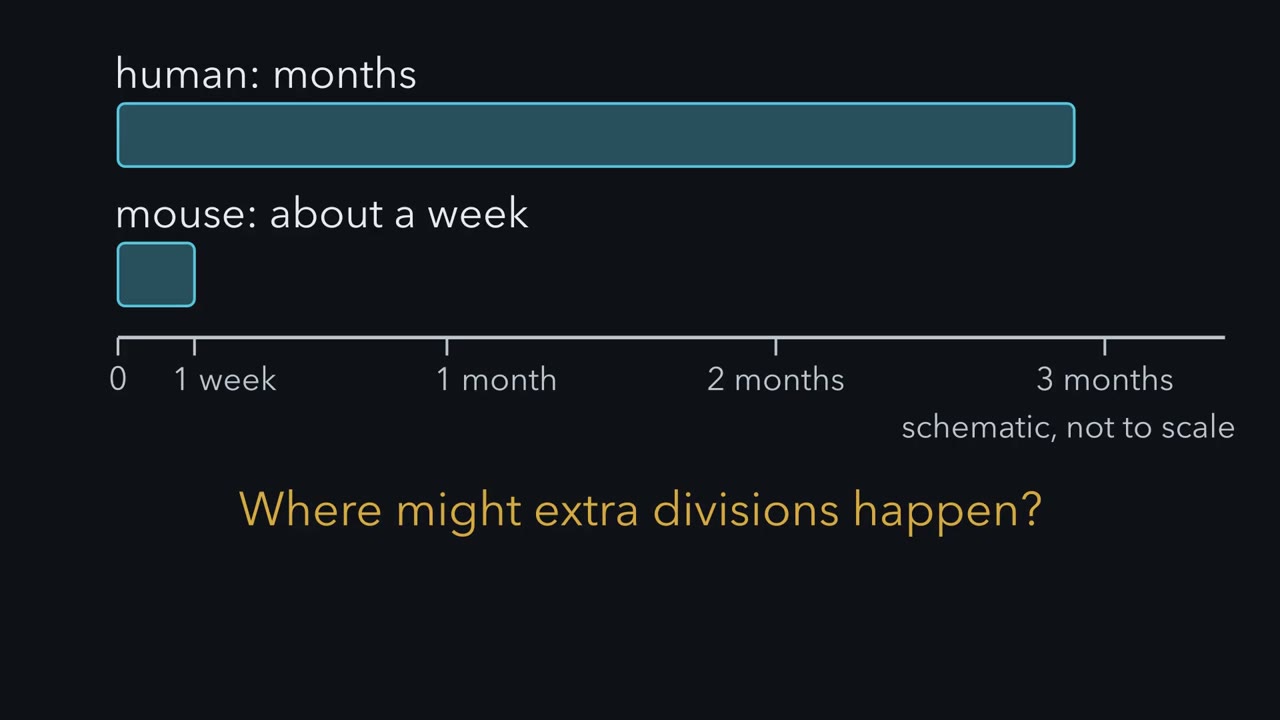
Time matters too. Neurogenesis takes about a week in the mouse, roughly two months in the rhesus monkey, and longer in humans. Extra time allows more rounds, if cell cycles do not lengthen. A steady pool adds in step with time. A growing pool compounds. One more difference lies outside the rule. Human neurons mature slowly. Spine density in prefrontal cortex stays above adult levels into the third decade. SRGAP2C slowed spine maturation in mouse neurons. Is that pace set by the body, or the cells?
Human neurons go into newborn mouse cortex. Whose pace do they keep? They matured over many months, close to a human time course. The mouse neurons around them had long since matured. At least part of the timing travels with the cells.
But maturation shapes connections, not neuron number. It lies outside the rule. And no test shows that one gene made the human cortex. Multiply, don't add: a leading explanation for our large cortex. How much came from founders, outer radial glia, or a longer clock is still open.
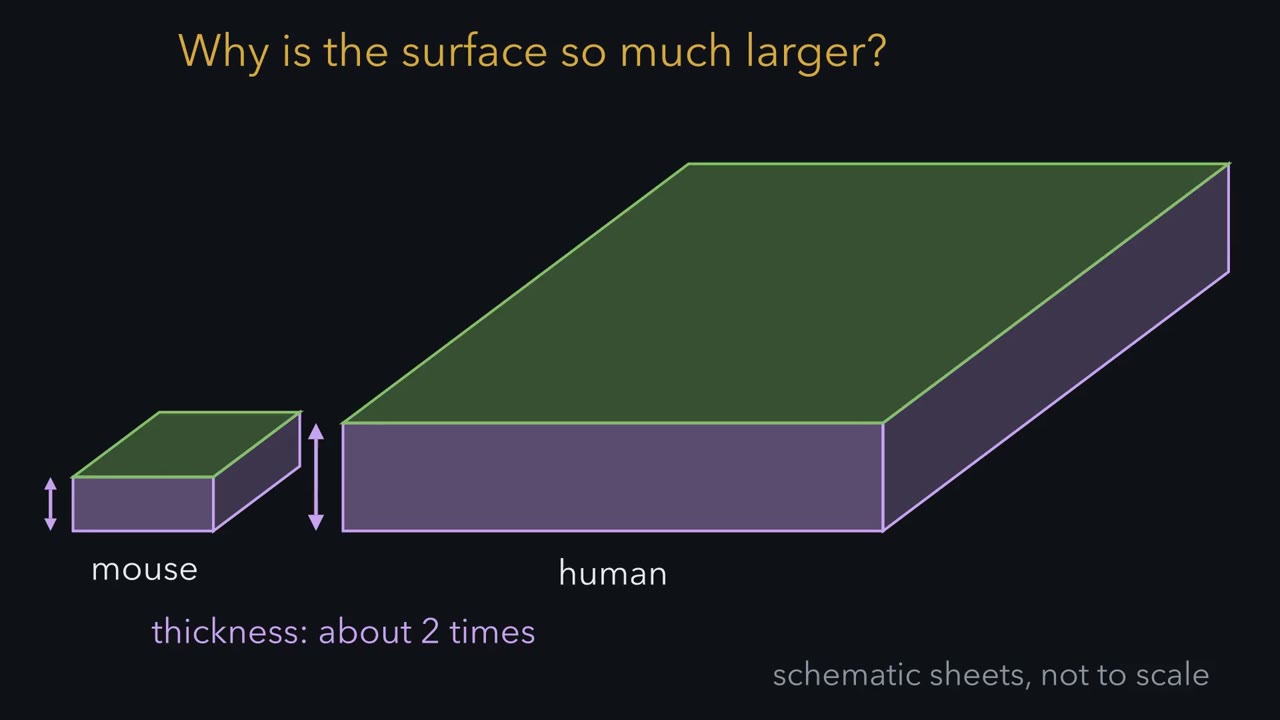
Your cortex is only about twice as thick as a mouse's. Why is its surface roughly a thousand times larger?
Continue in the lesson: What Makes the Human Brain Big →
2:31 · Free, with captions and a transcript. The lesson has the full text, the questions and the sources.
More films from this lesson
How this film was made. Narration: an AI narrator voice (Kokoro, af_heart) reading narration written from this lesson's text. Animation: AI-generated in code (Manim) by Claude, a schematic with no drawn molecular structures. Captions come from the narration script. See something wrong? Report it.