Films · Developmental Neuroscience
Multiply, Don't Add
Read the transcript of “Multiply, Don't Add”
Film transcript: Multiply, Don't Add
Your cortex is only about twice as thick as a mouse's. So why is its surface roughly a thousand times larger? Almost all of the gain is sideways. How does a brain build more of the same wall? Compare two kinds of division. In a symmetric proliferative division, one progenitor makes two. If every progenitor does this once, the pool doubles. In an asymmetric neurogenic division, it makes one progenitor and one neuron. The pool stays the same size. The radial glia lining the ventricle, the founders, divide symmetrically first. Later they switch to making neurons. Pasko Rakic showed that young neurons climb radial glial fibres. He argued that they stack into columns.
In 1988, he proposed the radial unit hypothesis. If every unit takes up about the same patch of surface, the number of units sets the area. The neurons per unit set the thickness. Predict. Species B gets three extra rounds of symmetric division, before the switch. Species C gets three extra asymmetric divisions per unit, after it, each adding one neuron. Which species gains more neurons? And which one gains area?
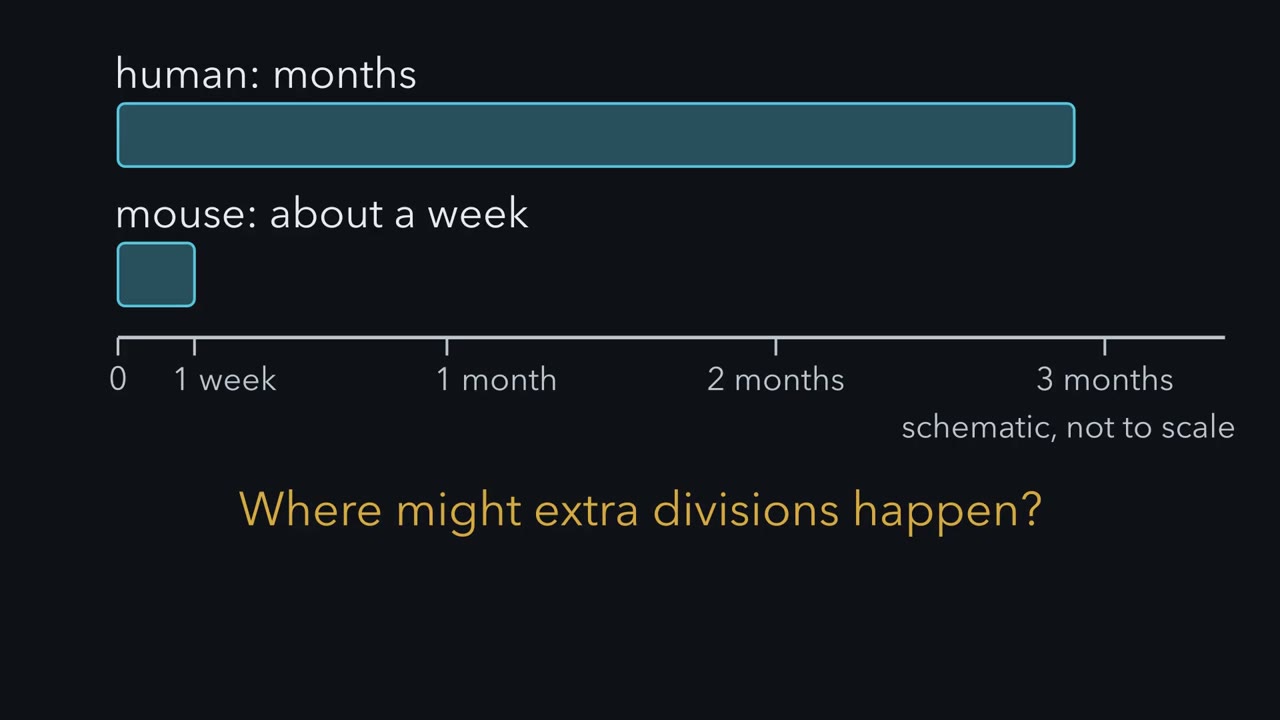
Species B. Doubling three times gives eight times the units, so, with the same patch per unit, eight times the area. Species C gains about three percent more neurons, and no extra units, so no extra area. Doubling multiplies. Adding only adds. Back to the mouse. Ten doublings make about a thousandfold. So, in this model, with every unit the same size, ten extra rounds would close the gap. Our brain is about three times a chimpanzee's. If our cortical area differs by a similar factor, the gap is under two rounds. Rakic made a related argument for primates in 1995. A delay of a few cell cycles before the switch could greatly enlarge the cortex.
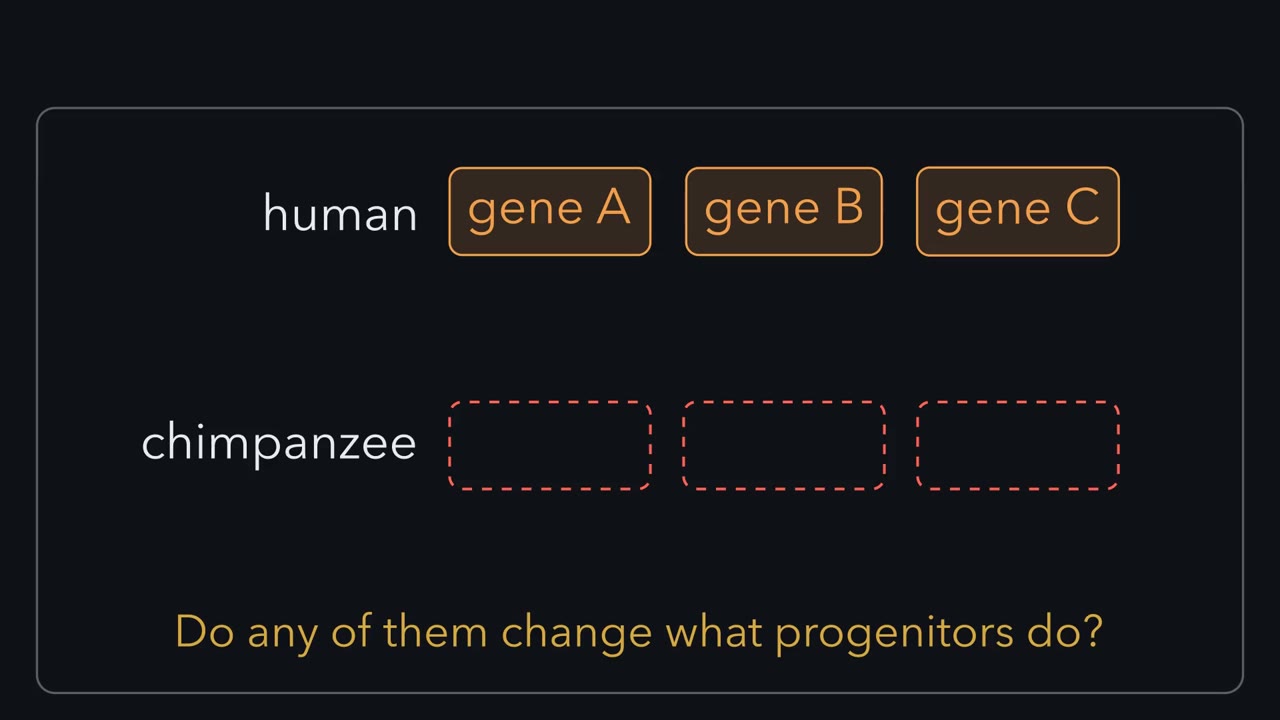
In mice, a stabilized form of beta β-catenin kept more progenitors dividing. The cortex grew in area, and buckled into folds. That shows extra founder divisions can enlarge the sheet, not how primates did it. In organoids, human cells took longer than ape cells to become radial glia. The human organoids grew larger. Neither test was done in a developing human brain. Multiply, don't add. Extra rounds of doubling can multiply the neurons a cortex makes. That is the leading explanation for our big cortex, and nearly all of the gain went into area. So for every cell and gene that follows, ask what it changes.
Your cortex is only about twice as thick as a mouse's. Why is its surface roughly a thousand times larger?
Continue in the lesson: What Makes the Human Brain Big →
3:13 · Free, with captions and a transcript. The lesson has the full text, the questions and the sources.
More films from this lesson
How this film was made. Narration: an AI narrator voice (Kokoro, af_heart) reading narration written from this lesson's text. Animation: AI-generated in code (Manim) by Claude, a schematic with no drawn molecular structures. Captions come from the narration script. See something wrong? Report it.