Films · Developmental Neuroscience
A Second Place to Double
Read the transcript of “A Second Place to Double”
Film transcript: A Second Place to Double
Human neurogenesis lasts months, not the mouse's week. Where might extra divisions happen? And why wouldn't they simply make our cortex thick? Rakic built his model around progenitors at the ventricle. But in fetal monkey cortex, the zone above them is split in two. What was dividing in the outer part? In 2010, Hansen, Kriegstein and colleagues filmed living slices of human fetal cortex. They found cells with the markers of radial glia, the proteins PAX6 and SOX2. These cells kept a fibre toward the brain surface, but had no process touching the ventricle. Before dividing, a cell moved its cell body up its fibre. Daughters could divide again, or become intermediate progenitors, which soon make neurons.
These are outer radial glia. Later imaging in fetal macaque found them making proliferative divisions too. So, in macaque at least, they can be a second site of doubling. How much can a little doubling matter? Take a toy lineage. One progenitor divides for 60 rounds, and each division adds a neuron. That makes 60 neurons. Predict. Now, in every round, give each progenitor a one in ten chance of making two progenitors instead. Every progenitor keeps dividing. On average, do you get about 60 neurons, a few hundred, or thousands?
Thousands, on average. Each doubling adds a progenitor that keeps dividing, so the pool grows by a tenth each round, like compound interest. Given enough rounds, a little doubling outgrows a lot of adding. So why no thicker cortex?
New neurons climb radial glial fibres. If every fibre ran straight up, with packing fixed, what would extra neurons do? In this cartoon, they would stack onto existing columns, and the cortex would thicken. Instead, the fibres diverge as they climb, fanning the scaffold outward. That favours spreading the neurons sideways, into area.
Outer radial glia are not uniquely human. Mice have a few, and ferrets and primates have many. The human outer subventricular zone is especially large. The marmoset, whose cortex is nearly smooth, has them too. So they are not enough for folding on their own. Founders can double at the ventricle. Outer radial glia can double far from it, and their fanned fibres favour area over thickness.
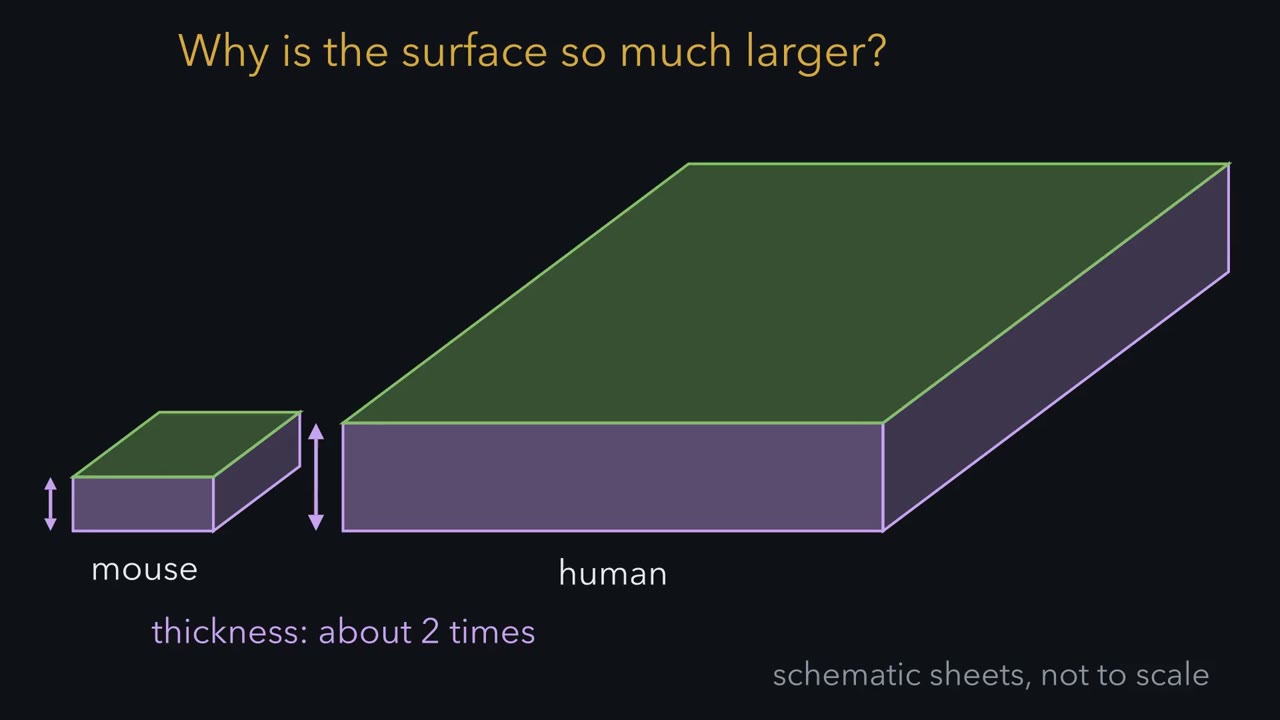
Your cortex is only about twice as thick as a mouse's. Why is its surface roughly a thousand times larger?
Continue in the lesson: What Makes the Human Brain Big →
3:06 · Free, with captions and a transcript. The lesson has the full text, the questions and the sources.
More films from this lesson
How this film was made. Narration: an AI narrator voice (Kokoro, af_heart) reading narration written from this lesson's text. Animation: AI-generated in code (Manim) by Claude, a schematic with no drawn molecular structures. Captions come from the narration script. See something wrong? Report it.