Films · Developmental Neuroscience
Remove One Letter
Read the transcript of “Remove One Letter”
Film transcript: Remove One Letter
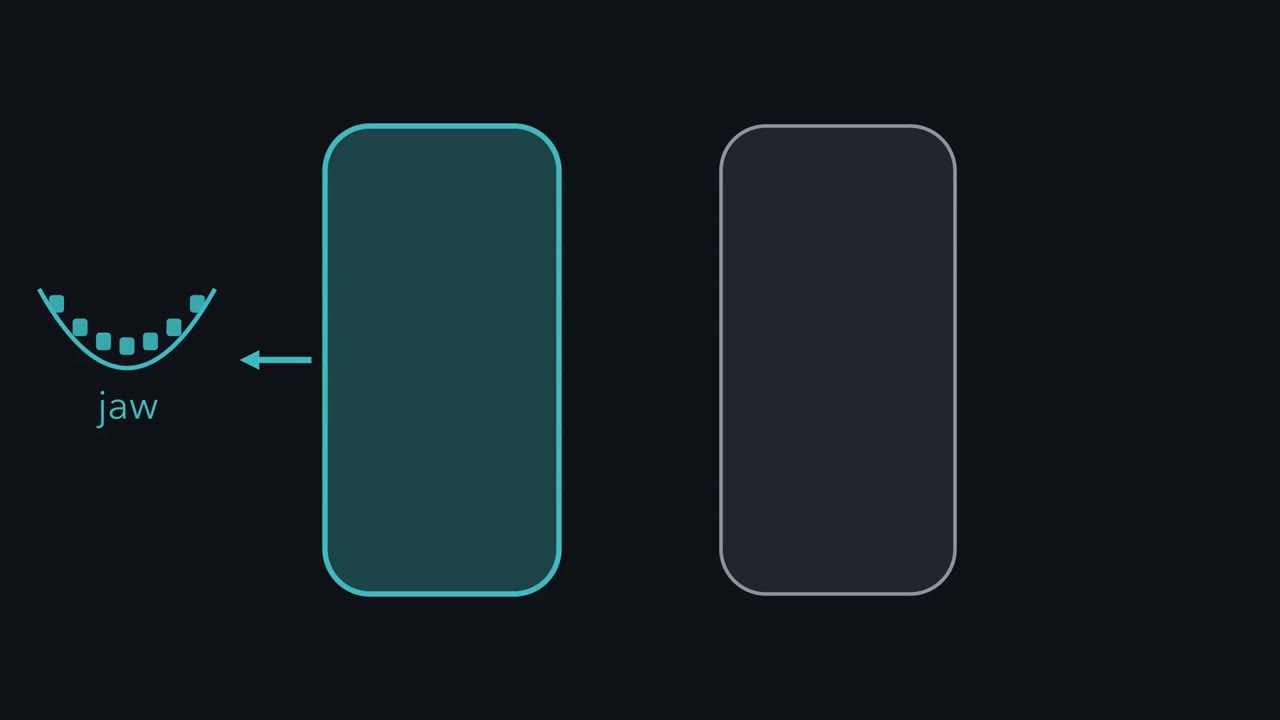
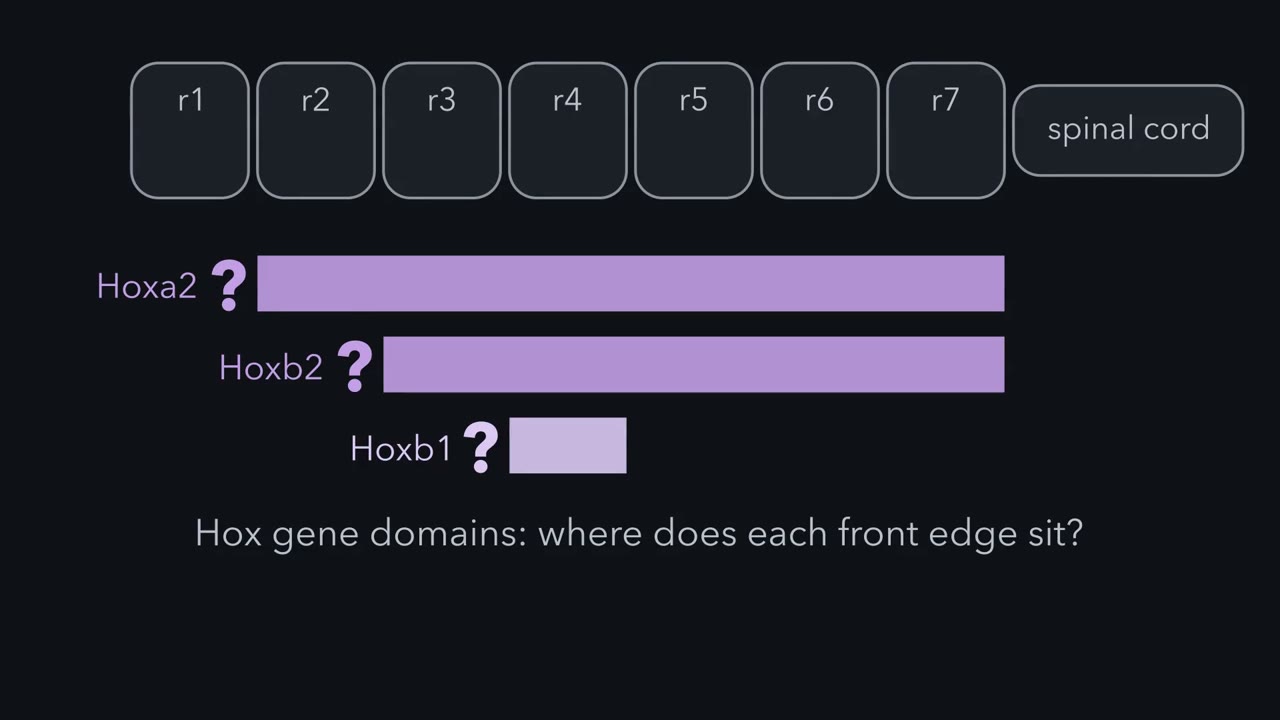
If the Hox code sets a segment's identity, what happens when one gene is taken away? A conventional knockout is a mouse line with one gene disrupted in every cell. In a normal mouse, facial motor neurons are born in r4 and migrate back to r6. There they form the facial motor nucleus. In the Hox code, Hoxb1 is the clearest difference between r4 and r3. Predict. Knock out Hoxb1. Does r4 disappear? Or does it stay and become something else?
In 1996, two groups reported Hoxb1 knockouts. One was led by Studer and Krumlauf, the other by Goddard and Capecchi. Rhombomere four was still there. Its progenitors still divided, and still made motor neurons. But r4 lost parts of its identity. Its motor neurons behaved like the trigeminal neurons of r2 and r3. In both mutants, the facial motor neurons failed to form or to migrate normally. No normal facial motor nucleus formed.
Compare a different gene, Krox20. Without it, r3 and r5 do not persist as distinct segments. Some of their cells survive, mix with neighbours, and take on their character. In kreisler (MafB) mutants, r5 is missing. So there are two different outcomes. Without Krox20, distinct territories are lost. Without Hoxb1, r4 remains but changes. That is the code acting as a cause, not just a marker.
Next: where do the code's edges come from? The takeaway: without Hoxb1, r4 survives but loses key parts of its identity. Other Hox knockouts differ, gene by gene.
Rhombomeres r2 and r4 start out looking alike. What tells one to build jaw motor neurons and the other facial ones?
Continue in the lesson: Head to Tail: Hox Genes, Retinoic Acid and Rhombomeres →
2:11 · Free, with captions and a transcript. The lesson has the full text, the questions and the sources.
More films from this lesson
How this film was made. Narration: an AI narrator voice (Kokoro, af_heart) reading narration written from this lesson's text. Animation: AI-generated in code (Manim) by Claude, a schematic with no drawn molecular structures. Captions come from the narration script. See something wrong? Report it.