Films · Developmental Neuroscience
Two Segments, Two Jobs
Read the transcript of “Two Segments, Two Jobs”
Film transcript: Two Segments, Two Jobs
Two hindbrain segments look almost alike. One builds the neurons that work the jaw. Another builds those that move the face. What tells them apart? From above, the early hindbrain is a row of bulges called rhombomeres. They run from r1 to r7, front to back. In 1989, Andrew Lumsden and Roger Keynes mapped where these motor neurons arise, in chick embryos. Trigeminal neurons, for jaw muscles, came from r2 and r3. Facial neurons came from r4 and r5. Swallowing neurons came from r6 and r7. Are the bulges real units?
Label one cell before boundaries appear, and one after. Where do their descendants go? In 1990, Scott Fraser, Keynes and Lumsden did it with a tracer dye. Clones labelled early could span two rhombomeres. Clones labelled after boundaries formed stayed inside one. Each rhombomere is a compartment: its progenitors do not cross into the next. Some neurons born later still migrate across.
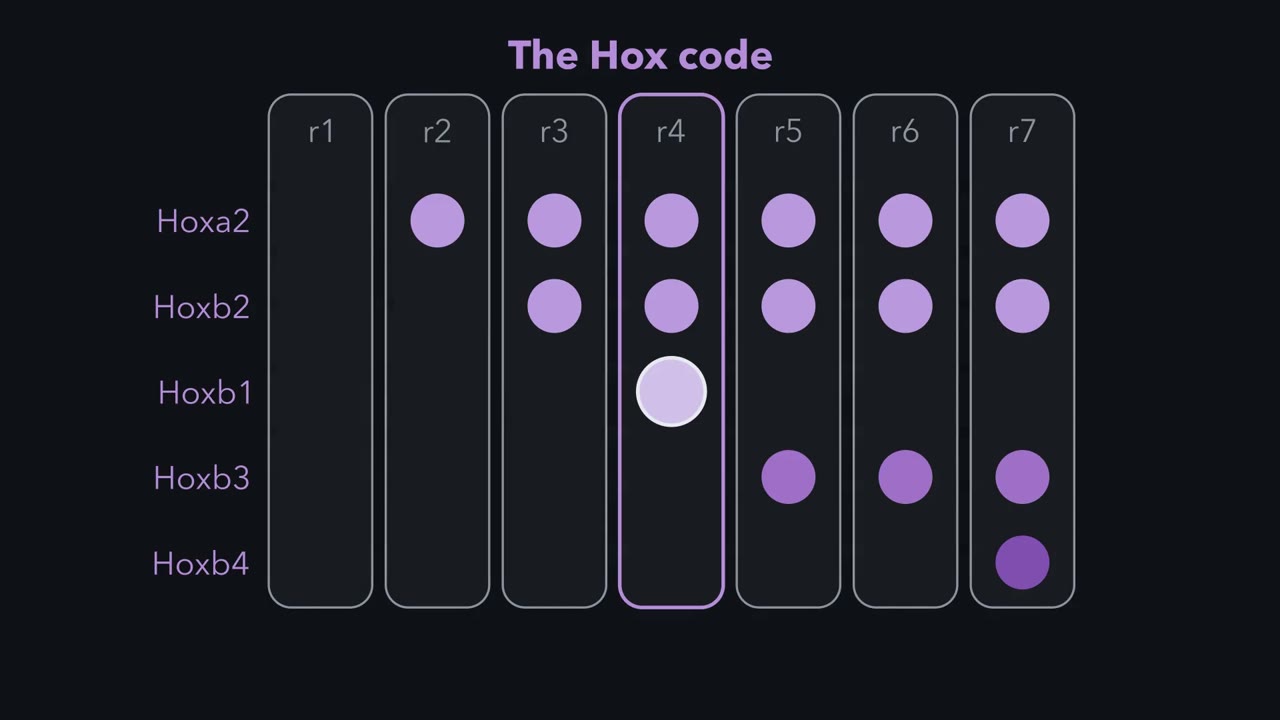
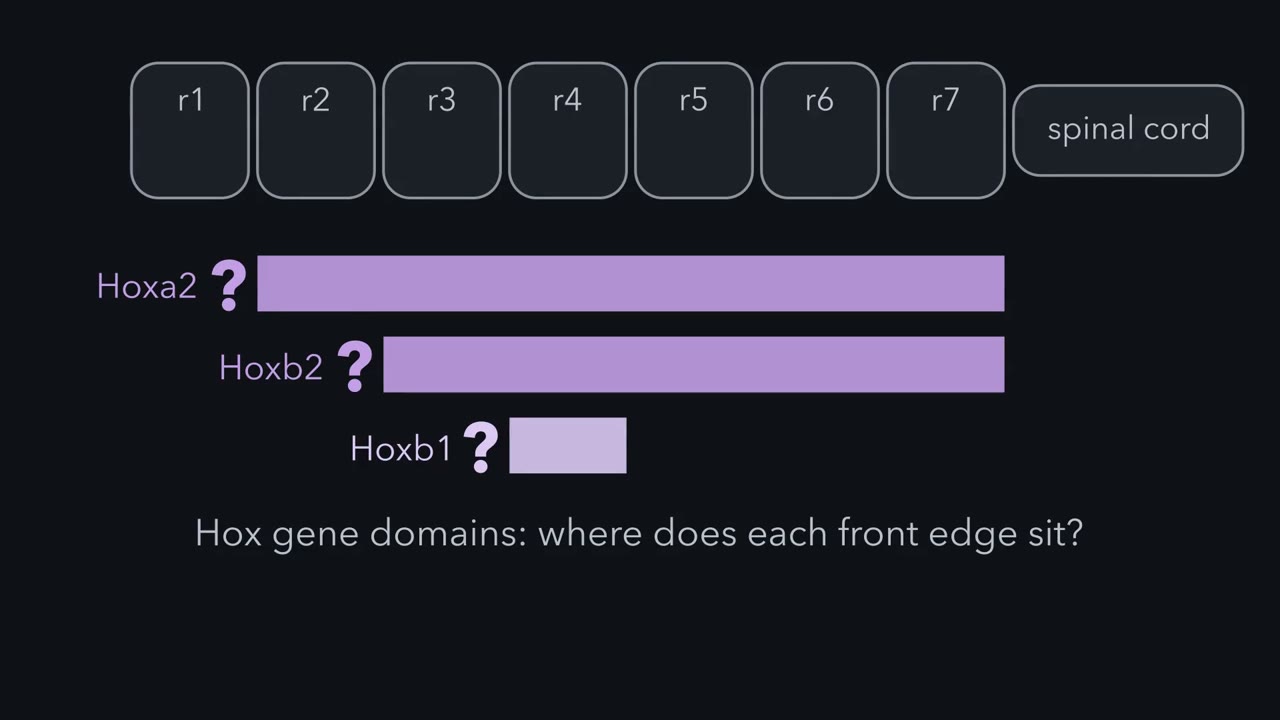
Units that keep their cells need a label: a set of transcription factors, mostly from Hox genes. In mouse, Hox domains have front edges at rhombomere boundaries. Read the code column by column. Every rhombomere differs. Rhombomeres r3 and r4 share Hoxa2 and Hoxb2. What separates them is Krox20 in r3. And later, strong Hoxb1 in r4. One idea to carry through: more early retinoic acid, a more posterior code; the code helps set the neurons. Early in the hindbrain, more retinoic acid, a vitamin A product, pushes a segment toward a more posterior identity. That combination, sharpened by segment genes such as Krox20, helps decide which motor neurons it builds.
So lookalike segments are not alike. Each carries its own code.
Rhombomeres r2 and r4 start out looking alike. What tells one to build jaw motor neurons and the other facial ones?
Continue in the lesson: Head to Tail: Hox Genes, Retinoic Acid and Rhombomeres →
2:28 · Free, with captions and a transcript. The lesson has the full text, the questions and the sources.
More films from this lesson
How this film was made. Narration: an AI narrator voice (Kokoro, af_heart) reading narration written from this lesson's text. Animation: AI-generated in code (Manim) by Claude, a schematic with no drawn molecular structures. Captions come from the narration script. See something wrong? Report it.