Reading the Trial, and When the Cell Is Gone
Read the transcript of “Reading the Trial, and When the Cell Is Gone”
Film transcript: Reading the Trial, and When the Cell Is Gone
Nine of twelve children met a trial's endpoint. Does that mean most of their hearing came back? The DB-OTO trial treated twelve children with OTOF-related profound deafness. Nine met the week 24 endpoint: an average of 70 dB HL or better. Three of twelve reached average normal sensitivity. So nine of twelve is a share of children meeting an endpoint. It is not a share of hearing. In a separate report by Wang and colleagues, one child's baseline was above the test ceiling of 95 dB. At week 26 the threshold was 58 dB. What does that tell you about the improvement?
Only that it was more than 37 dB. The true baseline was never measured. A floor on the improvement is not the improvement, and it is not a percentage of hearing. Now the harder case. When the hair cell itself is gone, putting back its gene cannot help. A new hair cell has to be made, perhaps from a surviving supporting cell. Birds replace damaged hair cells. In adult quail, counts recovered to within five percent of the original. The adult mammalian cochlea does not do this. One mammalian exception is vestibular, in the guinea-pig utricle.
In newborn mice, the factor ATOH1 pushes nonsensory cells of the cochlea, chiefly in the greater epithelial ridge, toward hair cells. Would the same factor work just as well a week later? By day eight, the factor alone gave very few new hair cells. Adding two more factors gave many more.
Hair-cell genes also became less accessible with age. That makes chromatin a candidate barrier. In mature mice, some reprogrammed cells grew rudimentary bundles. Nerve fibres were reported to contact them. Whether those contacts are working synapses is the unsettled step. Replacing a link in a surviving cell is being done in children. Rebuilding the cell is not.
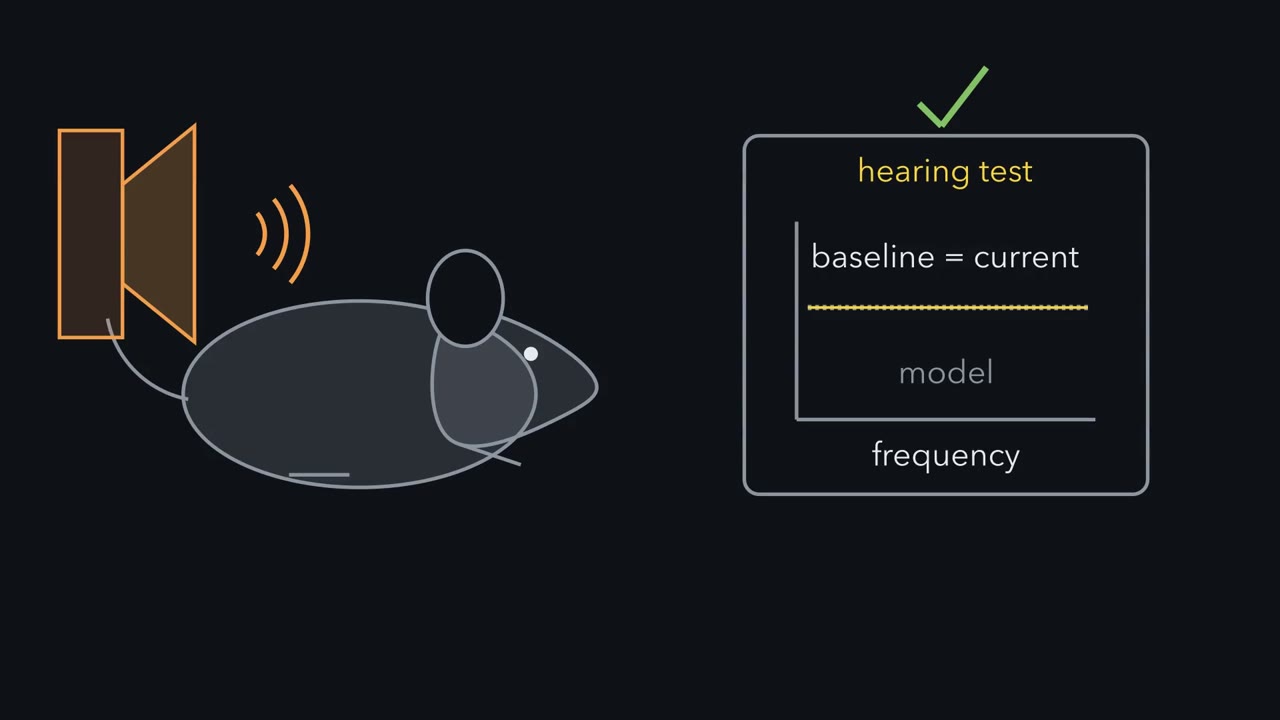
A mouse can pass its hearing test after loud noise and still have lost about half the ribbon synapses at one place in the cochlea. What does a normal threshold actually tell you?
Continue in the lesson: Hidden Hearing Loss, Gene Therapy and Regeneration →
2:35 · Free, with captions and a transcript. The lesson has the full text, the questions and the sources.
More films from this lesson
How this film was made. Narration: an AI narrator voice (Kokoro, af_heart) reading narration written from this lesson's text. Animation: AI-generated in code (Manim) by Claude, a schematic with no drawn molecular structures. Captions come from the narration script. See something wrong? Report it.