A Pore Inside a Complex
Read the transcript of “A Pore Inside a Complex”
Film transcript: A Pore Inside a Complex
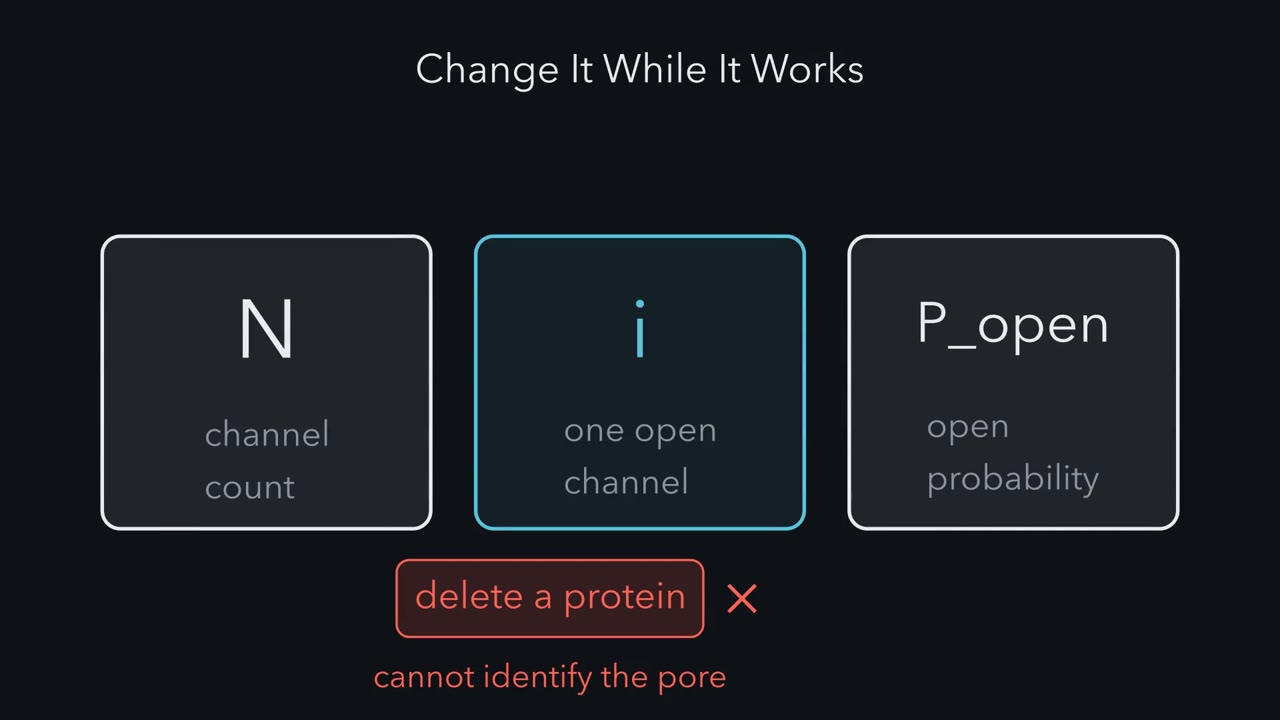
If TMC1 lines the pore, why does the current also depend on other proteins? No native mammalian structure was available, so Jeong, Clark and colleagues turned to a worm. They purified the native TMC-1 complex from C. elegans, and solved it by cryo-EM. The main assembly held two copies each of TMC-1, CALM-1, and TMIE. CALM-1 is the worm relative of the mammalian protein CIB2. The human complex in that paper was a model built on the worm structure, not a measurement. Read the mouse partners through the three factors. Without CIB2, cochlear stereocilia showed no detectable TMC1 or TMC2. So the channel count at the site falls. Without TMIE, tagged TMC1 could not be detected in the stereocilia either.
Predict. Overexpressed TMC1 still reaches the stereocilia there, yet gives no current. What does that tell you? TMIE is needed for more than getting TMC1 there. It may help build, couple or gate a working channel. Deafness-linked TMIE mutations also lowered the unitary current. In cells where TMC2 carried the current, they changed calcium permeability. So TMIE shapes the pore's properties, without being shown to be the pore.
LHFPL5 binds the tip-link protein PCDH15. Without it, Xiong and colleagues saw smaller single-channel events in 2012. Later recordings with TMC1-only channels found no change, so its molecular effect is still open. The current you measure belongs to the complex, not to one protein. Even a complete ladder leaves one question open. How does force from the tip link reach the pore? Of each experiment, ask which factor it tested. The case for the pore rests on several rungs together.
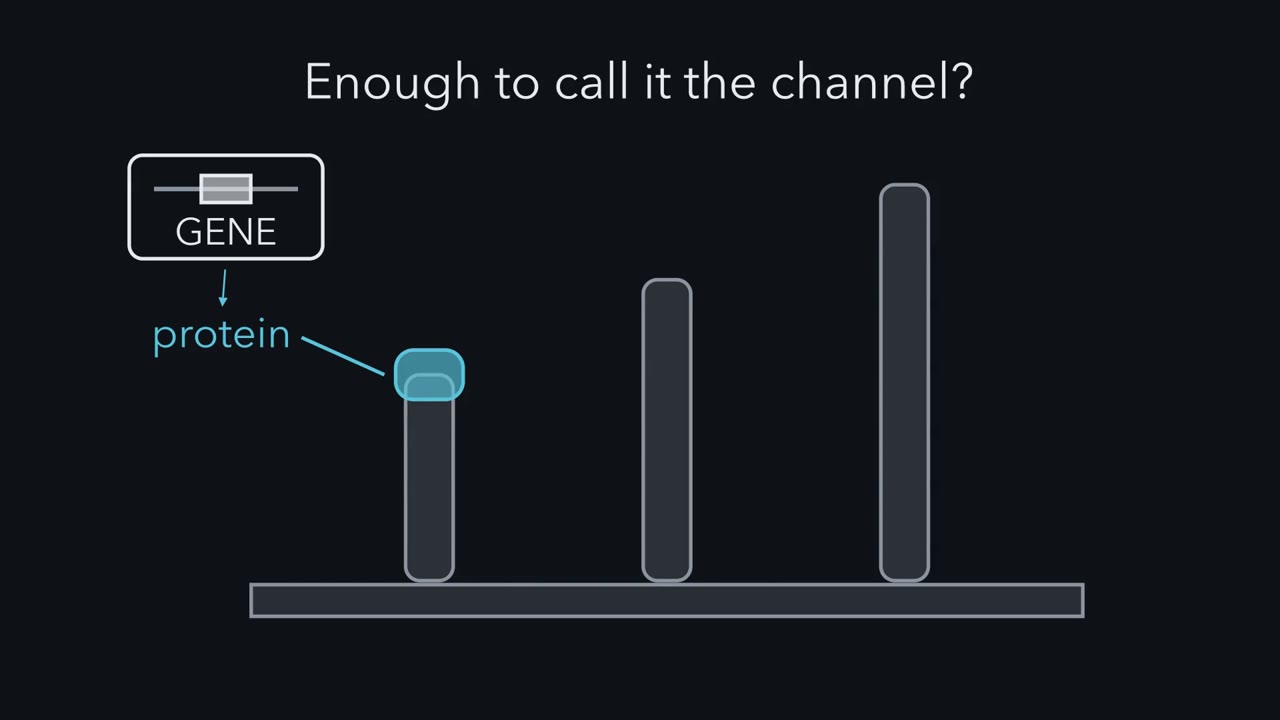
A gene is required for hearing, and its protein sits at the right place. What else must be shown before it counts as the channel?
Continue in the lesson: The Hair Cell's Transduction Channel →
2:23 · Free, with captions and a transcript. The lesson has the full text, the questions and the sources.
More films from this lesson
How this film was made. Narration: an AI narrator voice (Kokoro, af_heart) reading narration written from this lesson's text. Animation: AI-generated in code (Manim) by Claude, a schematic with no drawn molecular structures. Captions come from the narration script. See something wrong? Report it.