One Current, Three Factors
Read the transcript of “One Current, Three Factors”
Film transcript: One Current, Three Factors
A gene is needed for hearing, and its protein sits in the right place. Is that enough to call it the channel? Start with the current. A hair bundle is a staircase of stereocilia, in rows that rise in height. Tip links connect the tip of each shorter stereocilium to the side of its taller neighbour. Deflect the bundle toward its tallest row. The tip links are thought to pull channels open near their lower ends. With the cell held at a negative voltage, cations flow in, and the current is inward. This is the conventional transduction current. The current rises within a fraction of a millisecond. That is too fast for a chain of second messengers.
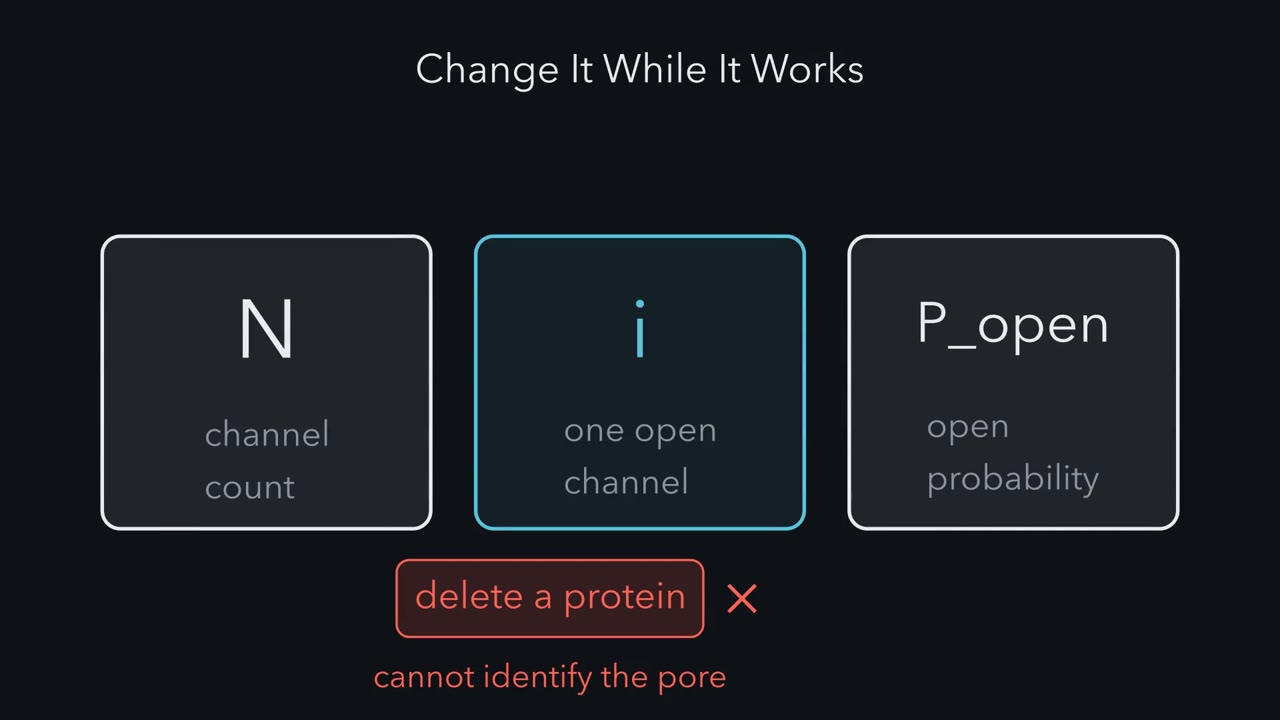
So force is thought to open the channel directly. Plot the size of the peak current against bundle displacement. The S-shaped curve saturates when nearly all channels are open. That current comes from many channels. Three things set it. First, how many working channels sit at the tip links. Call that N. Second, how much current one open channel passes. That is the unitary current, small i. Third, the chance that each channel is open. That is the open probability, P_open. For channels that are alike, multiply the three. That gives the average current from the whole bundle. Predict. A mutation halves that average current. Which of the three factors did it change?
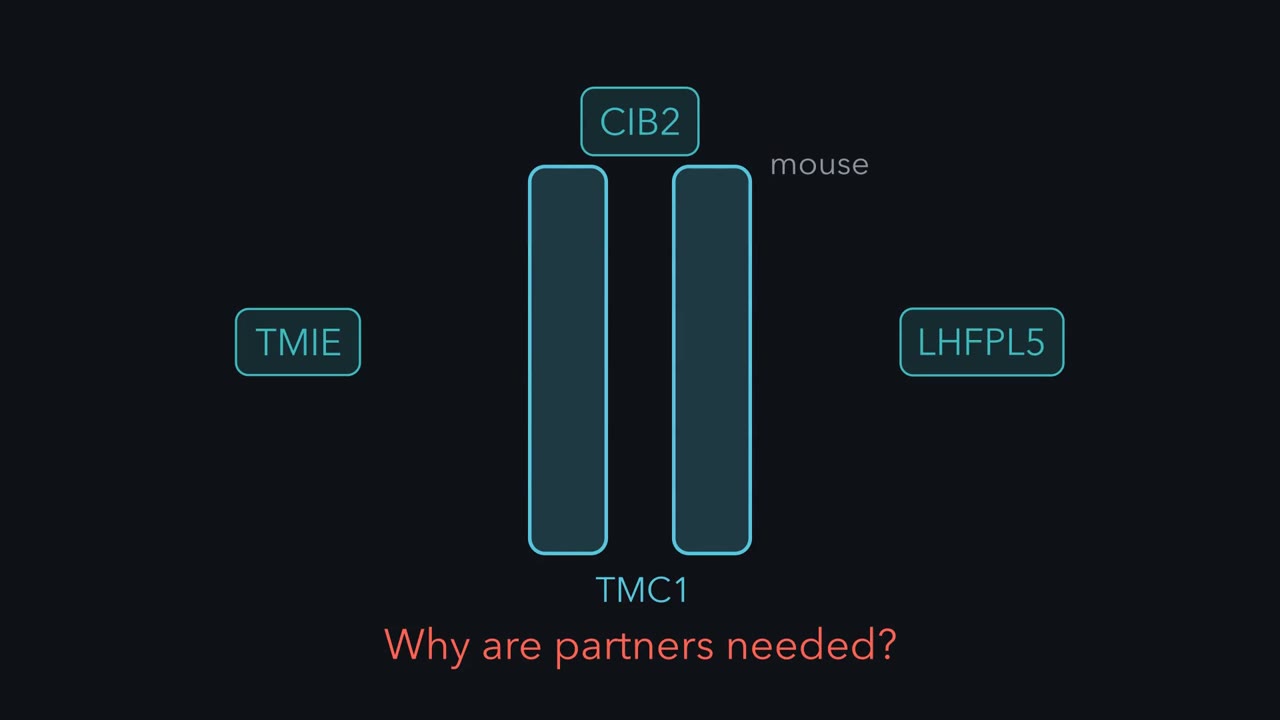
From the average alone, you cannot tell. Halve the channels, the unitary current, or the open probability. Each gives the same average current. A trafficking factor, an anchor or a lipid-modifying enzyme could all be needed. Deleting any one would silence the cell. So a lost current cannot tell you which factor you removed. Evidence about permeation speaks more directly to the pore. Which ions pass, and how much current does one open channel carry? So do a residue reached in a working channel, and activity of the protein on its own. But partners can change permeation too. So the case rests on several rungs together. Carry one question through every experiment.
Which factor did it test, and what did it rule out?
A gene is required for hearing, and its protein sits at the right place. What else must be shown before it counts as the channel?
Continue in the lesson: The Hair Cell's Transduction Channel →
2:35 · Free, with captions and a transcript. The lesson has the full text, the questions and the sources.
More films from this lesson
How this film was made. Narration: an AI narrator voice (Kokoro, af_heart) reading narration written from this lesson's text. Animation: AI-generated in code (Manim) by Claude, a schematic with no drawn molecular structures. Captions come from the narration script. See something wrong? Report it.