Press play to start at .
Acid On, Acid Off
From the film
- When stimulated, the parietal cell moves stored pumps into its membrane, and each cycle swaps a hydrogen ion for potassium using ATP.
- Acetylcholine, histamine and gastrin turn the pump on, and the vagus can start acid before food arrives.
- Acid flowing down to the antrum makes D cells release somatostatin, which holds back G cells: the more acid, the less gastrin.
- In the duodenum, acid releases secretin and fat and digested protein release CCK, and both inhibit gastric acid.
- A mucus gel traps bicarbonate against the lining, so the surface stays far less acidic than the lumen.
Read the transcript of “Acid On, Acid Off”
Film transcript: Acid On, Acid Off
Tap a sentence to play from there.
- 0:00 The first film showed the gut wall keeping its own beat.
- 0:04 The stomach runs one more machine: a pump.
- 0:08 Its juice reaches about pH 1.
- 0:11 That is roughly a million times more acidic than inside the cell making it.
- 0:17 What switches that pump on, and what switches it off?
- 0:23 At rest, the parietal cell keeps its pumps tucked inside small vesicles.
- 0:29 When stimulated, it moves them into the membrane of a deep fold facing the lumen.
- 0:35 Each cycle swaps a hydrogen ion out for a potassium ion, paid for with ATP.
- 0:42 Chloride follows potassium out, so hydrochloric acid builds.
- 0:46 Three signals turn the pump on: acetylcholine from nerves, histamine, and the hormone gastrin. The vagus nerve can start acid early.
- 0:58 Sight, smell, taste and chewing switch it on before food arrives.
- 1:02 Then food stretches the stomach, releasing more acetylcholine and gastrin.
- 1:08 Digested protein also acts directly on G cells in the antrum.
- 1:14 Gastrin travels in the blood to the body of the stomach, and acid climbs.
- 1:19 Here is the one idea.
- 1:22 Food arriving in a part of the gut turns that part on.
- 1:26 What that part makes, or passes downstream, turns it back down.
- 1:29 The stomach shows both halves.
- 1:33 Acid made in the body of the stomach flows down to the antrum.
- 1:38 There, acid makes D cells release somatostatin.
- 1:42 Somatostatin holds back the G cells beside them.
- 1:46 The more acid, the less gastrin.
- 1:49 Now the acidic, fatty chyme crosses into the duodenum, the first part of the small intestine. Will the duodenum call for more stomach acid, or less?
- 2:06 Less. Acid in the duodenum releases secretin from S cells.
- 2:13 Fat and digested protein release CCK from I cells.
- 2:18 Both inhibit gastric acid.
- 2:20 CCK probably works through somatostatin.
- 2:24 So the meal switches acid on in the stomach.
- 2:28 It switches acid off from two places downstream of the pump: the antrum and the duodenum. Once chyme reaches the intestine, the signals are mostly a brake.
- 2:39 The lining must survive the acid.
- 2:43 Surface cells secrete bicarbonate, and a mucus gel traps it against the lining.
- 2:48 So the surface stays far less acidic than the lumen.
- 2:53 Tight junctions limit how much acid leaks back in.
- 2:56 So acid is turned on by what arrives, and down by what the stomach sends onward.
- 3:03 Acid brakes it from the antrum.
- 3:06 Acid and fat brake it from the duodenum.
Gut movement: the same idea, other levels
A level is a place to start, not a rank. If this loses you, the rung below teaches the same idea, told more simply.
College, upper level · the level you chose
Gut Motility, Secretion and Gut Hormones · this lesson
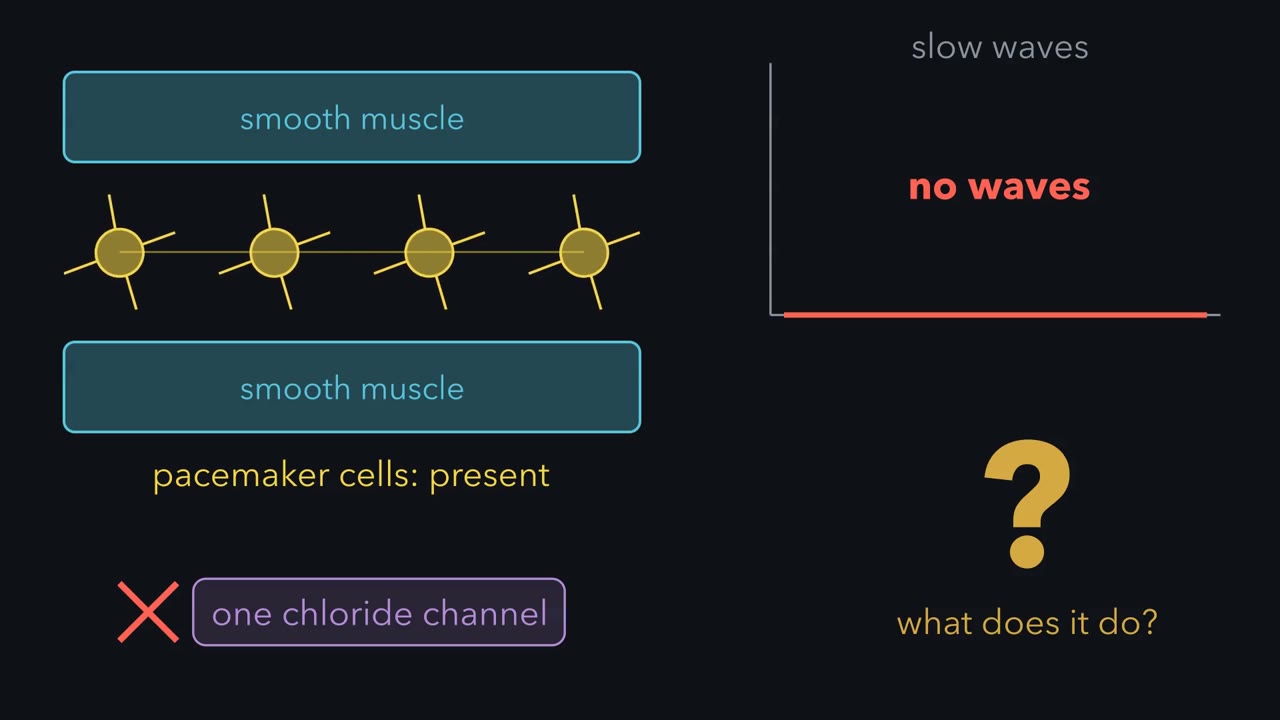
Cajal cells set the beat: Tmem16a-null mice have no slow waves.
Physiology · about 31 min · film 2:35 · 3 practice questions
Next door
- Spinal rhythm generators: Rhythm Without a Conductor · 2:16 The gut and the spinal cord both make rhythms inside their own network, with no beat sent from the brain.
- Smooth muscle: Smooth muscle force is a balance · 2:42 Gut movement is made by smooth muscle, which uses calcium to switch on a tag that lets myosin pull.
- Digestion and absorption: The master switch of digestion · 2:48 Mixing and pushing food is what brings it in contact with enzymes and the absorbing wall.
More films from this lesson
Continue in the lesson: Gut Motility, Secretion and Gut Hormones →
Free, with captions and a transcript. The lesson has the full text, the questions and the sources.
How this film was made. Narration: an AI narrator voice (Kokoro, af_heart) reading narration written from this lesson's text. Animation: AI-generated in code (Manim) by Claude, a schematic with no drawn molecular structures. Captions come from the narration script. See something wrong? Report it.