Press play to start at .
What the Gut Lets Go
From the film
- About 9 to 11 litres of fluid enter the adult gut each day, and about 99 percent of it is taken back.
- Stool water equals the load times one minus the fraction reabsorbed.
- From 99 to 98 percent capture, one point less capture doubles stool water, while an extra litre of load raises it only in proportion.
- Chloride secretion through CFTR runs mostly in the crypts, and sodium absorption through NHE3 and SGLT1 mostly on the villi.
- Cholera toxin keeps cyclic AMP high, which opens CFTR to raise the load and slows NHE3 to lower capture.
Read the transcript of “What the Gut Lets Go”
Film transcript: What the Gut Lets Go
Tap a sentence to play from there.
- 0:00 Nine to eleven litres of fluid enter your gut each day.
- 0:05 A couple of hundred grams of stool leave.
- 0:08 Where did that water go, and what decides how much leaves?
- 0:15 About 2 litres is what you drink.
- 0:18 Your own secretions add roughly 7 to 9 more: saliva, gastric juice, bile, pancreatic juice and intestinal fluid.
- 0:28 About 99 percent is taken back.
- 0:31 So what leaves is whatever was not taken back.
- 0:35 Stool water = load × (1 − fraction reabsorbed).
- 0:40 With round numbers, 11 litres × 1 percent is about a tenth of a liter a day.
- 0:47 Try two changes. Add 1 litre to the load, and keep 99 percent capture.
- 0:54 Or keep the load, and capture 1 point less.
- 0:58 Which raises stool water more?
- 1:05 The extra litre adds only about a hundredth of a litre, in proportion to the load.
- 1:12 One point less capture takes stool water from 0.11 litres to 0.22.
- 1:18 It doubles.
- 1:20 Here is the one idea.
- 1:23 What leaves is a small residue of a large flow.
- 1:26 When capture is nearly complete, that residue is very sensitive to it.
- 1:32 A bigger load raises it only in proportion.
- 1:35 Who adds to the load, and who captures?
- 1:39 In pits called crypts, a sodium pump and NKCC1 pack chloride into the cell.
- 1:45 When the channel CFTR opens, chloride pours into the gut.
- 1:51 Sodium follows between the cells, and water follows both.
- 1:55 On the fingers called villi, the flow runs the other way.
- 1:59 NHE3 and a partner exchanger bring sodium chloride in.
- 2:05 SGLT1 carries sodium in with sugar.
- 2:09 Water follows the absorbed salt.
- 2:12 Secretion mostly happens in the crypts, and absorption mostly on the villi, though one cell can do both.
- 2:19 Stool water is the difference.
- 2:22 Behind them stands the colon, which can absorb up to 4 to 5 litres a day.
- 2:28 Cholera pulls on both terms at once.
- 2:31 Its toxin jams a G protein in the on position, so cells keep making cyclic AMP.
- 2:38 In the crypts, that opens CFTR, and the load rises.
- 2:43 On the villi, it slows NHE3, and capture falls.
- 2:47 So the gut works near an edge.
- 2:50 It takes back nearly everything.
- 2:53 So a small slip in any capturing step shows up many times over in what leaves.
Bile acid recycling: the same idea, other levels
A level is a place to start, not a rank. If this loses you, the rung below teaches the same idea, told more simply.
College, upper level · the level you chose
Absorption, the Liver and Enterohepatic Circulation · this lesson
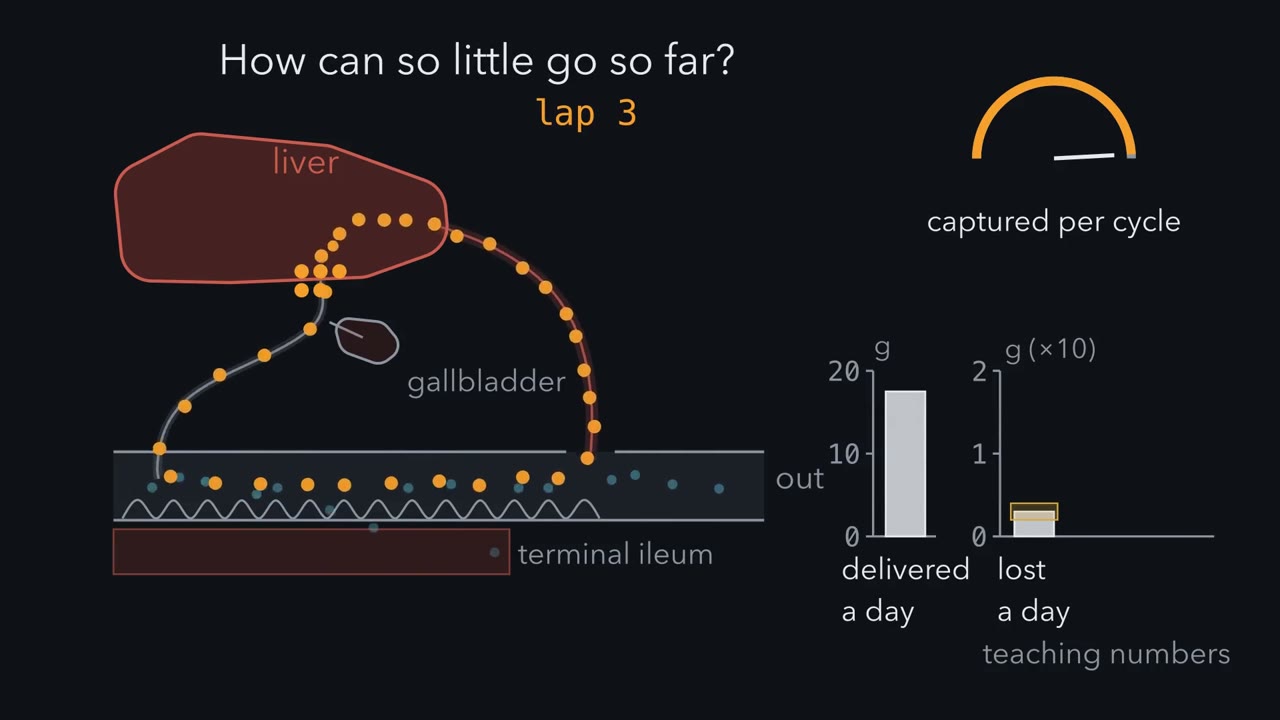
A 3.5 g bile acid pool cycles five times a day, losing little.
Physiology · about 28 min · 4 practice questions
Next door
- Cholesterol: The cholesterol gauge · 3:15 Bile acids are made from cholesterol, so recycling them or losing them changes how much cholesterol the liver must make.
- Lipids and fatty acids: Shape is destiny · 2:27 Bile acids break fat into tiny droplets, so the gut enzymes can reach it and absorb it.
- Digestion and absorption: The master switch of digestion · 2:48 Bile acids are one tool the gut uses to cut food into pieces small enough to absorb.
More films from this lesson
Continue in the lesson: Absorption, the Liver and Enterohepatic Circulation →
Free, with captions and a transcript. The lesson has the full text, the questions and the sources.
How this film was made. Narration: written from this lesson's text and read by an AI narrator voice (Kokoro, af_heart). Animation: AI-generated in code (Manim) by Claude, a schematic with no drawn molecular structures. Captions come from the narration script. See something wrong? Report it.