Films · Developmental Neuroscience
Followers, Glue and the Reader
Read the transcript of “Followers, Glue and the Reader”
Film transcript: Followers, Glue and the Reader
A growth cone meets many bundles of axons. Its filopodia touch several. Why does it join just one? When axons grow bundled together, they are fasciculated. When one leaves its bundle, it defasciculates. In grasshopper embryos, Raper, Bastiani and Goodman followed a neuron called G. Its growth cone joins one bundle, the A/P fascicle, made of axons from neurons called A and P. It grows along the P axons. Before G arrived, the team killed the P neurons, the neurons, or both. If any bundle would do, G should take a neighbour. What did G do?
Without the P axons, G failed to extend far along its route. It wandered, branched abnormally, and took no other bundle. Without only the axons, G behaved normally. G needs something particular to the P axons. Hence the labeled pathway hypothesis: bundles carry surface labels that growth cones recognize. In the fruit fly, the search found adhesion molecules, not a unique label for each bundle. Fasciclin II can bind Fasciclin II on a neighbouring axon. Without it, axons that travel together in certain pathways drift apart.
In a separate experiment, extra Fasciclin II kept motor axons stuck in their nerve. They bypassed their muscles. Opposite changes, opposite results. The amount of adhesion between axons matters. A second gene, beaten path, makes a protein on motor axons. Without it, motor axons fail to leave their nerve. Now reduce Fasciclin II in a beaten path mutant. What happens at the choice point?
The bypass defect is suppressed. Motor axons can often leave their nerve again. Lowering adhesion makes up for losing Beat. So Beat works at least partly against adhesion between axons. Beat also helps motor axons recognize a pathway cue called Sidestep. Last, the same cue can mean different things. In a simple comparison, netrin-1 can attract growth cones carrying the receptor DCC. With a second receptor, UNC5, beside DCC, it can repel them instead.
The growth cone's internal state, and the surface beneath it, can also flip the response. A cue is a message. The receptors and internal state of the growth cone decide what it means. So followers choose which axons to ride. And the reader decides what a cue means.
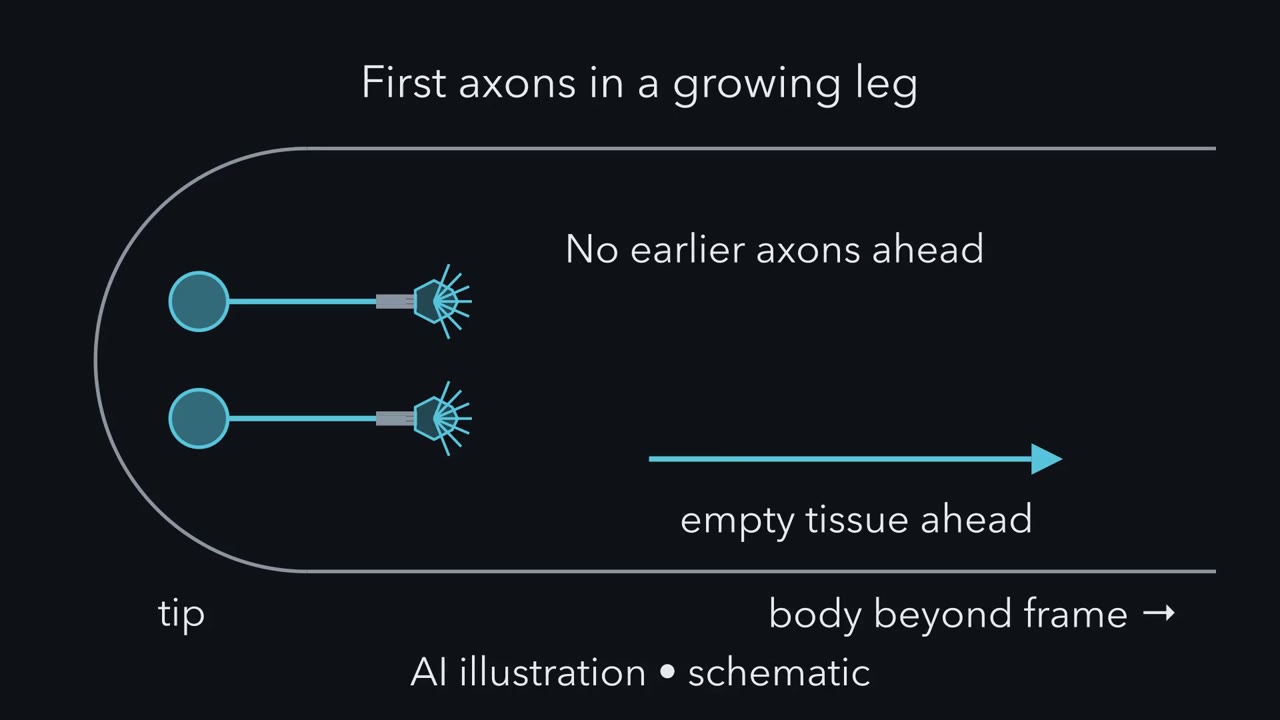
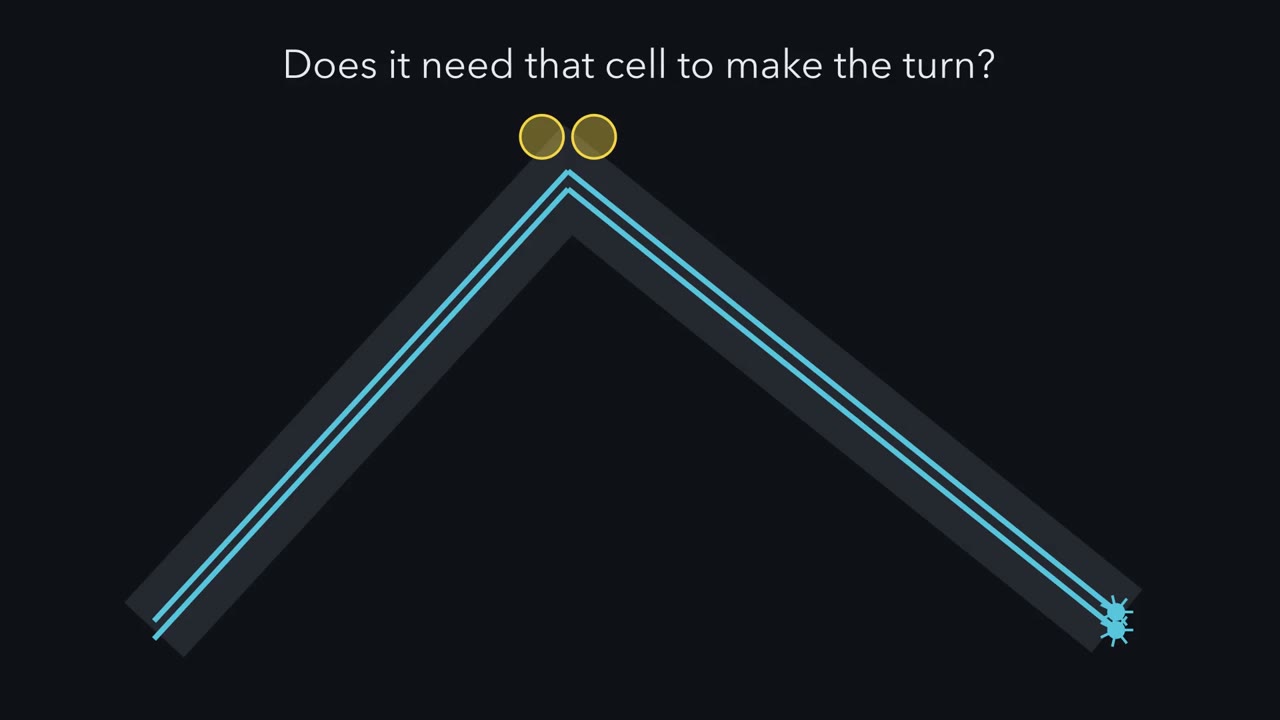
Kill a guidepost cell on a grasshopper embryo's leg, and the first axons to grow past it lose their way.
Continue in the lesson: Pioneers, Guideposts and the Logic of Guidance Cues →
3:17 · Free, with captions and a transcript. The lesson has the full text, the questions and the sources.
More films from this lesson
How this film was made. Narration: an AI narrator voice (Kokoro, af_heart) reading narration written from this lesson's text. Animation: AI-generated in code (Manim) by Claude, a schematic with no drawn molecular structures. Captions come from the narration script. See something wrong? Report it.