Press play to start at .
The Balance Behind the Bend
From the film
- Lactate is a fuel, not waste: other fibres and the heart burn it, and the liver makes glucose from it.
- Blood lactate is set by appearance minus clearance, and appearance keeps rising as work rises.
- The lactate threshold is the workload above which blood lactate accumulation speeds up; it has no universal value.
- It is not where oxygen runs out: above it, muscle keeps consuming oxygen and lactate is still cleared.
- In one study of trained men, clearance peaked below the threshold, which fits the faster climb but does not prove it causes the bend.
Read the transcript of “The Balance Behind the Bend”
Film transcript: The Balance Behind the Bend
Tap a sentence to play from there.
- 0:00 The first film found the ceiling.
- 0:03 In healthy people running or cycling at sea level, oxygen delivery mainly sets it.
- 0:09 But no one races for long at the ceiling.
- 0:13 As the pace rises, blood lactate climbs faster.
- 0:17 Is the muscle running out of oxygen?
- 0:22 A 2008 review names three things behind endurance.
- 0:27 The ceiling itself.
- 0:30 The fraction of it a person can sustain.
- 0:33 And economy, the oxygen cost of moving at a given speed.
- 0:38 That fraction is related to the lactate threshold.
- 0:42 To see that threshold, start with lactate.
- 0:46 It is a fuel, not waste.
- 0:49 Some pyruvate from glycolysis becomes lactate and leaves the fibres that make it.
- 0:55 Other fibres and the heart burn it, and the liver makes glucose from it.
- 0:59 How much fuel is that?
- 1:03 In one tracer study of 12 trained and untrained men, blood lactate supplied an estimated third of carbohydrate energy.
- 1:12 That was over 60 minutes at the lactate threshold.
- 1:16 So the lactate in blood is a balance.
- 1:19 Here is the key idea.
- 1:22 Blood lactate is set by the balance of appearance and clearance: how fast it enters, against how well it is removed.
- 1:30 As work rises, appearance keeps rising.
- 1:34 Now raise the work rate step by step.
- 1:37 Appearance climbs with every step.
- 1:40 Suppose clearance has already reached its peak and holds there.
- 1:45 What does blood lactate do?
- 1:52 It climbs faster, because appearance outpaces clearance more with every step.
- 1:58 In one study of trained men, clearance did peak below the threshold.
- 2:03 That fits the faster climb, but does not prove it causes the bend.
- 2:07 That bend marks the lactate threshold: the workload above which blood lactate accumulation speeds up.
- 2:15 It has no universal value.
- 2:18 It is not a fixed 4 mmol per L, or a fixed share of the ceiling.
- 2:23 Nor is it where oxygen runs out.
- 2:27 Above the threshold, muscle keeps consuming oxygen and burning fuel.
- 2:32 Lactate is still cleared and still burned.
- 2:35 Only the balance has tipped.
- 2:38 The same study compared trained and untrained men.
- 2:42 At each group's own threshold, clearance was 34 percent higher in the trained men.
- 2:48 Comparing groups shows an association, not cause.
- 2:52 So the bend in the curve is a balance tipping, not oxygen failing.
- 2:58 Lactate keeps flowing from the fibres that make it to the tissues that use it.
- 3:03 Above the threshold, it simply arrives faster than it is cleared.
Oxygen uptake and VO2max: the same idea, other levels
A level is a place to start, not a rank. If this loses you, the rung below teaches the same idea, told more simply.
College, upper level · the level you chose
Exercise: The Whole Body at Work · this lesson
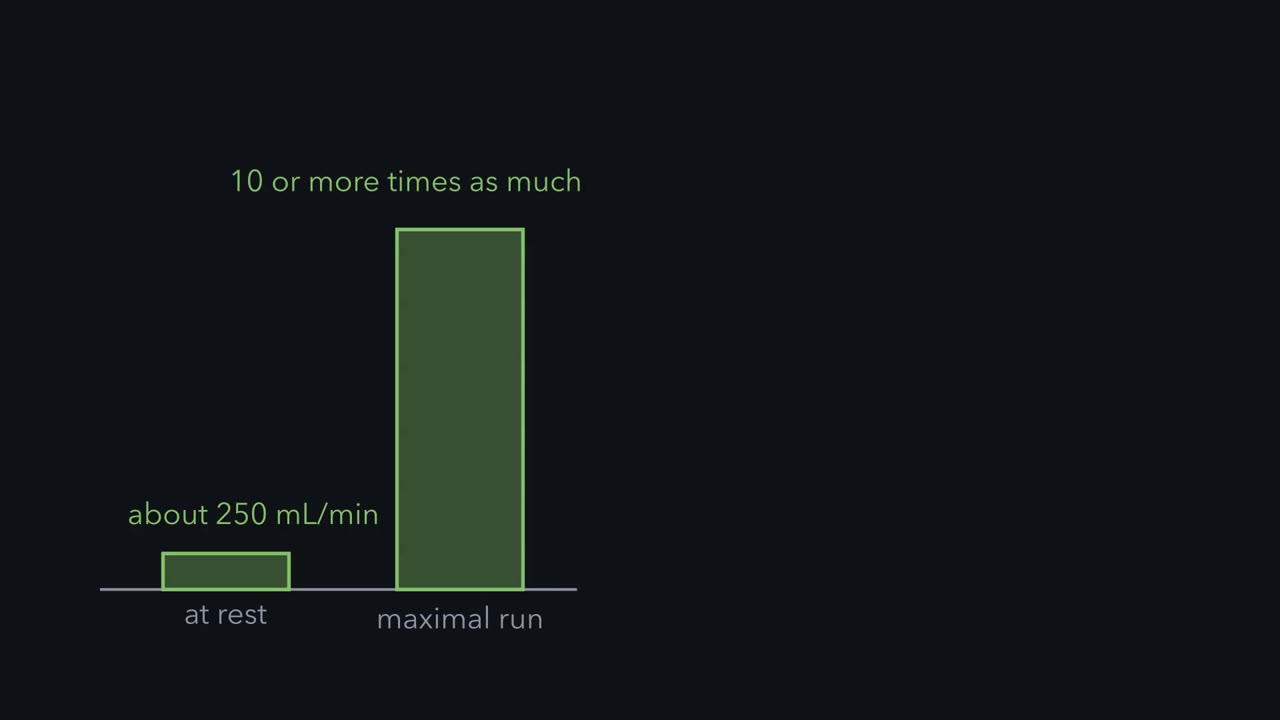
Fick split: 250 mL per min at rest rises tenfold through flow and extraction.
Physiology · about 31 min · film 2:50 · 3 practice questions
Next door
- Cellular respiration: Metabolism: Basic Concepts and Design The oxygen your body uses is burned with food in cells to make ATP, so uptake measures that work.
- Cardiac output: Output Is Where the Curves Cross · 3:12 The most blood the heart can send out is one of the two limits on how much oxygen can be used.
- Metabolic rate: The Price of Cold · 2:57 · Starting college Energy use rises with oxygen use, which is how metabolic rate can be measured in a resting animal.
More films from this lesson
Continue in the lesson: Exercise: The Whole Body at Work →
Free, with captions and a transcript. The lesson has the full text, the questions and the sources.
How this film was made. Narration: an AI narrator voice (Kokoro, af_heart) reading narration written from this lesson's text. Animation: AI-generated in code (Manim) by Claude, a schematic with no drawn molecular structures. Captions come from the narration script. See something wrong? Report it.