The Price of Cold
Read the transcript of “The Price of Cold”
Film transcript: The Price of Cold
Put a mouse in a chamber and cool the air, one step at a time. What happens to the heat it makes? And why does nothing happen at first? The first film drew the body as a tank. Heat made flows in through the orange tap. Heat leaks out through a blue outlet whose width can change. Now we watch what holding the level costs. In this model, we leave out sun and evaporation. So heat made must match the blue leak. We read heat made from the oxygen the mouse uses. At each step, we plot one orange point.
At first, the orange points stay flat. The mouse holds its temperature without making extra heat. Instead, it narrows the blue outlet. Skin vessels close, and fur lifts. This flat stretch is the thermoneutral zone. The resting rate along it is the basal metabolic rate, measured at rest and not digesting. But the outlet can only get so narrow. At the lower critical temperature, our model mouse reaches its narrowest outlet. Its conductance is at its minimum. Below that, the model holds the outlet at its minimum. Now only the orange tap can answer. Each degree colder adds the same extra heat. So the points climb in a straight line. Extend that line toward warmer air, and it reaches zero at body temperature.
That zero is only arithmetic. A living animal always makes some heat. Per Scholander, Laurence Irving and colleagues measured curves like this. They plotted resting heat made against air temperature, for mammals from the arctic and from the tropics. Now give an animal thicker fur, with the same basal rate and body temperature. Does the bend move to colder air, or to warmer air?
Colder. A narrower outlet can carry the basal heat away only across a bigger gap. And below the bend, the climb is shallower. That is the pattern they found. Thick-furred arctic mammals stayed on their flat line into far colder air than tropical ones. The difference lay mainly in insulation, not in a higher basal rate. So the curve is the heat balance, plotted against the air. Conductance sets where the bend falls, and how steeply the cost climbs below it.
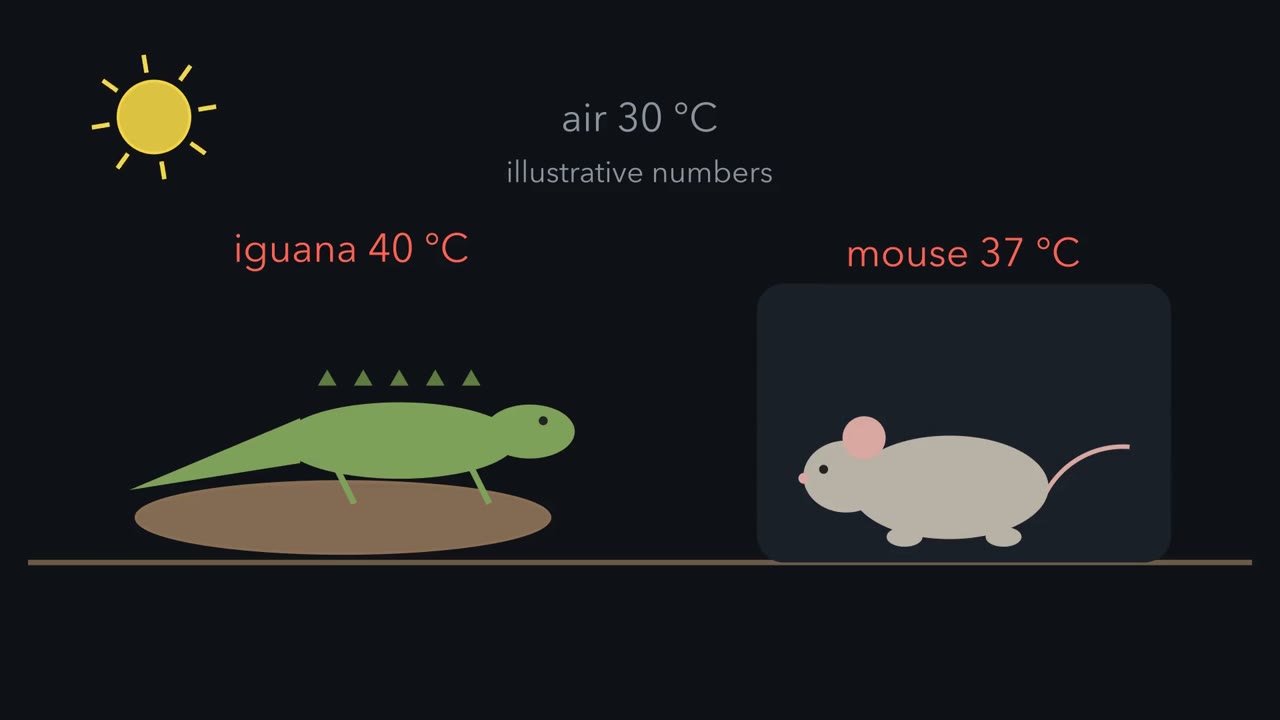
How can a lizard basking on a desert rock end up warmer than you are, without making much heat of its own?
Continue in the lesson: Heat Balance and Body Temperature →
2:57 · Free, with captions and a transcript. The lesson has the full text, the questions and the sources.
More films from this lesson
How this film was made. Narration: an AI narrator voice (Kokoro, af_heart) reading narration written from this lesson's text. Animation: AI-generated in code (Manim) by Claude, a schematic with no drawn molecular structures. Captions come from the narration script. See something wrong? Report it.