Why Later Is Fine, and What the Cord Does
Read the transcript of “Why Later Is Fine, and What the Cord Does”
Film transcript: Why Later Is Fine, and What the Cord Does
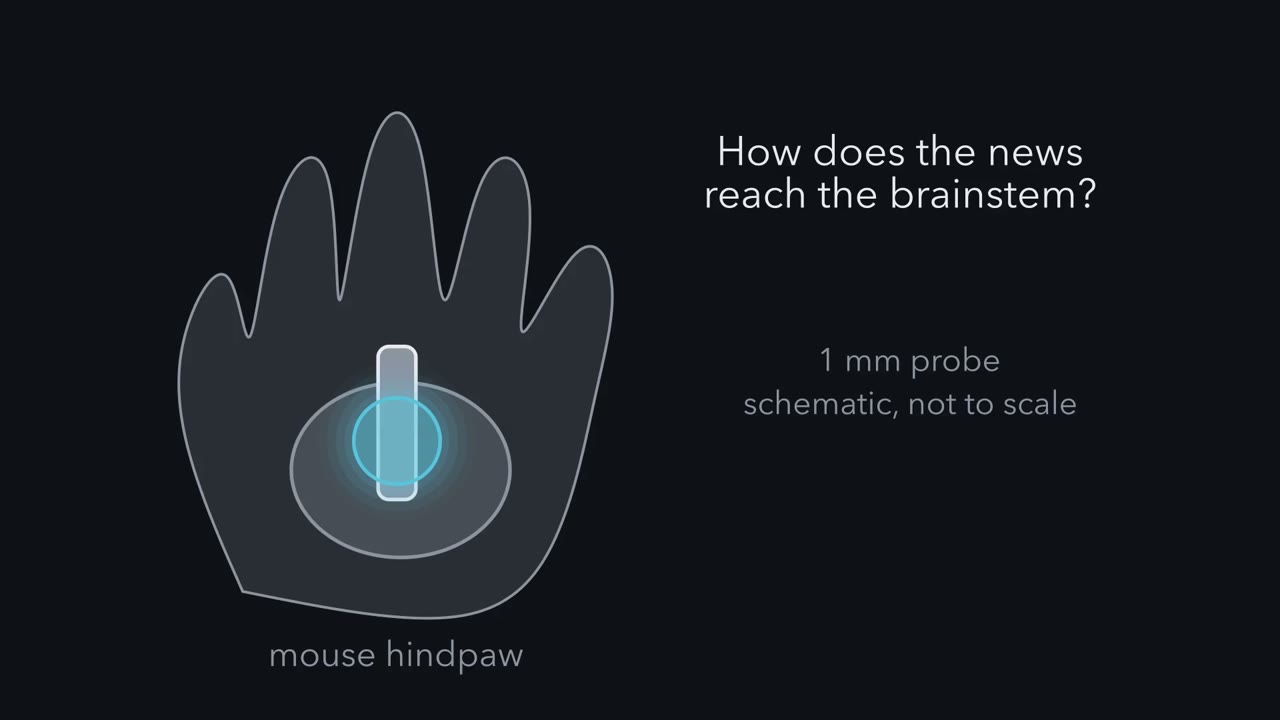
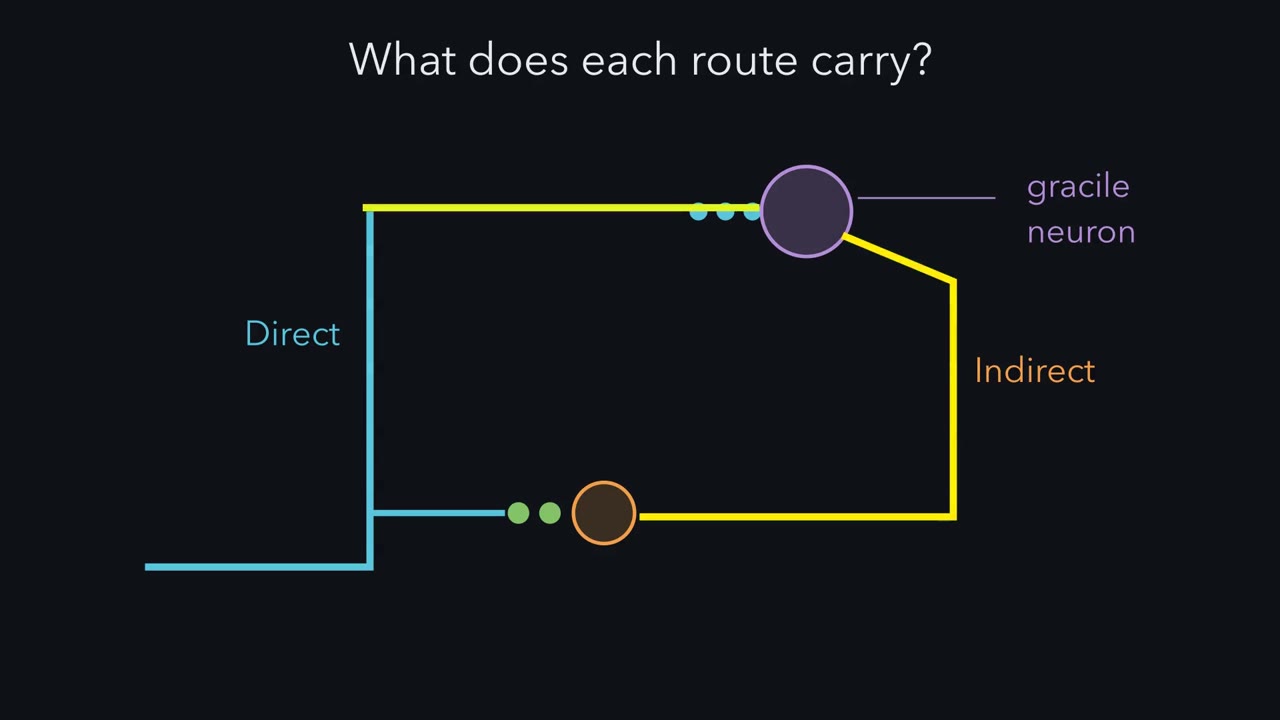
In a simple model, the indirect route arrives later. What does a slower report cost, and what does it add? Take illustrative numbers for a mouse hindpaw. In this model, the indirect input arrives about 4.5 milliseconds later. That lag is a model, not a measurement, and its size is uncertain. With equal paths from cord to brainstem, matched final synapses and a PSDC axon no faster, the spinal synapses make it later. Pause and predict. Does a lag of a few milliseconds matter more for a long press, or for fast vibration?
For the steady firing during a 300 millisecond press, it may matter little. The lag is a sliver at the start, though onset timing is a separate question. At 500 hertz, one cycle lasts 2 milliseconds. The lag spans more than two whole cycles. A fixed delay does not blur locking on its own route. Every spike is equally late, so the spikes still share one phase. That phase shifts, by a quarter cycle here. What blurs timing is jitter. In this toy model, each synapse adds random scatter to when the next spike fires. With assumed jitter, two synapses nearly erase locking at 500 hertz. At 50 hertz, locking barely changes. That model is not the paper's explanation.
But it shows how relay jitter could explain why fast timing rides the route with no relay. Now a second question. What does the cord do to the signal? PSDC neurons get most of their excitation from local interneurons. single dorsal horn neurons received input from both low-threshold and high-threshold mechanoreceptors. Two kinds of inhibition shape the output. In feedforward inhibition, the afferent excites the PSDC neuron and an inhibitory interneuron. That interneuron then inhibits the PSDC neuron. Here, Rorβ interneurons supplied it, using glycine. Presynaptic inhibition lands on the afferent terminal itself, and scales down the transmitter it releases.
Pause and predict. Remove either kind of inhibition. Does the PSDC receptive field shrink, or grow? It grows. And losing presynaptic inhibition left neurons firing after the indentation ended. These were chronic knockouts, recorded under anaesthesia. And no study here recorded these neurons in an awake animal. The takeaway: two routes, one patch of skin. One keeps the timing. The other, rebuilt in the cord, reports the pressure.
The brainstem can hear about one touch of the paw twice: directly, and again by a route through the spinal cord that, in a simple conduction model, arrives a few milliseconds later. What does the second report add?
Continue in the lesson: Where Touch Is First Processed: Dorsal Horn and Dorsal Column Nuclei →
3:12 · Free, with captions and a transcript. The lesson has the full text, the questions and the sources.
More films from this lesson
How this film was made. Narration: an AI narrator voice (Kokoro, af_heart) reading narration written from this lesson's text. Animation: AI-generated in code (Manim) by Claude, a schematic with no drawn molecular structures. Captions come from the narration script. See something wrong? Report it.