Silence One Route
Read the transcript of “Silence One Route”
Film transcript: Silence One Route
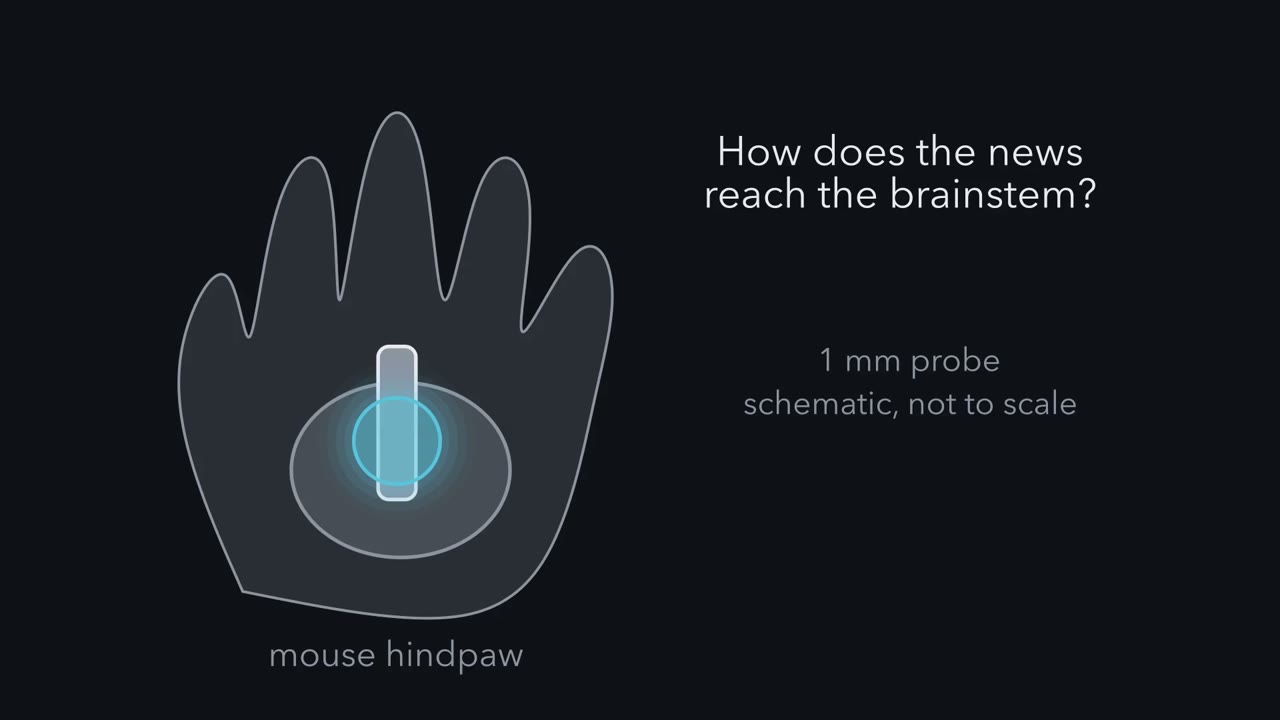
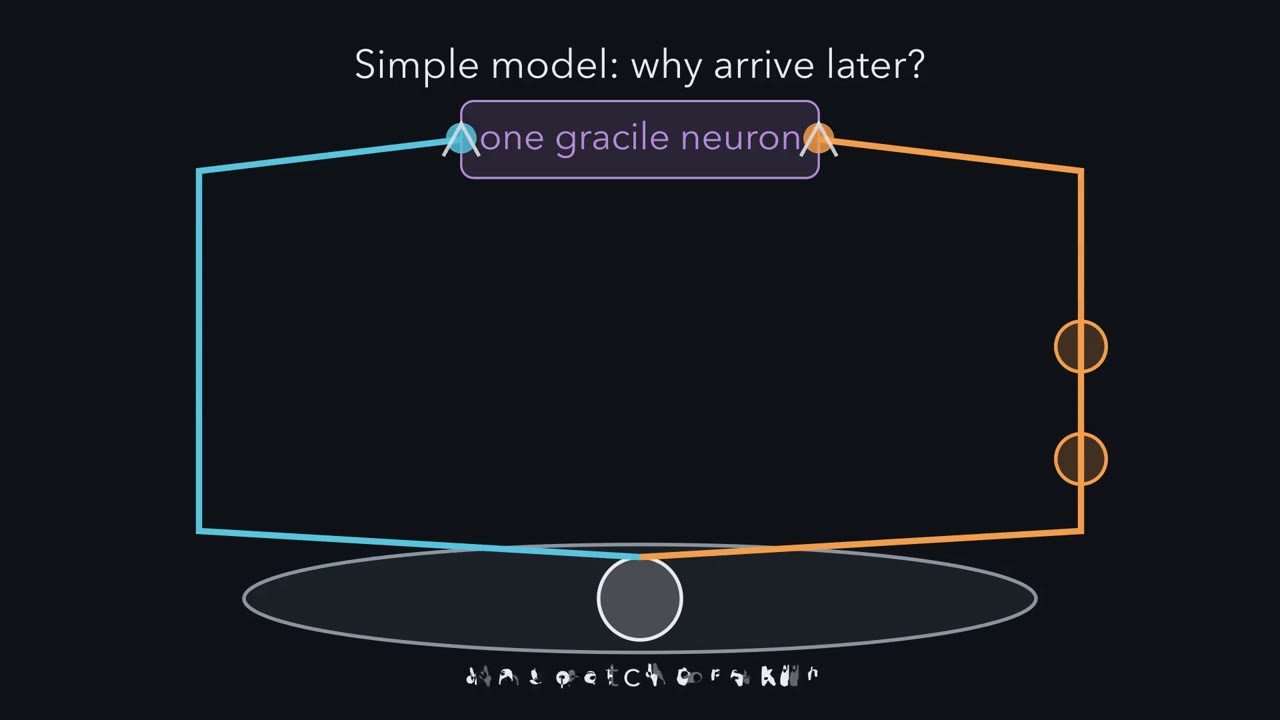
Two routes feed one gracile neuron. How can you tell what each one carries? Take one route away at a time, and watch what the neuron loses. Turecek, Lehnert and Ginty recorded single gracile neurons in the hindlimb region of anaesthetized adult mice. They identified neurons that project to the thalamus. Stimulating their axons there sent spikes backward, checked with a collision test.
Switch one removes the direct route. Light on the gracile nucleus silences the afferent terminals there, through a light-gated chloride channel. Switch two removes the indirect route. Drugs on the lumbar cord block its spinal synapses. The afferents’ direct branches climb past without a spinal synapse, so they keep conducting. Then three stimuli on the hindpaw. A vibration. A gentle displacement of the skin. And a sustained press with a blunt probe. Pause and predict. Which route carries vibration? Which carries a hard, sustained press? And gentle displacement?
Vibration first. The direct input carried vibration with high temporal precision, up to high frequencies. The indirect route can add to slow, 10 hertz vibration. Now the press. Blocking the spinal synapses almost eliminated sustained firing in most neurons. The block also raised the force needed to make the neuron fire at all. So the indirect route is not just a late add-on.
Gentle displacement used both routes. So direct for vibration, indirect for light touch, is too simple. Now map each input's receptive field on one neuron. The direct and indirect fields were highly aligned. So the two routes are not two maps. They are two reports on one spot, meeting on one neuron.
One limit. The light silencer was validated only for gentle forces. So the high-force result rests on the drug. And that drug is not specific to PSDC neurons. And strong firing at high force is not by itself evidence of pain. In awake mice, the high-force press evoked no pain-related behaviour. The takeaway: fast timing rides the direct route. Sustained pressure rides the indirect one. Gentle touch uses both, and both report the same skin.
The brainstem can hear about one touch of the paw twice: directly, and again by a route through the spinal cord that, in a simple conduction model, arrives a few milliseconds later. What does the second report add?
Continue in the lesson: Where Touch Is First Processed: Dorsal Horn and Dorsal Column Nuclei →
3:00 · Free, with captions and a transcript. The lesson has the full text, the questions and the sources.
More films from this lesson
How this film was made. Narration: an AI narrator voice (Kokoro, af_heart) reading narration written from this lesson's text. Animation: AI-generated in code (Manim) by Claude, a schematic with no drawn molecular structures. Captions come from the narration script. See something wrong? Report it.