Two Routes, One Patch of Skin
Read the transcript of “Two Routes, One Patch of Skin”
Film transcript: Two Routes, One Patch of Skin
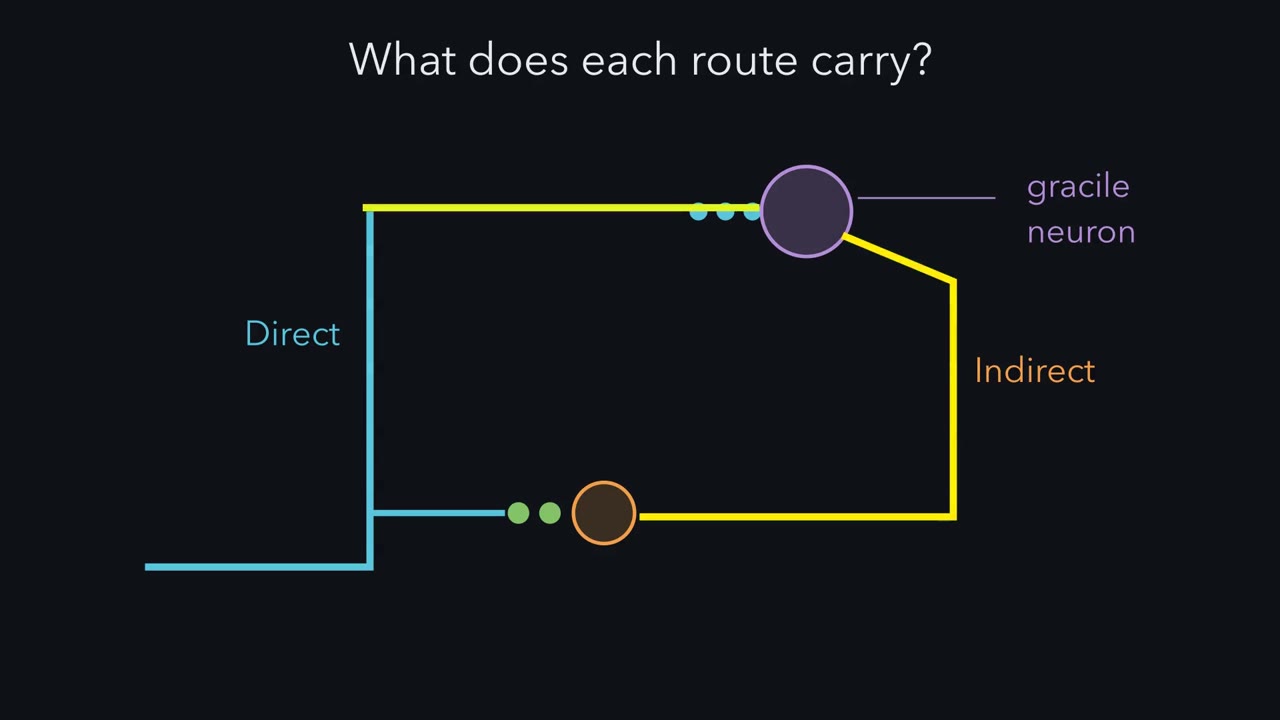
Press the skin of a mouse's hindpaw. How does the news reach the brainstem? The textbook draws one route. There are two. Start with the textbook drawing. A touch afferent, an Aβ low-threshold mechanoreceptor, enters the spinal cord. Its main branch climbs the dorsal column on the same side. It reaches the gracile nucleus in the brainstem with no synapse on the way. Call this the direct route. Now look below that drawing. The same afferent also sends branches into the dorsal horn, a layered circuit. Those branches drive local interneurons. Through them, and in places directly, they drive a spinal neuron whose own axon climbs the same dorsal column.
This is a postsynaptic dorsal column neuron, or PSDC neuron. It is driven in the dorsal horn and projects to the brainstem. Recordings in cats described these neurons by the early 1980s. Mouse work adds genetic access, and a test of each route. So draw a second line, in gold, from the afferent through the circuit and up to the gracile nucleus. Pause and predict. Does the gold line end on the same brainstem neurons as the blue line?
For thalamus-projecting gracile neurons, yes. The two inputs had highly aligned receptive fields. Both reported the same patch of skin. But the two reports are not the same. The direct route keeps precise timing. The indirect route reports sustained pressure, up to high forces. That is the idea for this lesson. Two routes, one patch of skin. One report keeps the timing. The other is rebuilt in the cord, not copied.
The limits: these are mouse studies, mostly in anaesthetized adults, and the dorsal column route only. The takeaway: one touch, two routes, two different reports on the same skin.
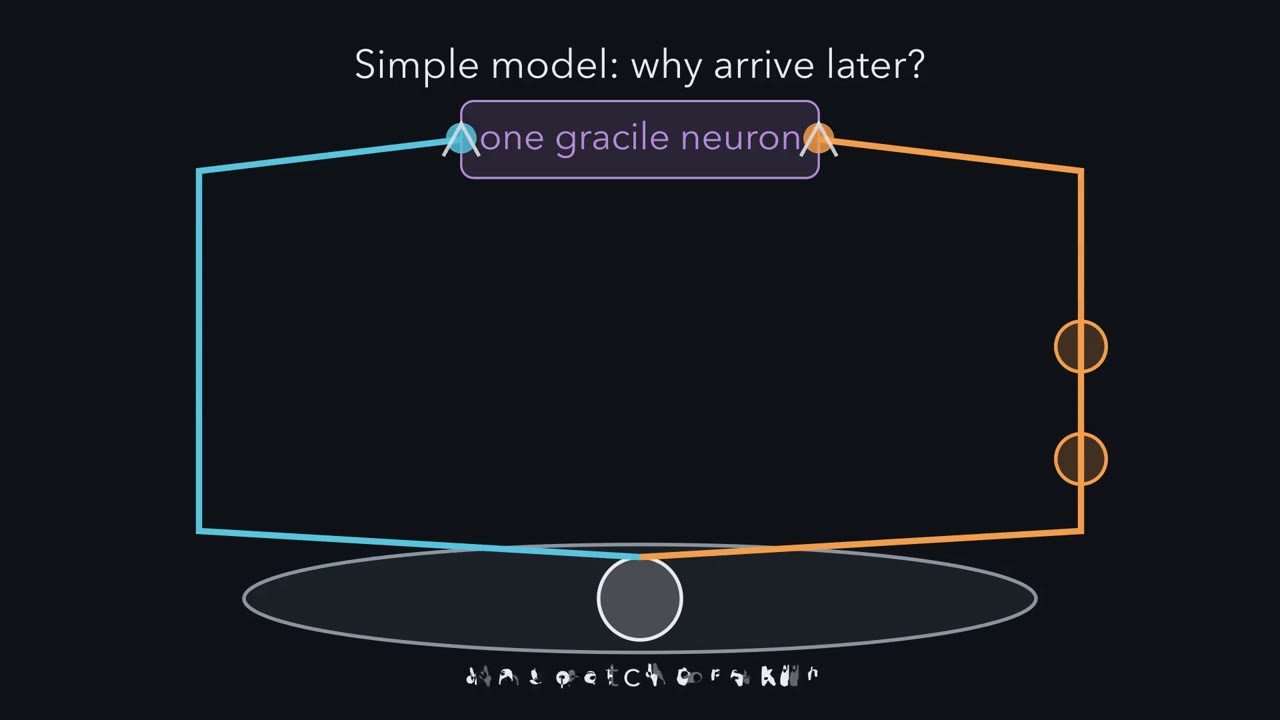
The brainstem can hear about one touch of the paw twice: directly, and again by a route through the spinal cord that, in a simple conduction model, arrives a few milliseconds later. What does the second report add?
Continue in the lesson: Where Touch Is First Processed: Dorsal Horn and Dorsal Column Nuclei →
2:19 · Free, with captions and a transcript. The lesson has the full text, the questions and the sources.
More films from this lesson
How this film was made. Narration: an AI narrator voice (Kokoro, af_heart) reading narration written from this lesson's text. Animation: AI-generated in code (Manim) by Claude, a schematic with no drawn molecular structures. Captions come from the narration script. See something wrong? Report it.