Reading the Wiring
Read the transcript of “Reading the Wiring”
Film transcript: Reading the Wiring
A starburst cell has branches pointing every way. Which ones inhibit a given ganglion cell? In 2002, Euler, Detwiler and Denk imaged calcium in single starburst dendrites, in rabbit retina. A dendrite gave larger calcium signals for motion outward from the cell body than for motion inward. Predict. The cell body sits where all the branches meet. What should its voltage show?
Little preference. Motion outward along one branch runs inward along the branch opposite it. A soma that simply summed equal spokes would see them cancel. The measured somatic voltage did not show the dendrites' preference. So the branch, not the cell, is the unit. Each branch has its own preferred direction, set by where it points. One limit here. A calcium signal is not transmitter release.
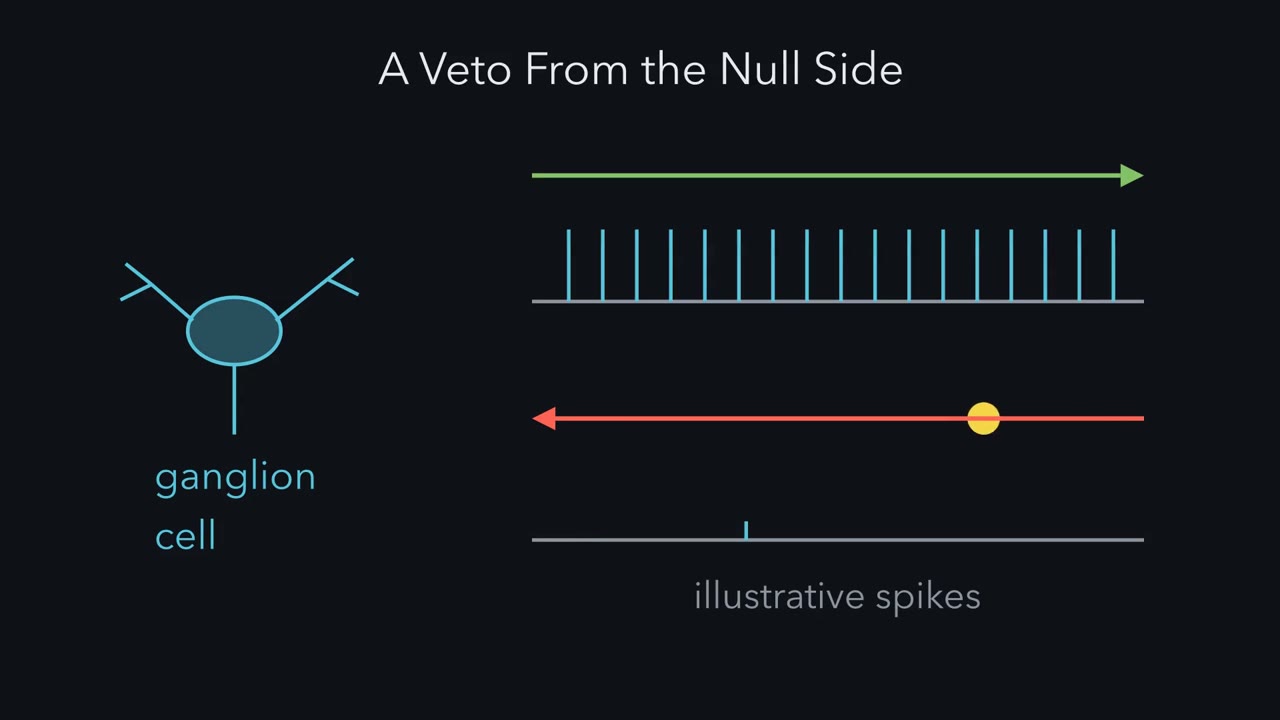
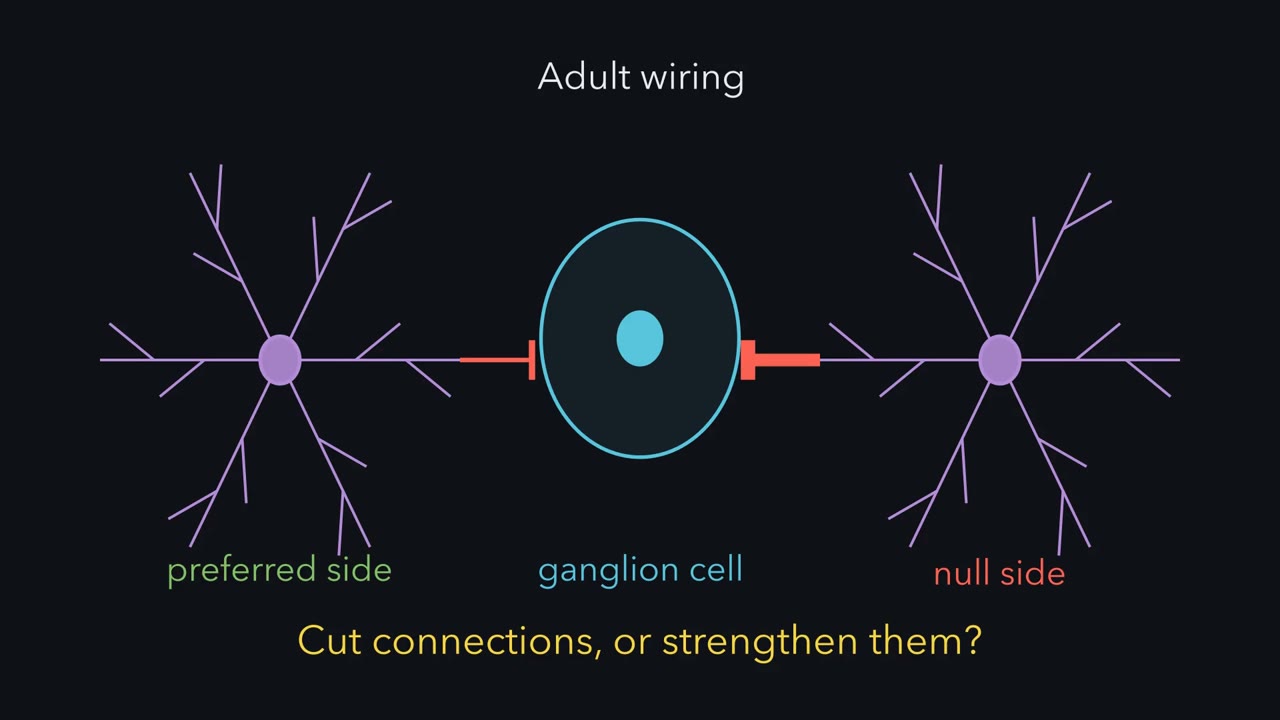
In that simple sum, input taken equally from every branch carries no direction signal. So the wiring should be selective. Paired recordings in rabbit had shown it. Branches pointing in a ganglion cell's null direction inhibited it, and preferred-pointing branches did not. In 2011, Briggman, Helmstaedter and Denk read the wiring directly, in mouse retina. First they imaged calcium during moving bars, to find each ganglion cell's preferred direction. Then they cut the same tissue for electron microscopy, and traced the cells and their contacts. Predict. Take a cell that prefers rightward motion. Which way should its contacting branches point?
Most starburst input came from branches pointing roughly left, in the null direction. And the direction of the individual branch predicted contact better than the line between cell bodies. One limit. A contact shows wiring, not synaptic strength. So the picture holds. Most starburst contacts come from branches pointing roughly in the cell's null direction.
A cell in the eye fires to a spot moving left and stays quiet for the same spot moving right. Which neuron makes the difference?
Continue in the lesson: Computing Motion in the Retina →
2:33 · Free, with captions and a transcript. The lesson has the full text, the questions and the sources.
More films from this lesson
How this film was made. Narration: an AI narrator voice (Kokoro, af_heart) reading narration written from this lesson's text. Animation: AI-generated in code (Manim) by Claude, a schematic with no drawn molecular structures. Captions come from the narration script. See something wrong? Report it.