The Sound That Comes Back
Read the transcript of “The Sound That Comes Back”
Film transcript: The Sound That Comes Back
Why would a healthy ear send sound back out? And what can a screening test learn from it? In 1978, Kemp played brief clicks into human ear canals and averaged the response. A slowly decaying sound remained after each click. In the ears tested with cochlear deafness, it was absent. Some emissions come from reflections of the travelling wave. Others come from the cochlea's nonlinearity. Picture a curve that acts on the sound wave instant by instant. It passes small inputs and flattens large ones. Feed it two tones, at 2,000 and 2,400 hertz. Predict. What comes out, besides the two tones you put in?
New tones. Where the two tones add up to a big peak, the curve squashes it. A cubic term mixes two of the first tone with one of the second. That makes 1,600 hertz, among other new tones. In ear-canal tests, that one is usually the largest.
Predict again. Play the same tones at a moderate level into a cochlea after death. What comes back? Usually little or nothing, at these levels. The living drive and amplification are gone. That does not mean every nonlinearity in the transduction channel has vanished. That is the one idea at work. The same vulnerable process gives the gain and makes the emission. A fast, saturating curve makes new tones whenever the input reaches its curved part. What ties this one to outer hair cells is that, at screening levels, it fails when they fail. A fast, saturating curve makes new tones when they fail. Newborn screening uses emissions. A pass shows outer hair cells can make an emission through the middle ear.
It does not show intact hearing. In auditory neuropathy, the brainstem response can be absent or very abnormal. One question stays open. How far along the cochlea is the gain gathered? A second tone can lower the response to first one. Changing its frequency changes where it acts, which helps map the gain. Take this with you. A living cochlea's nonlinearity makes new tones, and a microphone in the ear canal can hear them.
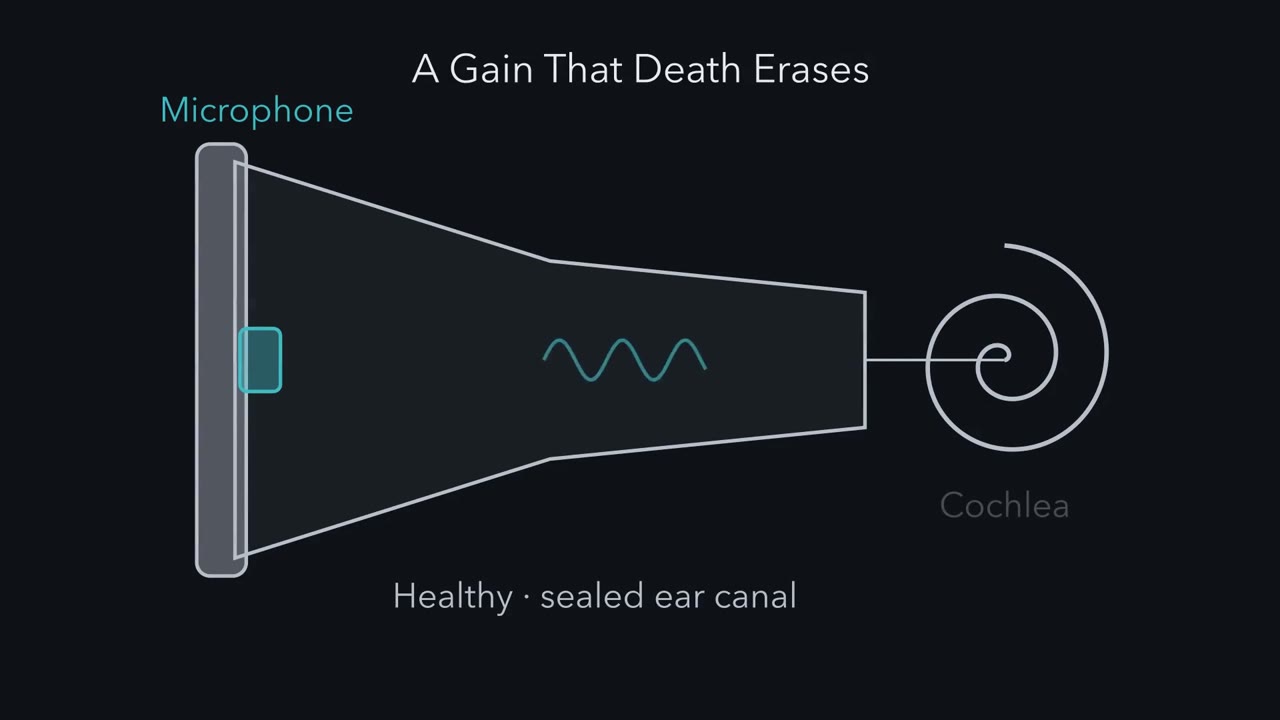
A microphone sealed in a healthy ear canal can record sound that your own cochlea made. What does that sound tell us about the amplifier, and what can it not tell us?
Continue in the lesson: The Cochlear Amplifier and Otoacoustic Emissions →
2:39 · Free, with captions and a transcript. The lesson has the full text, the questions and the sources.
More films from this lesson
How this film was made. Narration: an AI narrator voice (Kokoro, af_heart) reading narration written from this lesson's text. Animation: AI-generated in code (Manim) by Claude, a schematic with no drawn molecular structures. Captions come from the narration script. See something wrong? Report it.