From a Bent Bundle to a Pushing Cell
Read the transcript of “From a Bent Bundle to a Pushing Cell”
Film transcript: From a Bent Bundle to a Pushing Cell
How does one cell push on a sound wave, many thousands of times a second? The chain has five links. Sound bends the hair bundle back and forth. Bending toward the tallest stereocilia opens more transduction channels. Current flows in, so the voltage rises and falls with the bundle. The voltage moves charge inside prestin, which changes shape. The cell shortens and lengthens in step, and pushes on the organ of Corti. Why voltage? A 20 kHz tone completes a cycle every 50 microseconds. An amplifier working on every cycle cannot wait on a slow chemical step, such as ATP hydrolysis. Voltage has limits too. The membrane smooths fast voltage changes.
In simple estimates, its cutoff lies far below the highest frequencies basal cells amplify. How much that limits the amplifier is still argued. How can you watch prestin's charge move? Measure capacitance, the charge moved per change in voltage. In the simplest model, each prestin flips between two states, and voltage tilts the odds. So its charge moves along an S-shaped curve, mostly near its midpoint. The slope of an S peaks at its middle. So the extra capacitance is a bell, called nonlinear capacitance. Its steepness is set by z, the effective charge that moves per prestin. Predict. If z doubles, does the bell get wider or narrower?
Narrower. A larger z makes the S steeper. The width of the bell scales as one over z. Take the gerbil fit. At 50 mV above the midpoint, about 80% % of prestin is in the contracted state. The bell there is 64% % of its peak. This reads charge movement, not the force or power a hair cell produces. Structures of purified prestin suggest an area motor. But each is a candidate end state, not a working motor. Is the motor needed? In a prestin knock-in mouse, transduction and cell mechanics were normal. Yet amplification was lost. So the cell body's motility is necessary. In an excised frog organ, a hair bundle can also add energy. How the work is split between bundle and cell body in mammals has not been established.
Take this with you. Bundle, channel, voltage, prestin, push. The bell is the motor's electrical fingerprint.
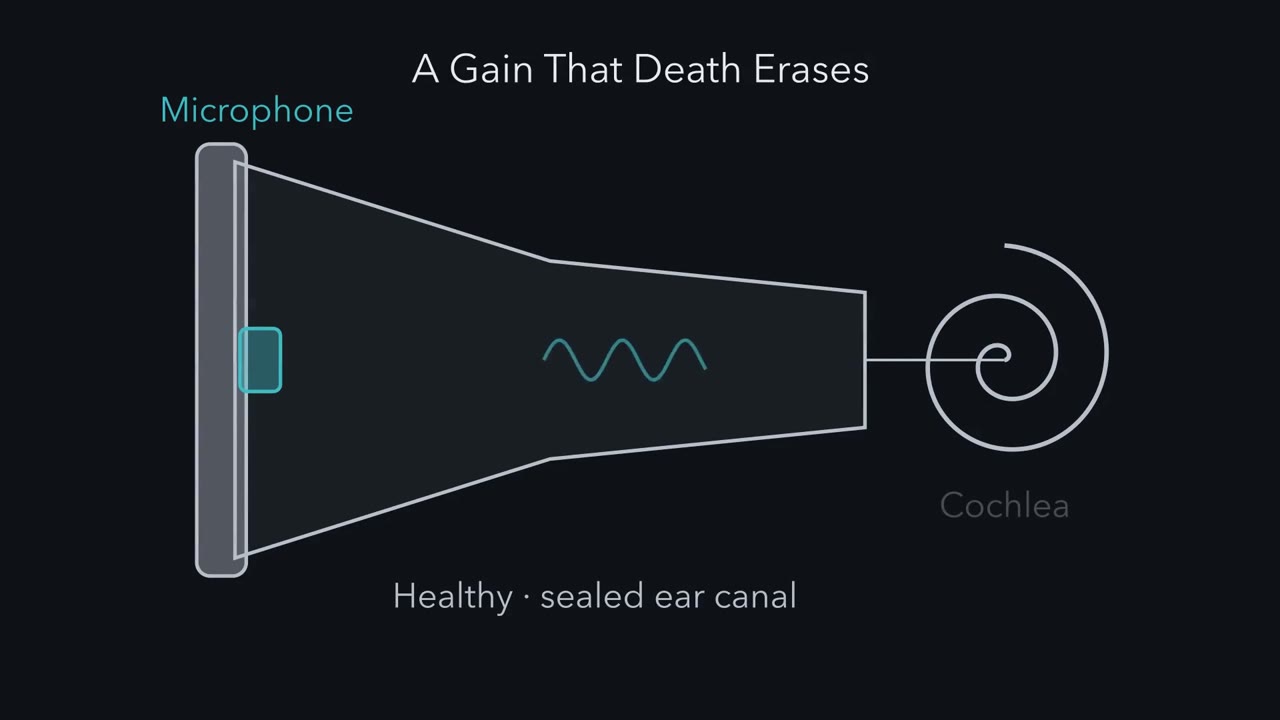
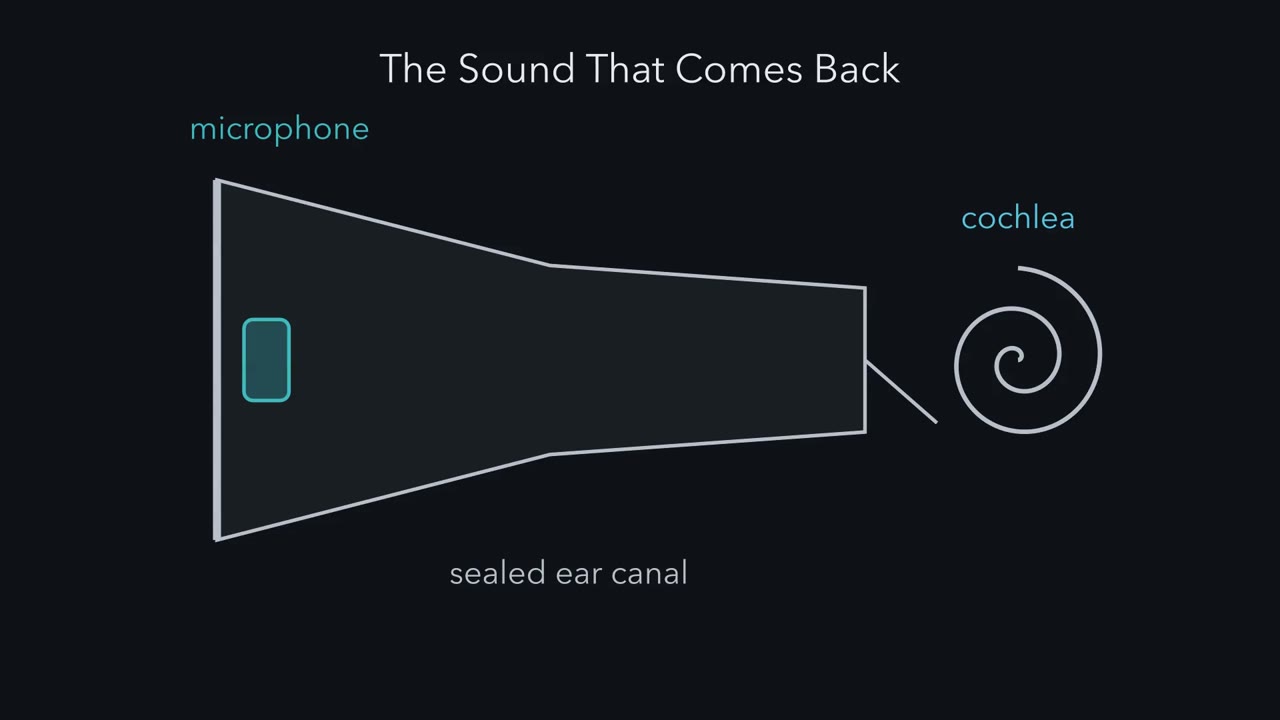
A microphone sealed in a healthy ear canal can record sound that your own cochlea made. What does that sound tell us about the amplifier, and what can it not tell us?
Continue in the lesson: The Cochlear Amplifier and Otoacoustic Emissions →
2:46 · Free, with captions and a transcript. The lesson has the full text, the questions and the sources.
More films from this lesson
How this film was made. Narration: an AI narrator voice (Kokoro, af_heart) reading narration written from this lesson's text. Animation: AI-generated in code (Manim) by Claude, a schematic with no drawn molecular structures. Captions come from the narration script. See something wrong? Report it.