Press play to start at .
The Roundabout Has Exits
From the film
- The cycle is amphibolic: it serves both breakdown and building.
- Citrate, alpha-ketoglutarate, succinyl-CoA and oxaloacetate are drawn off to build fatty acids, amino acids, heme and glucose.
- Each withdrawal takes carbon that would have become oxaloacetate, so without refilling the pool shrinks and the cycle slows.
- Anaplerosis refills the pool; in many tissues pyruvate carboxylase adds CO2 to pyruvate to make oxaloacetate, using ATP.
- Arriving acetyl-CoA switches pyruvate carboxylase on, a feedforward signal to build more platform.
Read the transcript of “The Roundabout Has Exits”
Film transcript: The Roundabout Has Exits
Tap a sentence to play from there.
- 0:00 Every turn of the roundabout rebuilds four-carbon oxaloacetate.
- 0:05 That makes it a reusable platform, not a fuel.
- 0:09 So here is a puzzle.
- 0:12 If the platform always comes back, why does the cell spend ATP to make more of it?
- 0:20 Because the roundabout has exits.
- 0:23 The cycle is amphibolic: it serves both breakdown and building.
- 0:29 Citrate leaves to make fatty acids.
- 0:32 Alpha α-Ketoglutarate becomes glutamate and other amino acids.
- 0:37 Succinyl-CoA builds heme.
- 0:39 Oxaloacetate itself feeds gluconeogenesis, the making of new glucose.
- 0:45 Each exit takes carbon that would have become oxaloacetate.
- 0:49 If nothing replaces it, the platform pool shrinks.
- 0:54 Citrate synthase, the step that starts each turn, is limited by oxaloacetate supply.
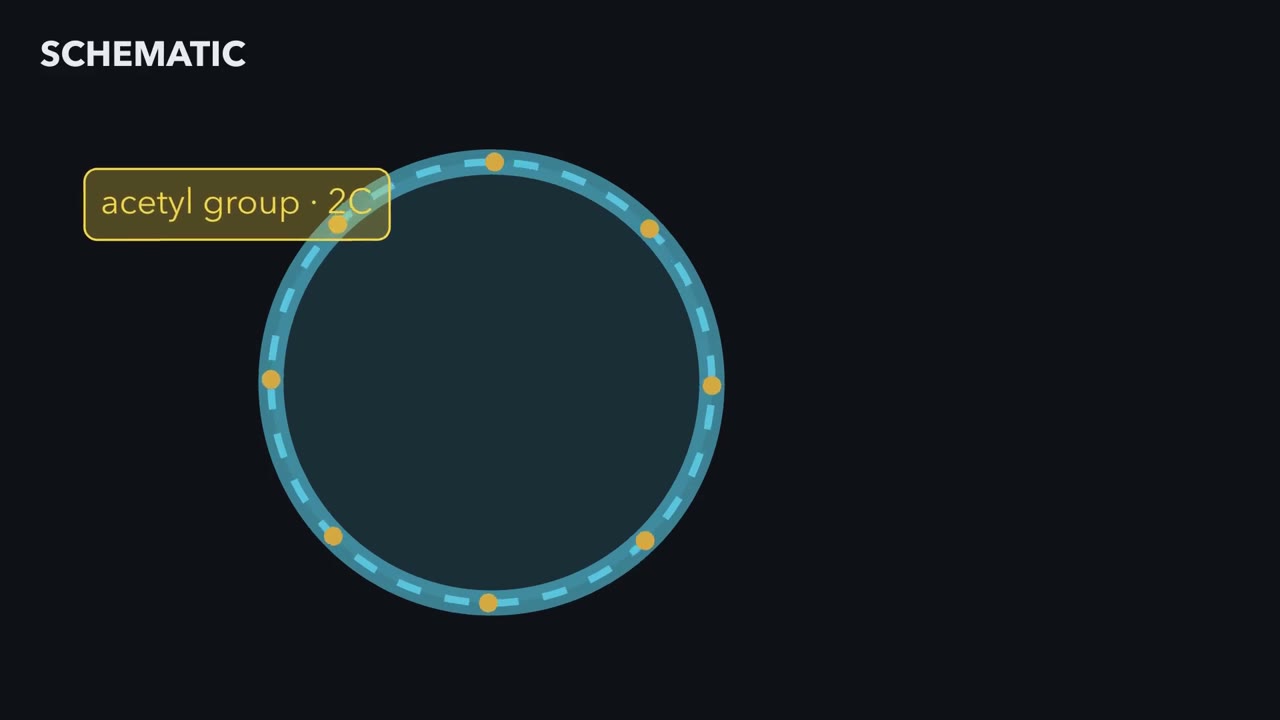
- 1:01 So fewer acetyl groups can merge.
- 1:03 The cycle slows, and fewer loaded carriers leave for the chain.
- 1:08 Hans Krebs saw this pool at work in minced pigeon breast muscle.
- 1:13 A pinch of a four-carbon acid made the muscle burn far more oxygen than that pinch could explain. Each added molecule joined the pool and carried many acetyl groups through.
- 1:27 Here is the guiding idea.
- 1:30 Oxaloacetate behaves as a catalyst only while nothing is drawn off.
- 1:35 Whatever leaves for building must be put back.
- 1:39 That refilling has a name: anaplerosis.
- 1:42 In many tissues, the chief refill enzyme is pyruvate carboxylase.
- 1:48 It adds CO₂ to pyruvate, making a new oxaloacetate.
- 1:53 The reaction uses ATP.
- 1:56 That is the ATP spent in the opening puzzle.
- 2:00 Now predict. Pyruvate carboxylase needs an on switch.
- 2:06 Which molecule, arriving at the roundabout's entrance, would make the most sensible signal to build more platform?
- 2:19 Acetyl-CoA, the incoming fuel.
- 2:23 When it is arriving, it switches pyruvate carboxylase on.
- 2:27 This is feedforward control.
- 2:30 The message reads: fuel is arriving, so build more of the platform.
- 2:35 Pyruvate carboxylase is not the only way in.
- 2:40 In dividing cells, glutamine is a major source.
- 2:44 So a working cycle is a busy hub.
- 2:47 Carbon leaves for building, refills come in, and the platform pool holds steady.
- 2:53 So the platform is reusable, but it is not untouchable.
- 2:57 The roundabout loads electron carriers and supplies builders at the same time.
- 3:03 What the builders take, anaplerosis must give back.
Citric acid cycle: the same idea, other levels
A level is a place to start, not a rank. If this loses you, the rung below teaches the same idea, told more simply.
College, upper level · the level you chose
The Citric Acid Cycle: Harvesting Electrons · this lesson
One turn: 3 NADH, 1 FADH₂, 1 GTP, 2 CO₂, and oxaloacetate comes back.
Biochemistry · about 25 min · film 3:31 · 3 practice questions
Next door
- Cellular respiration: Metabolism: Basic Concepts and Design The cycle is the middle stage of releasing the energy in food.
- Chemiosmosis: Electrons build a proton battery · 3:54 The electrons the cycle collects are cashed for ATP by a proton gradient.
- Glycolysis: Spend, Balance, Control · 2:37 Glycolysis supplies the pyruvate that feeds the cycle.
More films from this lesson
Continue in the lesson: The Citric Acid Cycle: Harvesting Electrons →
Free, with captions and a transcript. The lesson has the full text, the questions and the sources.
How this film was made. Narration: an AI narrator voice (Kokoro, af_heart) reading narration written from this lesson's text. Animation: AI-generated in code (Manim) by Claude, a schematic with no drawn molecular structures. Captions come from the narration script. See something wrong? Report it.