A Reflex Is Not the Hurt
Read the transcript of “A Reflex Is Not the Hurt”
Film transcript: A Reflex Is Not the Hurt
A paw pulls away from a touch. Does that tell you how much it hurts? Every behavioural result so far was a withdrawal threshold. A reflex is easy to mistake for pain. Corder and colleagues imaged neurons in the basolateral amygdala of male mice, across repeated sessions. One ensemble responded to noxious stimuli and encoded their unpleasantness. After a nerve injury, innocuous stimuli recruited the same ensemble.
Then they tagged those neurons genetically, and silenced them. Predict. With the ensemble silenced, does the paw still pull away? Yes. The withdrawal reflexes were preserved. But escape and avoidance fell. The reflex and the affective behaviour are two measurements, and they can come apart. This was male mice, in one model. In people, these cell-type manipulations cannot be done. So the human study here asks a different question: prediction. Baliki and colleagues scanned adults whose back pain was still subacute. A year later, they asked who still had pain.
Recovering meant a set drop in pain intensity. It did not mean pain-free. Stronger baseline connectivity between medial prefrontal cortex and nucleus accumbens predicted who persisted. That area is a pair-ordering probability. It is not a cause, and not one person's risk. The takeaway: in rodent models, the wiring, the cord and the immune cells all change. In mice, affective behaviour can be separated from the reflex. In people, we have association and prediction.
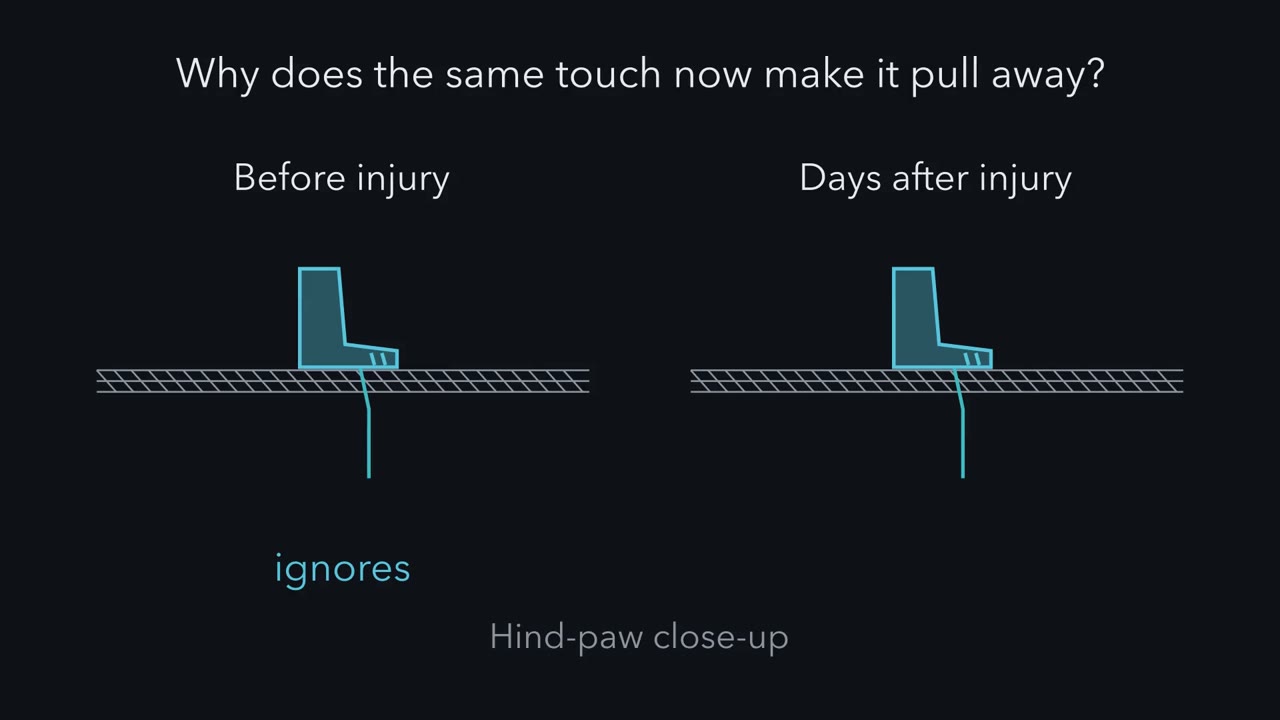
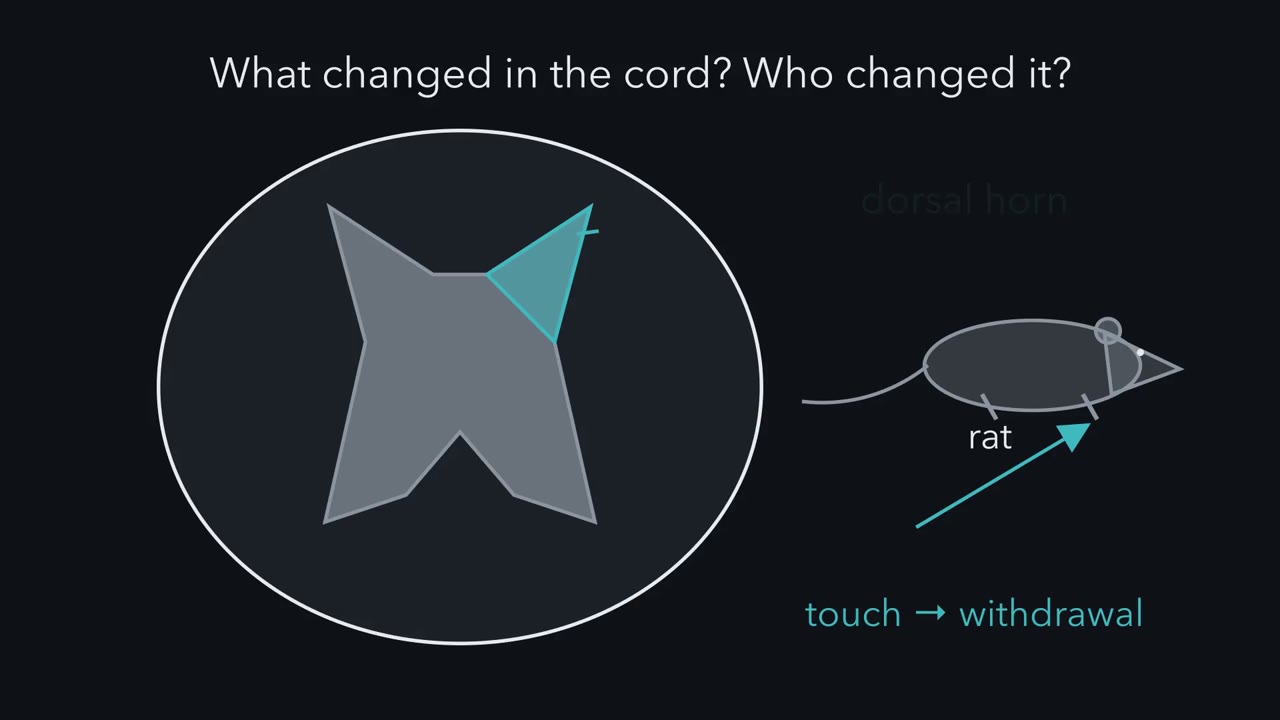
After a nerve injury, a touch the animal used to ignore makes it pull away, and it keeps doing so for weeks. Is persistent pain an alarm that never switched off, or a nervous system that has changed?
Continue in the lesson: When Pain Persists →
2:04 · Free, with captions and a transcript. The lesson has the full text, the questions and the sources.
More films from this lesson
How this film was made. Narration: an AI narrator voice (Kokoro, af_heart) reading narration written from this lesson's text. Animation: AI-generated in code (Manim) by Claude, a schematic with no drawn molecular structures. Captions come from the narration script. See something wrong? Report it.