Press play to start at .
Thrombin Needs a Surface
From the film
- The platelet plug anchors a procoagulant membrane at the breach, because activated platelets turn their phosphatidylserine outward.
- Tissue factor with factor VIIa makes only a trickle of thrombin, and tissue factor pathway inhibitor shuts that assembly down.
- The trickle is a signal: it activates platelets and cuts factors V, VIII and XI, building the machine that makes thrombin in bulk.
- IXa with VIIIa and Xa with Va work on the platelet membrane, where, on the usual estimate, well over 90 percent of a wound's thrombin is made.
- Antithrombin, sped up by a surface sugar on intact lining, leaves thrombin a reach of about one to five micrometres, an order-of-magnitude estimate rather than a measurement.
Read the transcript of “Thrombin Needs a Surface”
Film transcript: Thrombin Needs a Surface
Tap a sentence to play from there.
- 0:00 Last time, a global number came from a local reading: a kidney cell judged the oxygen in its own patch.
- 0:08 A cut seals in minutes, while the same clotting proteins flow through every healthy vessel untouched. Where is the line drawn?
- 0:20 The plug has already done one job.
- 0:23 It anchored a membrane at the breach: activated platelets turn their phosphatidylserine outward, and so become a procoagulant surface.
- 0:33 Tissue factor sits on cells beneath the lining, out of contact with blood until the wall breaks. Exposed, it binds factor VIIa, and that pair cuts factor X and factor IX. Factor Xa with Va makes a little thrombin.
- 0:51 Nowhere near enough to clot anything, and it does not last: tissue factor pathway inhibitor shuts that assembly down.
- 0:59 The trickle was never meant to clot blood.
- 1:02 It is a signal: it activates platelets and cuts factors V, VIII and XI.
- 1:08 Thrombin has built the machine that makes thrombin in bulk, and it assembles on the platelet membrane.
- 1:16 Factor IXa with VIIIa makes factor Xa, and Xa with Va cuts prothrombin.
- 1:22 On the usual estimate, well over 90 percent of a wound's thrombin is made there.
- 1:28 Here is the one idea.
- 1:31 Thrombin is made on surfaces, not in solution.
- 1:35 A clot grows where a surface holds the enzymes, and nowhere else.
- 1:39 The burst does the visible work.
- 1:43 Thrombin cuts fibrinogen to fibrin, a mesh through the plug.
- 1:47 It activates factor XIII, which cross-links the mesh against arterial pressure.
- 1:53 Thrombin made at the breach could drift downstream.
- 1:57 Antithrombin destroys it, and on intact lining a surface sugar speeds antithrombin up by a hundred to a thousandfold.
- 2:06 How far does thrombin get: a whole vessel, or a cell or two?
- 2:15 One to five micrometres.
- 2:18 One to a few cell thicknesses, from diffusion and decay rates: an order-of-magnitude estimate, not a measurement.
- 2:27 In open plasma the reach is tens of micrometres, and flow only shortens it.
- 2:33 More brakes belong to the intact lining.
- 2:36 Thrombomodulin turns thrombin into an activator of protein C, which inactivates factors Va and VIIIa.
- 2:45 Prostacyclin and nitric oxide keep passing platelets quiet, and later plasmin dissolves the fibrin.
- 2:52 Read it back. The plug puts a surface where the wall breaks, the trickle switches it on, the burst happens there.
- 3:01 That is why your finger clots while blood in your lung stays liquid.
Red blood cells: the same idea, other levels
A level is a place to start, not a rank. If this loses you, the rung below teaches the same idea, told more simply.
College, upper level · the level you chose
Blood Cells, Hematocrit and Clotting · this lesson
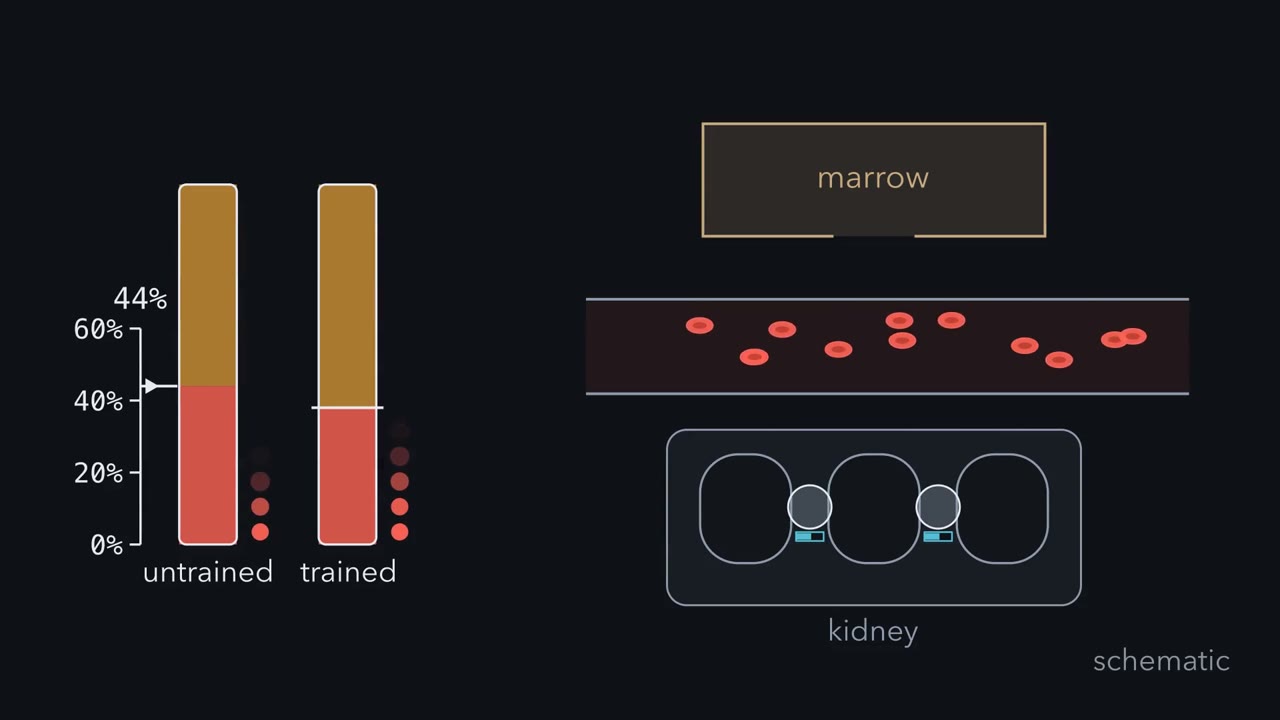
Training lowers hematocrit while red cell mass rises: plasma volume moves too.
Physiology · about 33 min · 4 practice questions
Next door
- Stem cells: How a Stem-Cell Pool Persists While Its Clones Come and Go · 3:48 · College: the core Stem cells in the bone marrow keep making new red blood cells, because each one wears out in months.
- Blood clotting: Blood Vessels, Blood and Lymph · Starting college Platelets, another kind of blood cell from the marrow, are what start the plug that seals a cut.
- Oxygen uptake and VO2max: Oxygen Uptake Is Flow Times Extraction · 2:50 More red cells carry more oxygen per litre of blood, which raises the oxygen a body can use.
More films from this lesson
Continue in the lesson: Blood Cells, Hematocrit and Clotting →
Free, with captions and a transcript. The lesson has the full text, the questions and the sources.
How this film was made. Narration: an AI narrator voice (Kokoro, af_heart) reading narration written from this lesson's text. Animation: AI-generated in code (Manim) by Claude, a schematic with no drawn molecular structures. Captions come from the narration script. See something wrong? Report it.