How a Stem-Cell Pool Persists While Its Clones Come and Go
Read the transcript of “How a Stem-Cell Pool Persists While Its Clones Come and Go”
Film transcript: How a Stem-Cell Pool Persists While Its Clones Come and Go
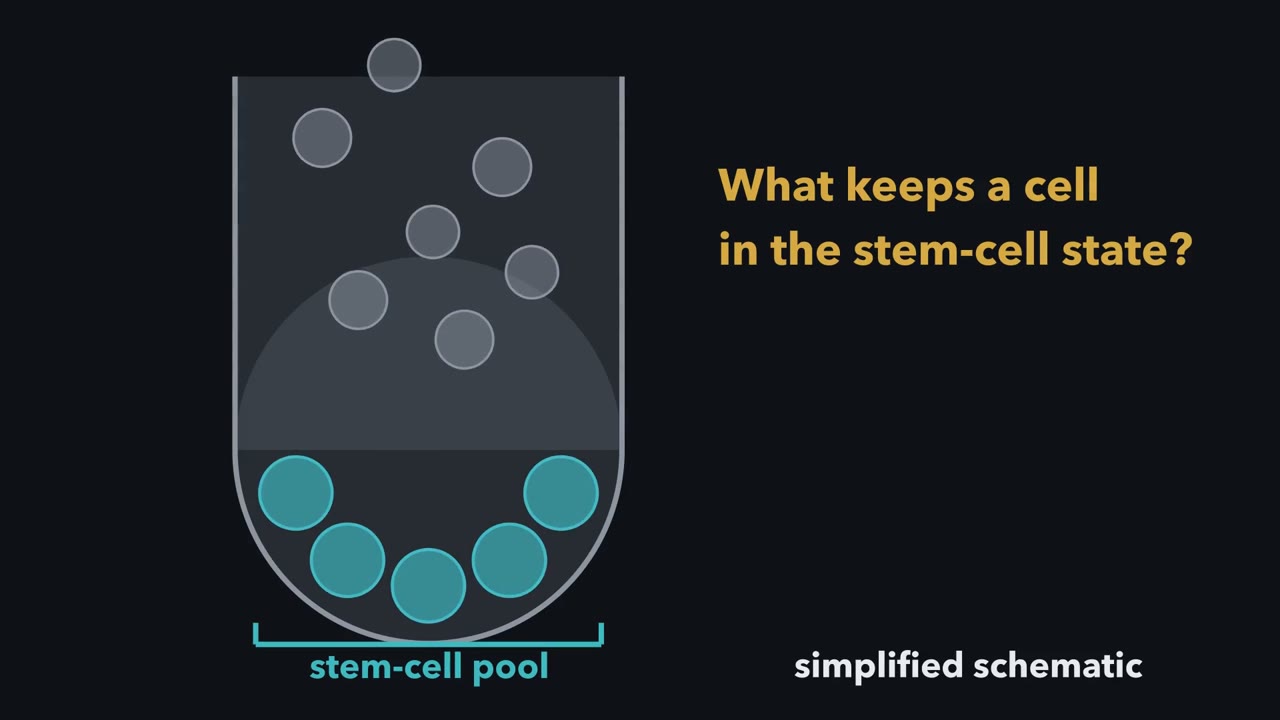
A mouse replaces its intestinal lining every few days. How can its stem-cell supply last when individual clones can vanish? Watch one crypt, the pocket where new lining cells begin. In this simplified picture, a handful of blue stem cells occupy the crypt base. The epithelium is the intestinal lining.
Cells need niche contact or signals to keep a base position. Stem cells have two jobs. First, they make specialized descendants that leave the base. Second, they maintain a stem-cell pool over time. Neighbours can fill positions as cells leave, so the pool may persist without preserving every cell. Shape or Lgr5 expression alone cannot prove those jobs.
Scientists give one expressing cell a permanent green lineage mark. Every daughter inherits green, even after it stops expressing Lgr5. The mark follows ancestry. Suppose the marked cell is only a short-lived precursor, a cell with limited output. What should happen to green after its descendants leave the lining?
A short-lived clone would fade away. Instead, observed green ribbons persisted for sixty days and contained every epithelial lineage. A lineage is a descendant family. That is multipotent output: several cell types within one tissue. But a long-lived ribbon does not mean its first green cell survives forever. The trace identifies a stem-cell population through descendant output over time. What descendants do, not a marker alone, supplies the evidence. Now give nearby stem cells permanent Confetti colours: green, yellow, red and cyan. In normally renewing mouse small intestine, Lgr5-high cells divide about once daily. Most divisions are symmetric.
Here that means both daughters retain stem positions, or both leave them. The clones appear to compete for niche-supported positions. Green expands when red leaves. Red disappears. Later, cyan pushes into green positions.
Colour shares change while the total pool stays constrained. Repeated replacements erase most colours and expand another until one clone fills the base. Different repeats produce different winners. The result is takeover by one clone, not survival of every starting clone. The number of supported positions stays roughly constrained while clone identities change. Balance belongs to the population, not every division. No cell is appointed the permanent winner. This pattern is neutral drift: chance competition among equivalent lineages. So follow descendants over time. During normal mouse-gut renewal, the pool can make specialized cells while most clones vanish and one may take over.
The population persists even as its membership changes. A stable stem-cell pool persists while most of its clones vanish.
The lining of a mouse's small intestine is replaced every few days, yet it lasts for life. Stem cells do it by making new specialized cells while keeping up their own numbers. How would you prove which cells are the stem cells, and what keeps them that way?
Continue in the lesson: Stem Cells and Tissue Renewal →
3:43 · Free, with captions and a transcript. The lesson has the full text, the questions and the sources.
More films from this lesson
How this film was made. Narration: written from this lesson's text and read by an AI narrator voice (Kokoro, af_heart). Animation: AI-generated in code (Manim) by Claude, a schematic with no drawn molecular structures. Captions come from the narration script. See something wrong? Report it.