A Ramp to a Bound
Read the transcript of “A Ramp to a Bound”
Film transcript: A Ramp to a Bound
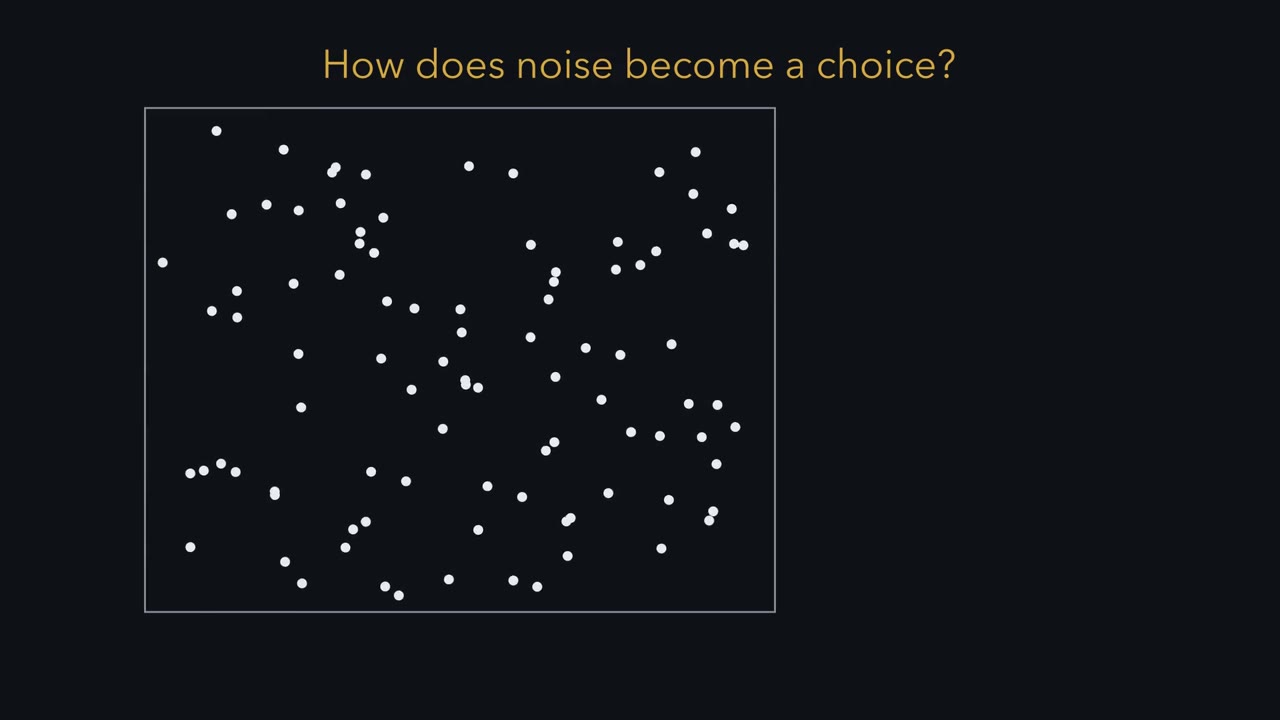
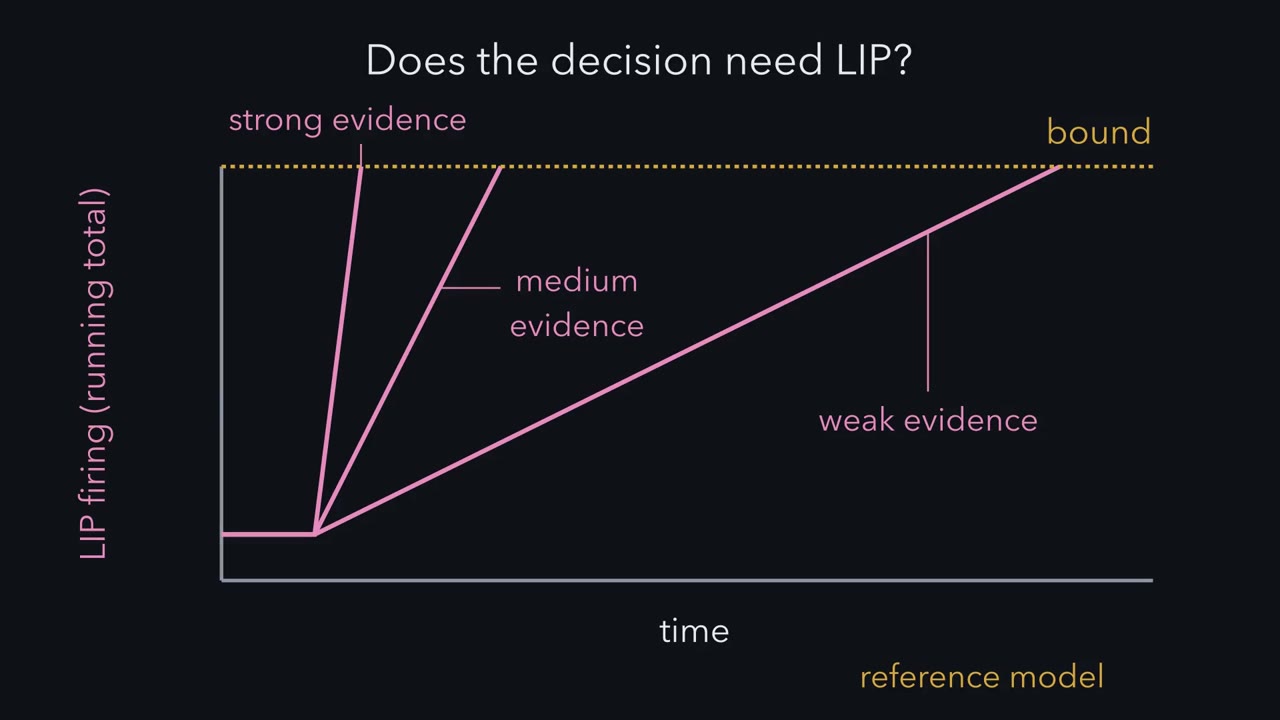
When should a brain stop collecting evidence and commit to an answer? The evidence comes from MT, the middle temporal area, whose neurons are tuned to direction. What adds it up? The simplest rule is a bound. Keep adding until the running total reaches a set level, then act. Picture a graph, with time along the bottom and the running total up the side. The total drifts upward. Stronger motion means a steeper drift, so the total reaches the bound sooner. Noise adds a wobble. On some trials the total arrives early, and on others late. For a choice between two directions, draw a second bound below the start, for the other answer. On weak-motion trials, the wobble sometimes carries the total to the wrong bound.
That is an error. This is a drift-to-bound model. Suppose some neuron held this running total. What would its firing do just before the eye moves? trials choosing the target this neuron represents, it should climb, more steeply when the motion is strong. And it should reach about the same level just before the eye moves. The other choice has a different endpoint. Now the data. Roitman and Shadlen recorded from the lateral intraparietal area, or LIP, in rhesus monkeys. Its neurons fire before an eye movement to a target in their response field.
Averaged over many trials, the lines lie together for the first 200 milliseconds or so. Then they ramp. The ramp is steeper for stronger motion when the monkey chose the target in the response field. Lined up to the eye movement, the firing reaches about the same rate, whatever the motion strength. The authors read this as an apparent threshold.
These are averages over many trials. Single trials may look different. Noise also changes the timing. At weak motion, the wobble carries many trials to a bound early, sometimes the wrong one. With two bounds, you never wait forever. So mean times are shorter than a noiseless model predicts. Now move both bounds farther from the start. Choices get slower, and more accurate wherever there is net motion.
The slowing is biggest at weak motion, where the wobble, not the drift, sets the time to the bound. A decision can be a running total that stops at a bound. The bound sets the trade between speed and accuracy.
On average, a parietal neuron's firing climbs toward a similar level just before a monkey announces its choice. In one study, silencing that area left the choice no worse. What was the neuron doing?
Continue in the lesson: Attention, Executive Control and Decisions →
3:10 · Free, with captions and a transcript. The lesson has the full text, the questions and the sources.
More films from this lesson
How this film was made. Narration: an AI narrator voice (Kokoro, af_heart) reading narration written from this lesson's text. Animation: AI-generated in code (Manim) by Claude, a schematic with no drawn molecular structures. Captions come from the narration script. See something wrong? Report it.