Adding Up Noisy Evidence
Read the transcript of “Adding Up Noisy Evidence”
Film transcript: Adding Up Noisy Evidence
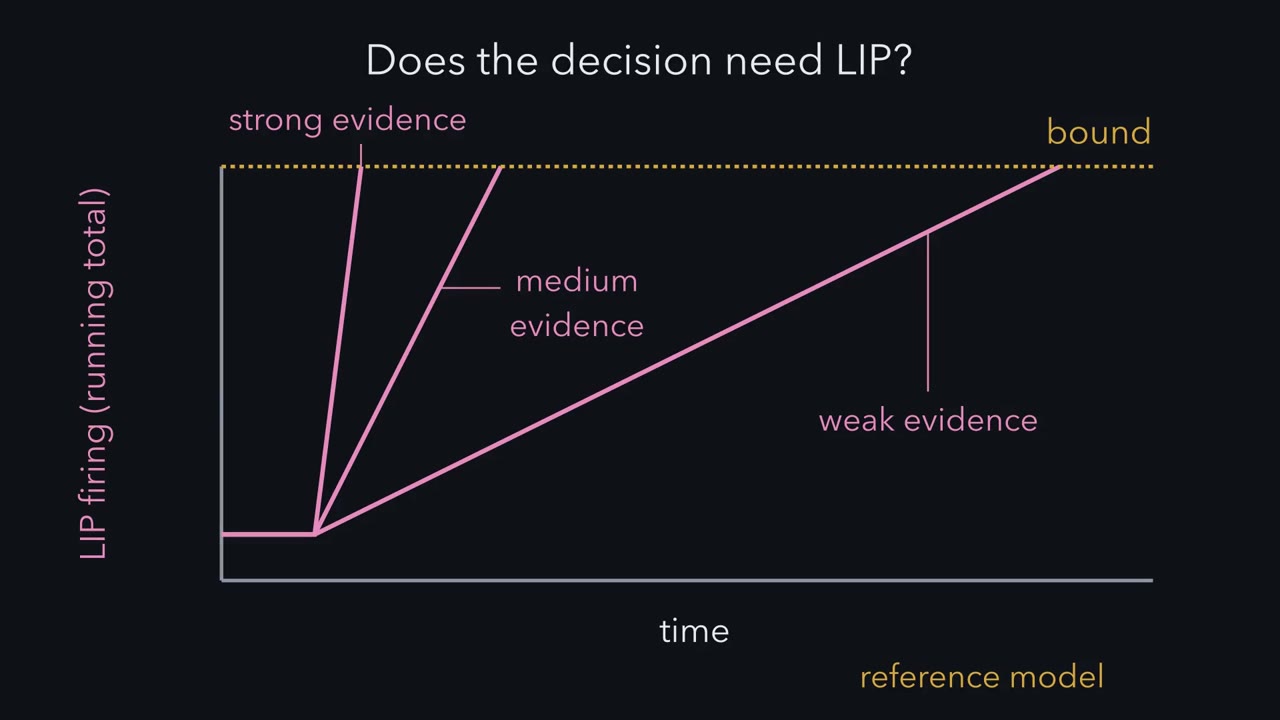
A monkey watches a cloud of moving dots. It must decide which way they are going. How does it turn noise into a choice? Some dots move together, and the rest move at random. The share moving together is called coherence. The monkey answers with a quick eye movement to one of two targets, whenever it is ready. Stronger motion gives faster and more accurate choices. With no net motion at all, the choices fall to chance. Meanwhile, averaged over many trials, a neuron in its parietal cortex fires faster and faster. Is it making the decision? Hold that question. Any single moment of the dots tells you very little. Each glimpse is a weak hint, buried in noise.
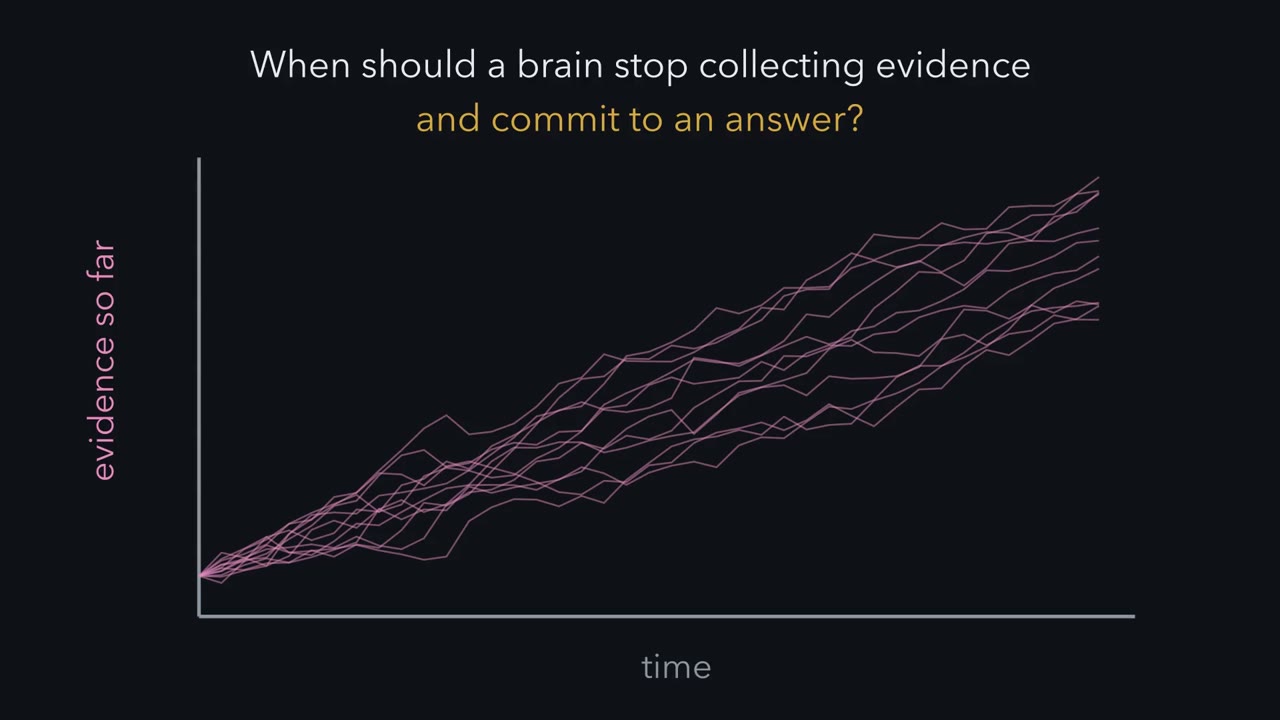
So keep a running total. Count each glimpse toward one direction or the other. Hints toward the true direction pile up in step. The random jiggle points every which way, so it partly cancels. Here is a question. You watch four times as long. Is your running total four times as reliable?
No. It is only twice as reliable. The signal grows in step with time. The noise grows too, but only as the square root of time. Assume each glimpse carries the same average signal, with independent noise of the same spread. Reliability here means signal divided by that spread. It grows as the square root of the samples added. That explains the behaviour. Weak motion gives a small push per glimpse, so the total takes longer to become trustworthy. Waiting longer buys accuracy and costs time. So a brain that adds up evidence needs a rule for when to stop. The same arithmetic works across neurons. It helps explain why some effects of attention matter.
The lesson returns to that. Adding up noisy evidence makes it more reliable, because the signal adds in step while the noise partly cancels.
On average, a parietal neuron's firing climbs toward a similar level just before a monkey announces its choice. In one study, silencing that area left the choice no worse. What was the neuron doing?
Continue in the lesson: Attention, Executive Control and Decisions →
2:17 · Free, with captions and a transcript. The lesson has the full text, the questions and the sources.
More films from this lesson
How this film was made. Narration: an AI narrator voice (Kokoro, af_heart) reading narration written from this lesson's text. Animation: AI-generated in code (Manim) by Claude, a schematic with no drawn molecular structures. Captions come from the narration script. See something wrong? Report it.