Press play to start at .
One Missing Enzyme
From the film
- In the adrenal cortex, one shared trunk from cholesterol branches toward aldosterone, cortisol and mostly weak androgens, and 21-hydroxylase sits on the routes to cortisol and aldosterone only.
- Read any adrenal state in three steps, in this order: the enzymes, then what the steroids present can do at a receptor, then the loops.
- In classic salt-wasting 21-hydroxylase deficiency, cortisol and aldosterone fall and 17-hydroxyprogesterone piles up just before the block.
- Low cortisol releases the brake on ACTH, and the extra flow spills into the androgen branch, so androgens rise.
- With too much ACTH, androgens rise with cortisol; a cortisol-producing adrenal adenoma suppresses ACTH, so the androgen-making zone goes quiet.
Read the transcript of “One Missing Enzyme”
Film transcript: One Missing Enzyme
Tap a sentence to play from there.
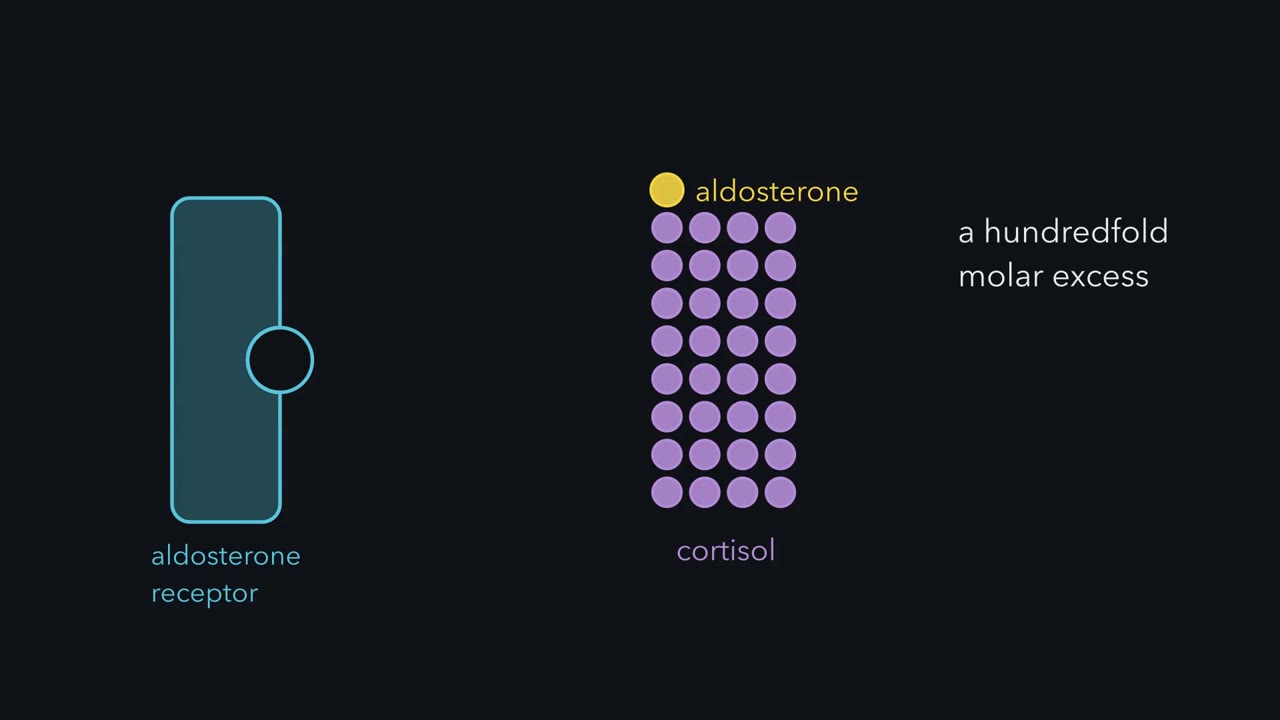
- 0:00 An enzyme beside the kidney's receptor decides which steroid reaches it.
- 0:06 Inside the adrenal gland, enzymes decide which steroids get made.
- 0:12 Some newborns lack one of those enzymes.
- 0:15 Yet one kind of hormone rises.
- 0:18 How can losing an enzyme make more hormone?
- 0:24 In the adrenal cortex, steroids grow like a tree.
- 0:29 Cholesterol enters one shared trunk, and ACTH speeds that slow first step.
- 0:35 Three branches leave it, ending in aldosterone, cortisol and mostly weak androgens.
- 0:41 One enzyme, 21-hydroxylase, sits on the routes to cortisol and aldosterone.
- 0:48 The androgen branch does not need it.
- 0:51 Read any adrenal state in three steps, in this order.
- 0:56 One, the enzymes: a missing enzyme lowers everything after it, and backs up what comes just before.
- 1:03 Two, the receptors: what can the steroids now present do?
- 1:08 Three, only then, the loops.
- 1:10 Take classic salt-wasting 21-hydroxylase deficiency, where enzyme activity is near zero. Step one. Cortisol and aldosterone fall.
- 1:23 17-hydroxyprogesterone, the substrate just before the block, piles up.
- 1:29 It is the screening marker.
- 1:32 Step two. Nothing that piles up can replace aldosterone, because the block comes before the precursor that acts like aldosterone.
- 1:43 Worse, backed-up progesterone and 17-hydroxyprogesterone weakly block the mineralocorticoid receptor.
- 1:51 They can add to the salt loss.
- 1:54 Step three, the loops.
- 1:56 Low cortisol releases the brake on ACTH, which drives the shared trunk harder.
- 2:03 The extra flow spills into the one branch still open: the androgens.
- 2:08 They rise, and long ACTH drive enlarges the gland.
- 2:13 Meanwhile sodium is lost, so volume and pressure fall.
- 2:17 Now use the rule on two adults who both make too much cortisol.
- 2:23 In one, the pituitary makes too much ACTH.
- 2:27 In the other, an adrenal adenoma makes cortisol on its own.
- 2:32 Which way do the adrenal androgens go in each?
- 2:40 With too much ACTH, the whole trunk is driven, so androgens rise with cortisol.
- 2:47 The adenoma's cortisol suppresses ACTH.
- 2:51 The androgen-making zone goes quiet with it, so androgens fall.
- 2:56 Both have high cortisol, yet their androgens move in opposite directions.
- 3:02 The difference is step three, the loops.
- 3:05 So start where the pathway breaks.
- 3:08 Then ask what the steroids left behind can do.
- 3:12 Let the feedback respond last.
- 3:15 This rule predicts each level's direction compared with a healthy person, not its size.
The adrenal glands: the same idea, other levels
A level is a place to start, not a rank. If this loses you, the rung below teaches the same idea, told more simply.
College, upper level · the level you chose
The Adrenal Cortex and Medulla · this lesson
Zones decide what is made; 11-beta-HSD2 keeps cortisol off the aldosterone receptor.
Physiology · about 30 min · film 2:34 · 4 practice questions
Next door
- Pituitary hormone chains: Two Ways Out: Blood and Wires · 3:03 Cortisol is made when a pituitary hormone calls for it, and cortisol then feeds back to turn that call down.
- Blood sugar control: How the body switches fuels · 2:32 Cortisol and adrenaline raise blood sugar when the body is under stress, pushing against what insulin does.
- Potassium balance: Potassium on Two Clocks · 3:16 The adrenal salt hormone aldosterone makes the kidney keep sodium and give up potassium.
More films from this lesson
Continue in the lesson: The Adrenal Cortex and Medulla →
Free, with captions and a transcript. The lesson has the full text, the questions and the sources.
How this film was made. Narration: an AI narrator voice (Kokoro, af_heart) reading narration written from this lesson's text. Animation: AI-generated in code (Manim) by Claude, a schematic with no drawn molecular structures. Captions come from the narration script. See something wrong? Report it.