Press play to start at .
Pushing the Same Way
From the film
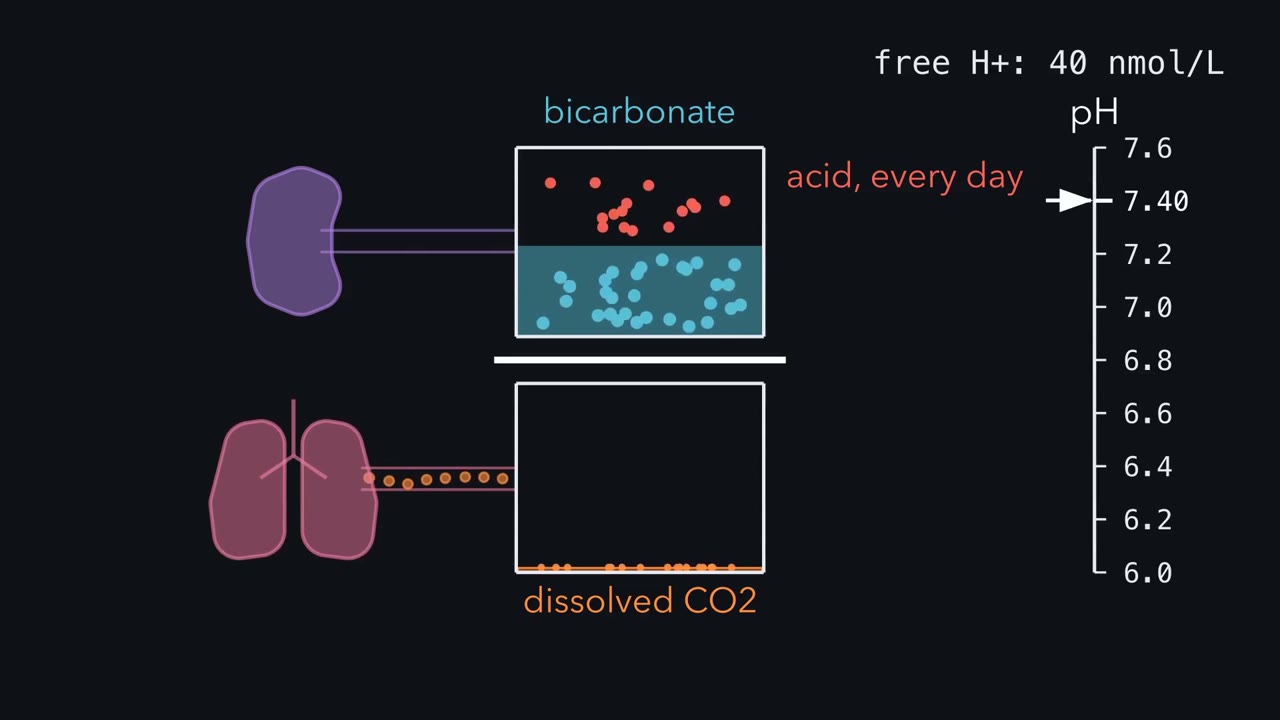
- In a metabolic acidosis bicarbonate falls first; within minutes breathing deepens and carbon dioxide falls too, reaching its full extent over about 12 to 24 hours.
- Compensation moves the other term in the same direction, so the ratio heads back toward 20.
- It is usually partway, sometimes nearly all the way in chronic respiratory disorders, and never past pH 7.4.
- For metabolic acidosis, Winter's formula expects a pCO2 of 1.5 times bicarbonate plus 8, give or take 2; it is a fitted line with scatter, not a law.
- Numbers moving in opposite directions, or a compensation far off the fit, mean two things are going on at once.
Read the transcript of “Pushing the Same Way”
Film transcript: Pushing the Same Way
Tap a sentence to play from there.
- 0:00 Plasma pH follows one ratio.
- 0:04 The lungs keep its bottom; the kidney keeps its top.
- 0:08 When a disturbance pushes one term, what does the other keeper do?
- 0:15 If carbon dioxide moves first, the disturbance is respiratory.
- 0:20 If bicarbonate moves first, it is metabolic.
- 0:24 Take a metabolic acidosis: bicarbonate falls from 24 to 12.
- 0:30 Dissolved CO2 is 0.03 times its pressure.
- 0:35 At 40 mmHg, that is 1.2.
- 0:40 Hold it there, and the ratio drops to 10 to 1.
- 0:44 pH would fall to 7.1.
- 0:47 But within minutes, breathing begins to deepen, and carbon dioxide falls too.
- 0:53 It reaches its full extent over about 12 to 24 hours.
- 0:58 Both terms fall, so the ratio climbs back toward 20.
- 1:03 In this made-up patient, CO2 settles at 27 mmHg.
- 1:09 That leaves 0.81 dissolved.
- 1:13 The ratio is 14.8, and pH is 7.27.
- 1:18 Full repair would mean 20 to 1 again.
- 1:22 With bicarbonate at 12, how low would CO2 need to fall, in mmHg?
- 1:34 To 20 mmHg. The lungs stopped at 27.
- 1:40 They bought back about 0.17 of a pH unit, but not all of it.
- 1:45 Here is the one idea.
- 1:49 Compensation moves the other term in the same direction as the first.
- 1:53 The ratio heads back toward 20, usually partway.
- 1:58 Sometimes, in chronic respiratory disorders, it gets nearly all the way.
- 2:04 It never carries pH past 7.4.
- 2:07 For metabolic acidosis, Winter's formula expects 1.5 times bicarbonate, plus 8, give or take 2. Here, that is 24 to 28, so 27 fits.
- 2:21 It is a line fitted to people, with scatter, not a law.
- 2:25 When CO2 rises first, the kidney answers the same way.
- 2:31 At once, buffering raises bicarbonate about 1 mmol/L for every 10 mmHg.
- 2:39 Over days, the kidney makes new bicarbonate, about 5 per 10, in one study.
- 2:45 Full repair would need 6.
- 2:48 So read a blood gas against this rule.
- 2:51 Numbers moving in opposite directions, or a compensation far off the fit, mean two things are going on at once.
- 2:59 So the lungs answer a metabolic push, and the kidney answers a respiratory one.
- 3:05 Each pulls pH back toward 7.4, and neither overshoots.
Acid-base balance: the same idea, other levels
A level is a place to start, not a rank. If this loses you, the rung below teaches the same idea, told more simply.
College, upper level · the level you chose
Acid-Base Balance · this lesson
Bicarbonate to dissolved CO2 near 20 to 1 sets pH; lungs fast, kidney slow.
Physiology · about 31 min · 6 practice questions
Next door
- pH and buffers: Water, Weak Bonds, and the Generation of Order Buffers are the first defence that keeps blood pH steady, before the lungs and kidneys adjust it.
- Carrying carbon dioxide: Carrying Oxygen and Carbon Dioxide · Starting college Most carbon dioxide travels in blood as bicarbonate, the same partner that holds blood pH steady.
- Control of breathing: Carbon Dioxide Sets the Breath · 3:09 Breathing faster or slower changes how much carbon dioxide stays in blood, which moves its pH within minutes.
More films from this lesson
Continue in the lesson: Acid-Base Balance →
Free, with captions and a transcript. The lesson has the full text, the questions and the sources.
How this film was made. Narration: an AI narrator voice (Kokoro, af_heart) reading narration written from this lesson's text. Animation: AI-generated in code (Manim) by Claude, a schematic with no drawn molecular structures. Captions come from the narration script. See something wrong? Report it.