Biology · Skim version
Water and Life
Read the full lesson → Skim the whole course →
The guiding idea
On a hot July day in the Chesapeake Bay, why did the air swing by about 8 degrees Celsius while the water changed by less than 1.5?
A water molecule is bent and polar, so its charged ends tug on its neighbors, on ions and on other polar molecules.
From the film: One Tug, Many Jobs
- A water molecule is bent and polar: its oxygen end is slightly negative and its hydrogen ends slightly positive.
- A hydrogen bond is the weak pull between the hydrogen of one water molecule and the oxygen of a neighbor; these keep breaking and re-forming, while the covalent bonds inside each molecule stay put.
- Water's charged ends pull the ions of salt off the crystal, but leave mostly nonpolar oil in its own drop.
- Water sticks to itself (cohesion); at the surface this gives surface tension, and the surface is still liquid, not a skin.
- Water sticks strongly to polar surfaces such as paper (adhesion) but only weakly to water-repellent ones; adhesion plus cohesion give capillary action.
From the film: Where the Sunshine Goes
- Temperature reflects the average energy of motion of a substance's particles.
- Per gram, water needs about five times as much energy as dry sand to warm by one degree: its specific heat is high.
- Warming water also stretches and rearranges its web of hydrogen bonds, which takes extra energy, so each degree costs water more.
- Heat capacity is mass times specific heat: under the same heater, a bathtub of water warms far more slowly than a cup.
- Each gram of water warms slowly; a whole bay, which also mixes its warmth downward and loses some by evaporation, warms slower still.
-
Explore: heat water and sand side by side
-
Explain: a molecule with charged ends
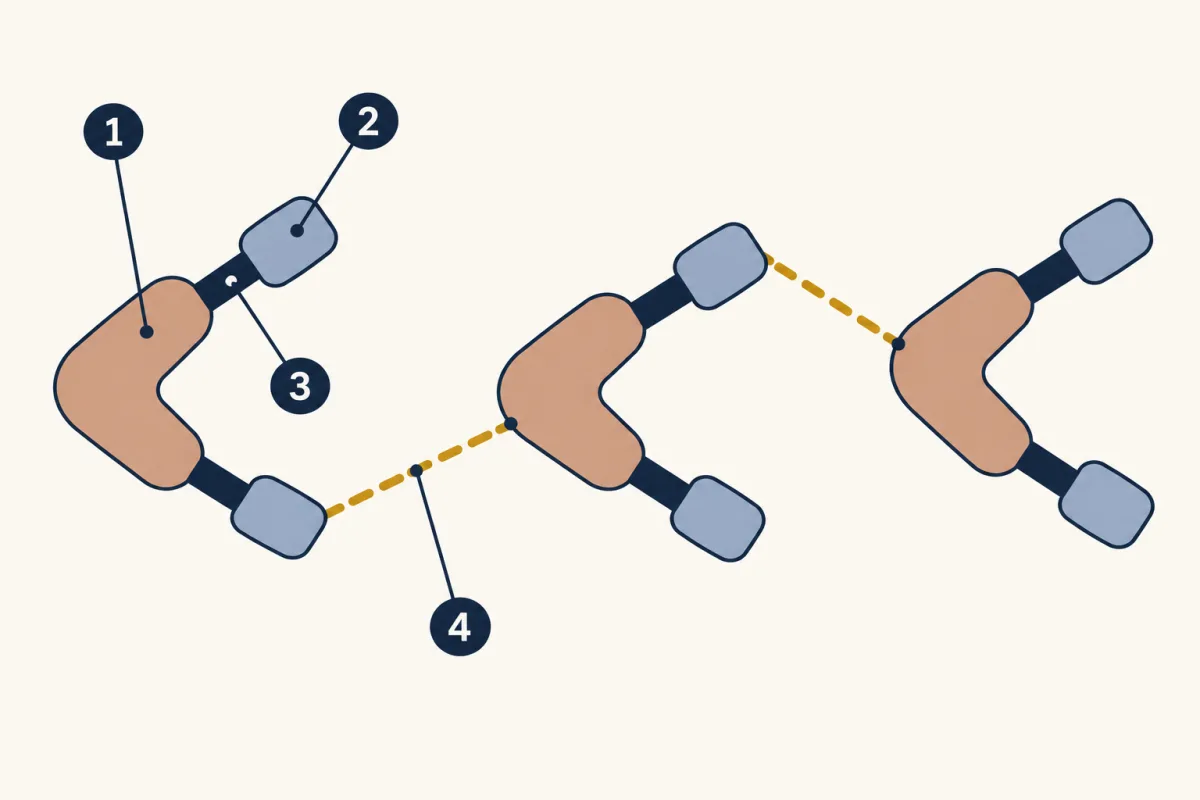
- oxygen end
- hydrogen end
- covalent bond
- hydrogen bond
-
Explain: dissolving, sticking and climbing
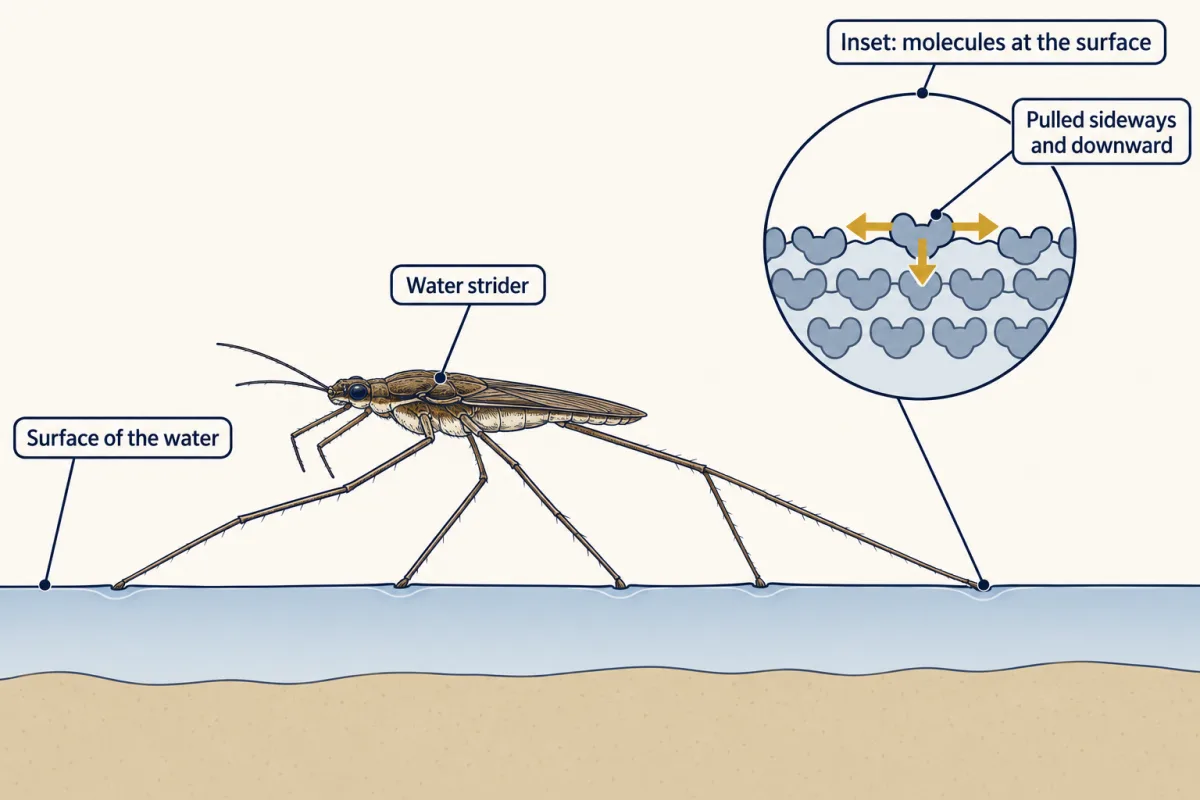
At the surface each water molecule is pulled sideways and downward by its neighbours. That pull, together with legs covered in tiny water-repellent hairs, is why a small strider can stand on a pond; the water is still liquid, not a skin. AI-generated illustration 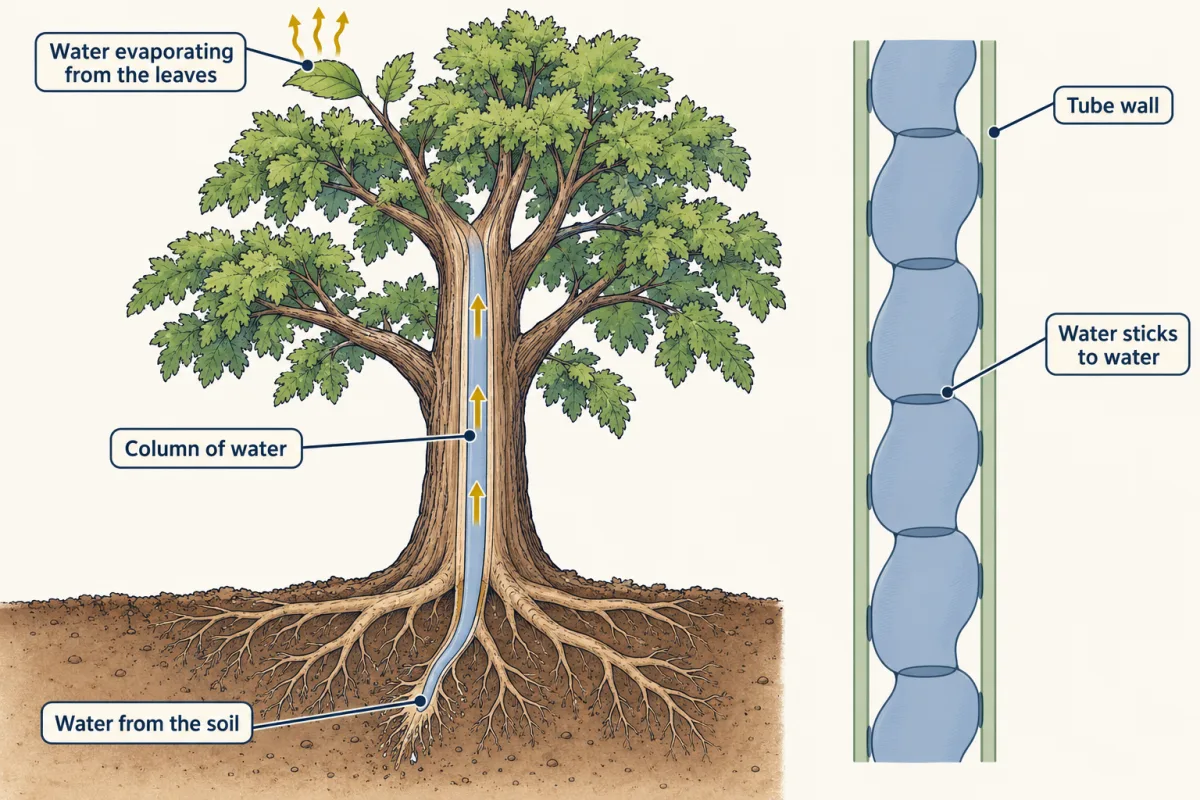
Water leaving a leaf pulls the next molecules up behind it, and cohesion keeps the column from breaking. Adhesion to the tube walls helps hold it in place. AI-generated illustration -
Explain: why the Bay barely warmed
-
Elaborate: air and water at a Bay buoy
-
Evaluate: check your thinking
-
Going deeper
Where this lesson fits
After thisStudy next
- What Am I Made Of?This course · Lesson 2
Polarity and water's pull on polar molecules explain how small building blocks join and how big molecules behave in water.
- Crossing the MembraneThis course · Lesson 8
Water as a solvent and its pull on polar and charged particles explain why osmosis and membrane crossing work as they do.
Suggested by an AI model from the lessons themselves, then checked. How we use AI