Neuroscience · Skim version
Principles of Sensory Coding
Read the full lesson → Skim the whole course →
The guiding idea
A heavier weight on a frog's muscle receptor did not make bigger impulses, only more of them. How do identical spikes carry a whole world?
A spike means what its neuron is tuned to: in a rate code, a neuron's firing rate is its tuning curve read at the stimulus, plus a trial-to-trial fluctuation.
From the film: What a Spike Means
- A spike means what its neuron is tuned to.
- For spikes counted over a fixed time, a neuron's rate is its tuning curve read at the stimulus plus a fluctuation that averages to zero.
- Which neurons fire and their relative rates together tell you what, where and how much; in Adrian's frog stretch receptor, heavier loads made spikes more frequent, not bigger.
- A graded receptor potential fades as it spreads, so it must become spikes to reach the spinal cord or brain.
From the film: Neighbours Compare
- In the Limulus eye, lighting a unit's neighbours lowered its discharge, and cutting the lateral connections removed that inhibition.
- In a simple model, each unit reports its own light minus a share of its neighbours' light.
- Lateral inhibition discounts uniform regions, so an edge stands out against them.
From the film: The Flank and the Monkey
- A neuron fires most at the peak of its tuning curve, but a small change is easiest to detect on the steep flank, where the mean rate moves most compared with the noise.
- In a two-choice task, 50% correct is chance, and a common convention puts the threshold at 75%.
- In the monkey motion experiments, under those conditions most MT neurons were about as sensitive as the monkey, which shows how much signal one neuron holds, not that it made the choice.
-
One ending, three weights
-
What a spike means
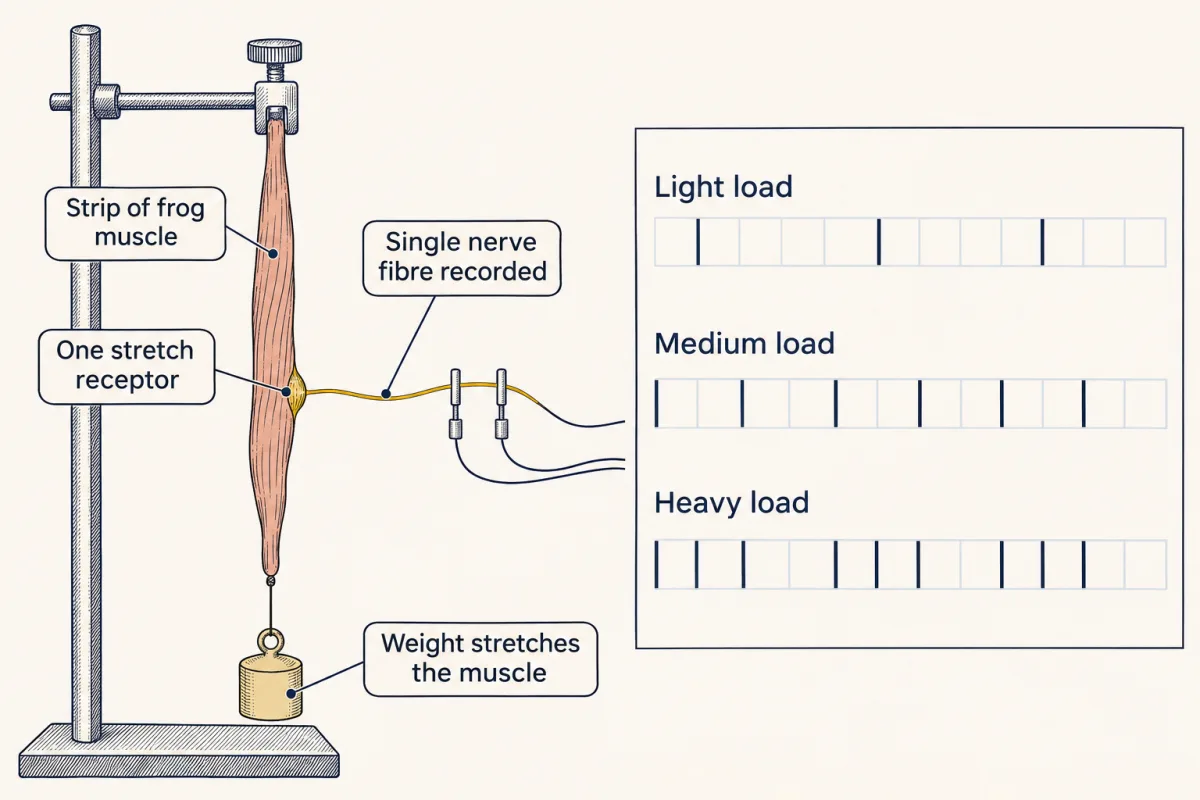
Recording one stretch receptor's fibre, Adrian and Zotterman found that a heavier load did not make the impulses bigger, only more frequent. AI-generated illustration -
From stimulus to rate
-
Where and when: receptive fields and adaptation
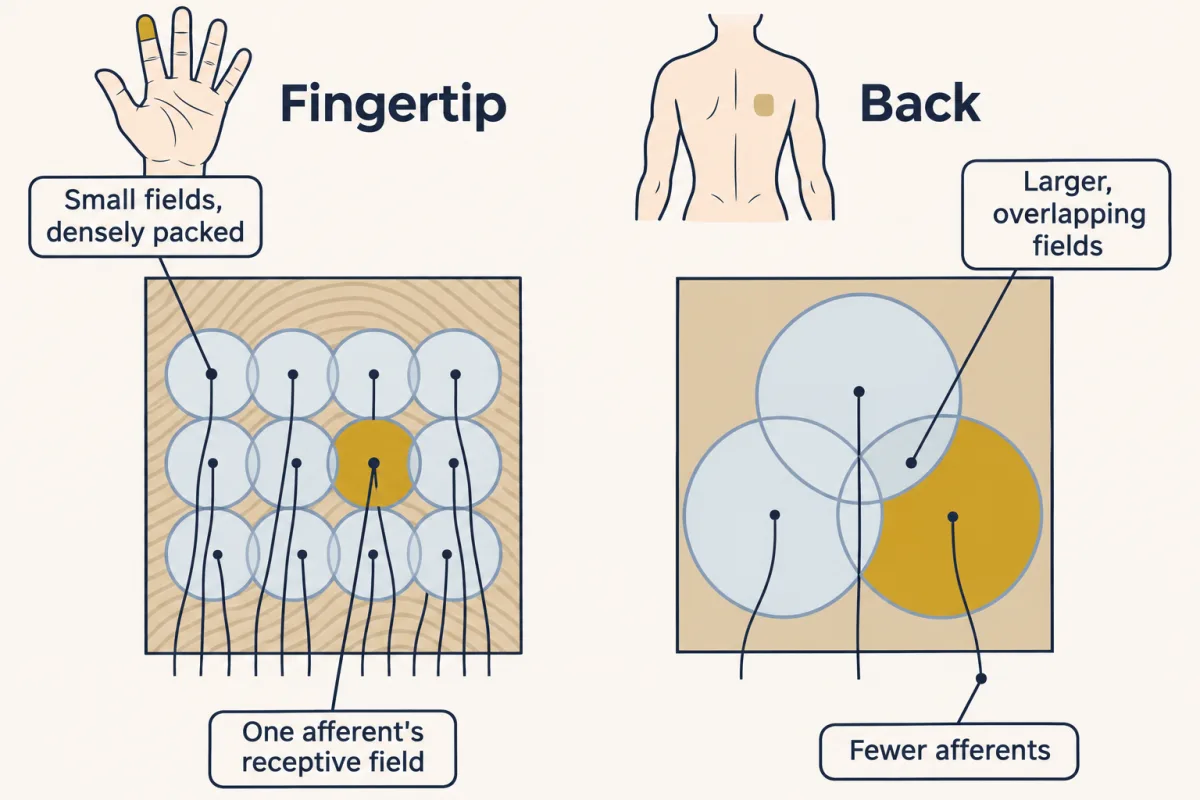
Afferents on the fingertip have small, densely packed receptive fields, while those of the same kind on the back have larger, overlapping fields and are fewer. AI-generated illustration -
Neighbours compare: lateral inhibition
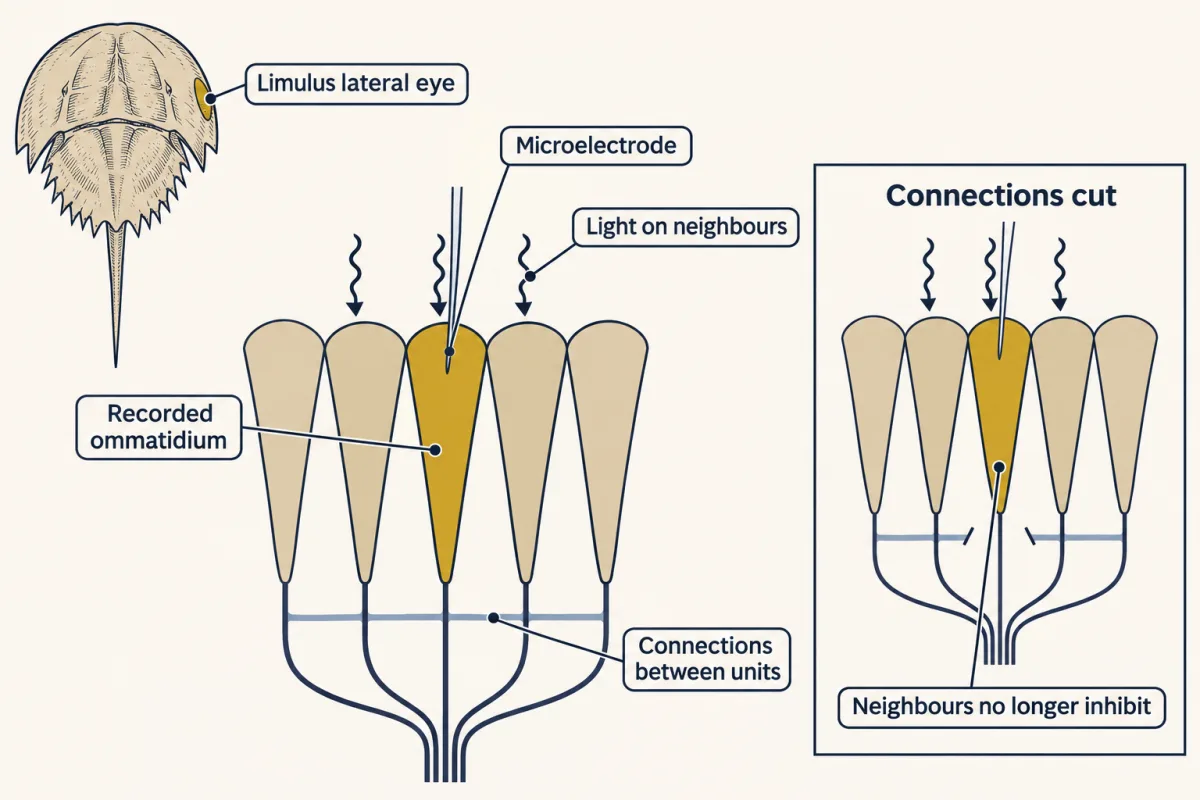
Lighting a recorded Limulus ommatidium's neighbours lowered its discharge, and once the lateral connections to it were cut, the neighbours' light no longer inhibited it (Hartline, Wagner and Ratliff). AI-generated illustration -
From a tuning curve to a threshold
-
Lines or patterns: coding what kind of stimulus
-
Going deeper
Where this lesson fits
Before thisReview first
- The Resting Membrane and Passive SignalsThis course · Lesson 3
You need the weighted-conductance balance point and the length constant from there to see why receptor potentials are graded and fade.
- The Action Potential and ConductionThis course · Lesson 4
Turning a graded receptor potential into regenerating spikes uses the action potential mechanism taught there.
- Integration, Inhibition and NeuromodulationThis course · Lesson 7
Lateral inhibition here is subtraction of neighbours' input, which builds on how inhibition combines with excitation there.
After thisStudy next
- The RetinaThis course · Lesson 10
The retina applies receptive fields, surrounds and the rod's graded response to light in a vertebrate eye.
- Touch and PainThis course · Lesson 13
Touch afferents show receptive fields, rapid and slow adaptation, and transduction channels in a real sense.
- Smell and TasteThis course · Lesson 14
This lesson's labelled-line versus population-code question is worked through in detail for smell and taste.
Suggested by an AI model from the lessons themselves, then checked. How we use AI