Biology · Skim version
From DNA to Protein
Read the full lesson → Skim the whole course →
The guiding idea
How can changing one letter out of hundreds in a gene make red blood cells bend into stiff sickle shapes?
In protein-coding genes, DNA order sets mRNA codons and amino acid order.
From the film: From Gene Copy to Protein Chain
- In protein-coding genes, DNA order sets mRNA codons and amino acid order.
- In plant and animal cells, transcription makes an mRNA copy while the chromosomes stay in the nucleus.
- A ribosome reads each mRNA codon, and transfer RNA brings the matching amino acid.
- At a stop codon, no amino acid is added and the chain is released.
From the film: When the Reading Changes
- In coding DNA, swaps change one codon; frameshifts change later codons.
- A substitution can leave the chain unchanged, change an amino acid or create a stop.
- In the sickle allele, valine replaces glutamic acid, and low-oxygen hemoglobin can form stiff rods.
- A changed letter does not guarantee a changed trait.
-
Copy a gene into messenger RNA
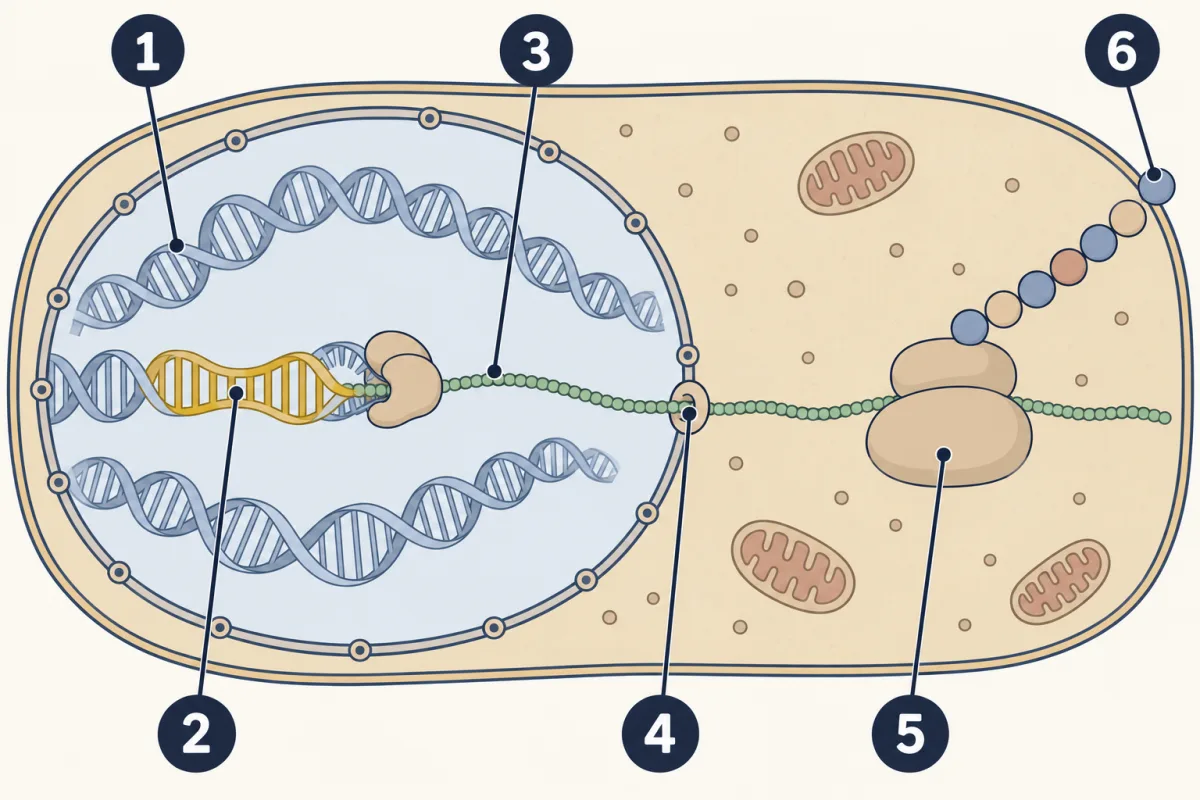
- DNA
- gene
- mRNA
- pores in the nuclear membrane
- ribosome
- chain of amino acids
-
Read the message into an amino acid chain
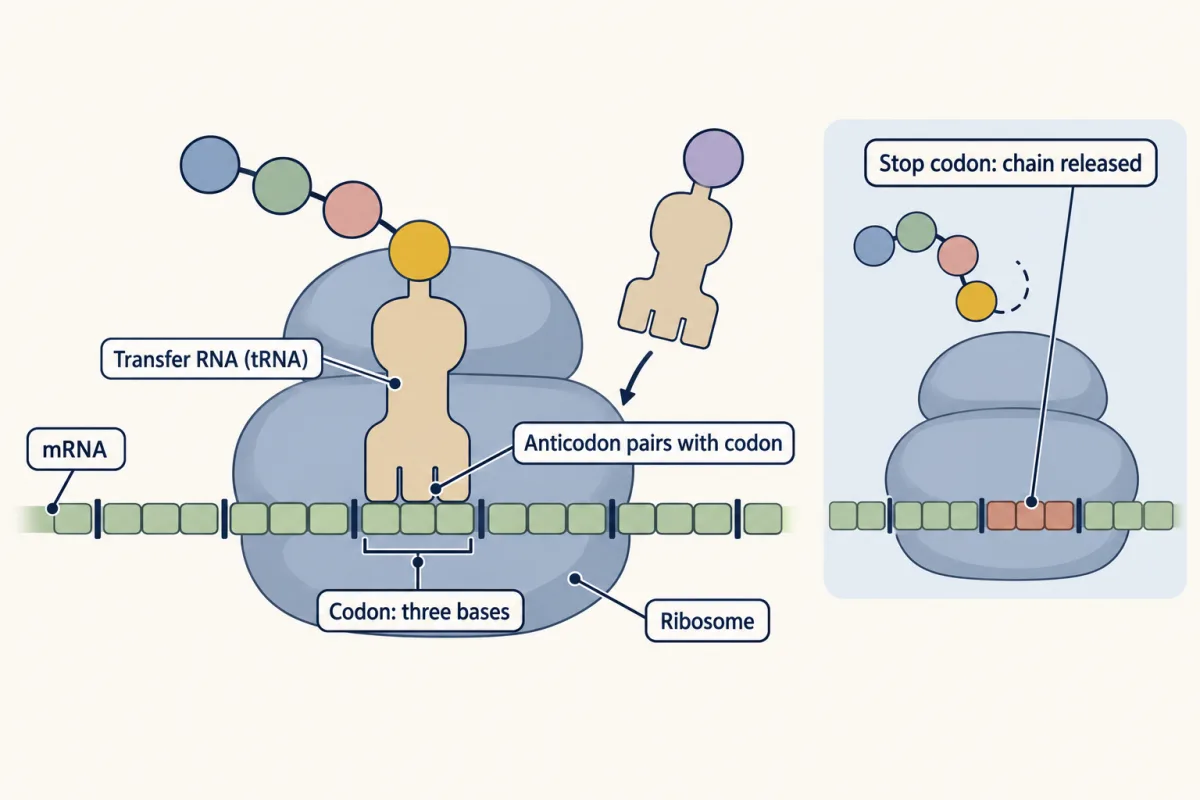
A ribosome reads one mRNA codon at a time, and matching tRNAs extend the amino acid chain until a stop releases it. AI-generated illustration -
Explore: transcribe, translate and mutate a gene
-
When one letter reaches a whole cell
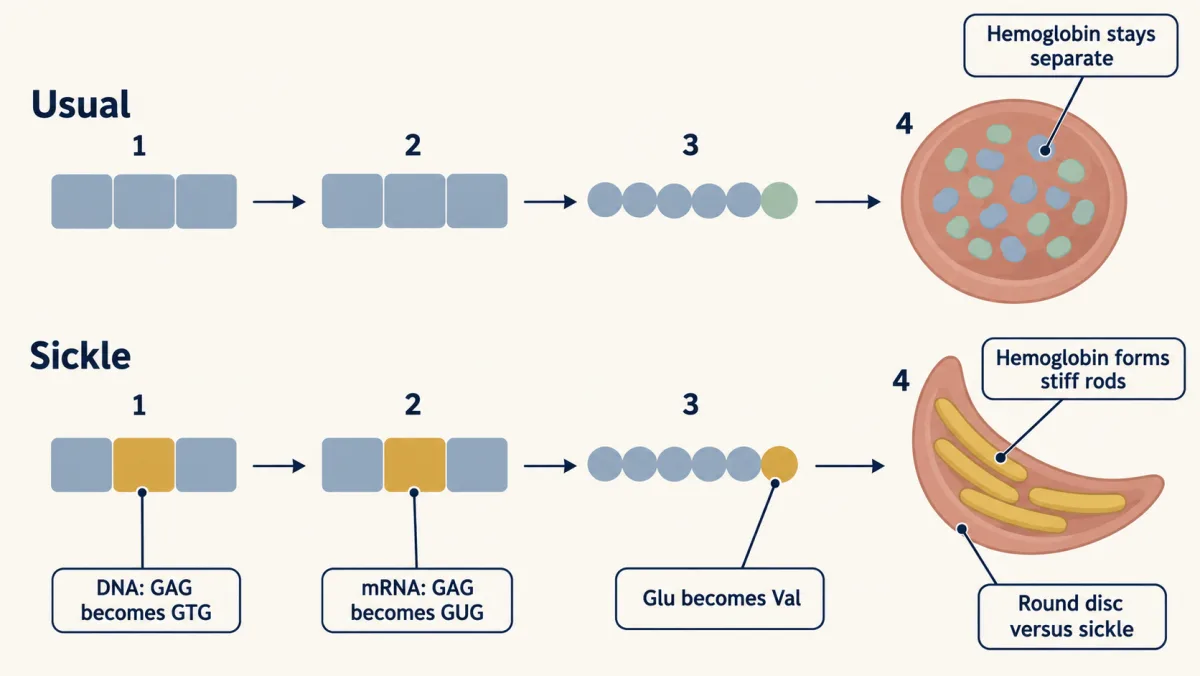
Changing coding DNA from GAG to GTG replaces glutamic acid with valine, and that hemoglobin can form stiff rods, mostly when low on oxygen, bending a red blood cell. AI-generated illustration -
Use evidence: when is a mutation harmful?
-
Going deeper
-
Evaluate: check your thinking
Where this lesson fits
Before thisReview first
- DNA: Structure and CopyingThis course · Lesson 16
You need DNA's base pairing and strand order from there to pair mRNA bases with the template.
- What Am I Made Of?This course · Lesson 2
You need to know proteins are chains of amino acids from there to follow what translation builds.
After thisStudy next
- Engineering GenesThis course · Lesson 22
Bacteria make human insulin because the nearly universal code lets them read a human gene.
- Variation and SurvivalThis course · Lesson 27
Mutations that change proteins, like the sickle change, are one source of the variation selection acts on.
- Meiosis and VariationThis course · Lesson 19
It shows how mutated alleles like the sickle allele are passed on and shuffled into children.
Suggested by an AI model from the lessons themselves, then checked. How we use AI