Neuroscience · Skim version
The Cerebellum
Read the full lesson → Skim the whole course →
The guiding idea
Most of the neurons in one count of the human brain sit in the cerebellum. Damage it and you can still move. What do you lose?
The cerebellum learns to predict, and it learns from error; damage leaves movement intact but clumsy, on the same side as the lesion.
From the film: A Predictor That Learns from Error
- Damage to the cerebellum leaves movement clumsy rather than weak.
- In the classical model, the cerebellum learns to predict what a command will do, and it learns from error.
- In this model, a well-timed error signal can weaken the parallel fibre synapses active at the right moment, which with other inputs unchanged means more nuclear output next time.
- The Marr-Albus-Ito model is well supported for some tasks, but it is not the whole story.
From the film: Following the Sign
- In rabbit experiments, only parallel fibres paired with the climbing fibre produced a lasting depression of the synapse, which stayed smaller for at least an hour.
- With other inputs unchanged, a weaker input to the Purkinje brake means more output from the nucleus.
- In mouse slices of the flocculus, depression is strongest for fibres active about 120 ms before the climbing fibre, so a learned change can act before late visual feedback arrives.
- The rule has limits: mice with no LTD in standard slice tests still learned the tested tasks, and climbing fibres also signal reward.
From the film: Prisms: Learning You Can Watch
- In the prism task, errors shrink throw by throw, and the opposite miss after the goggles come off shows that the mapping between seeing and moving was recalibrated.
- In people with damage to the olivocerebellar system, prism adaptation was impaired; in the model, a smaller k gives a flatter curve and a smaller after-effect.
- One account is that losing the cerebellum's prediction leaves the arm leaning on slow feedback, which can cause overshoot and swing.
- Two crossings cancel, so a left cerebellar lesion usually disturbs the left arm.
-
Moving badly, not weakly: three puzzles
-
Three roles, one circuit
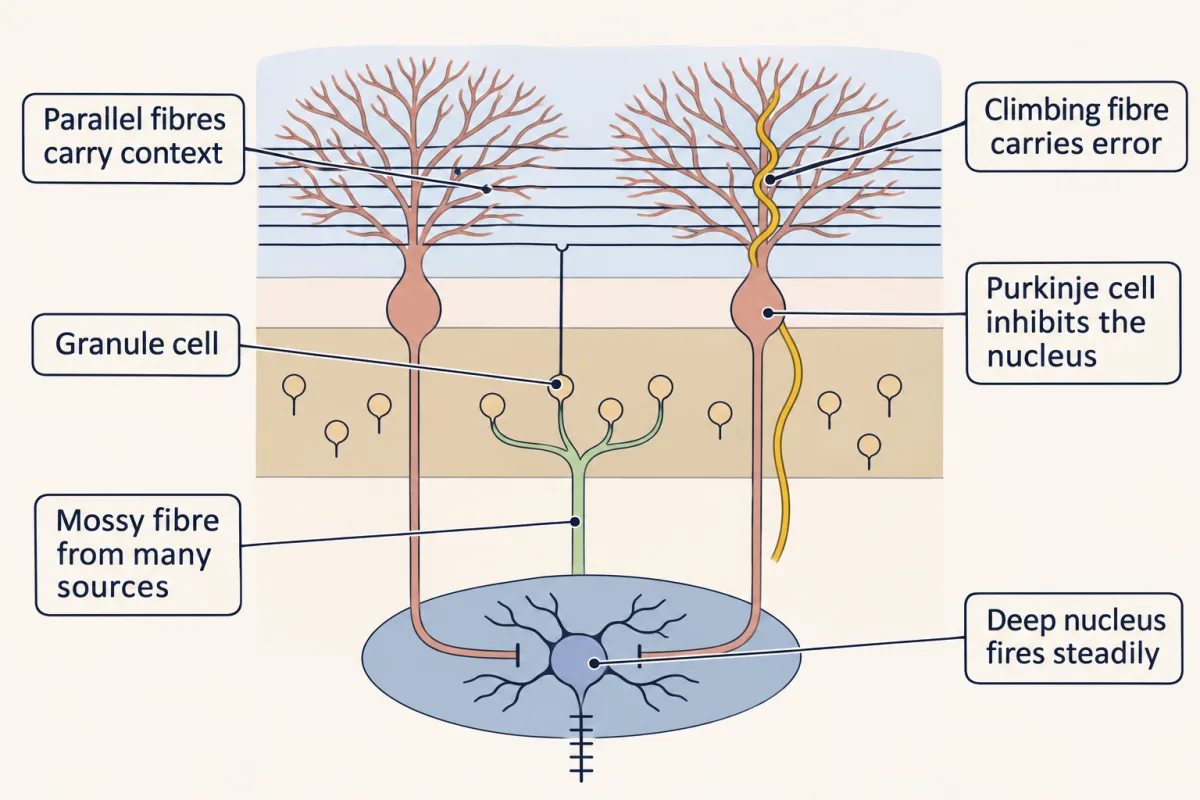
Parallel fibres from granule cells bring context to Purkinje cells, one climbing fibre brings what the classical model treats as the error signal, and the Purkinje cell shapes the output by inhibiting a deep nucleus neuron that already fires steadily. AI-generated illustration -
Reading the two signals
-
Following the sign: how an error becomes a correction
-
Adaptation in people
-
Predicting a lesion: what, which side, which region
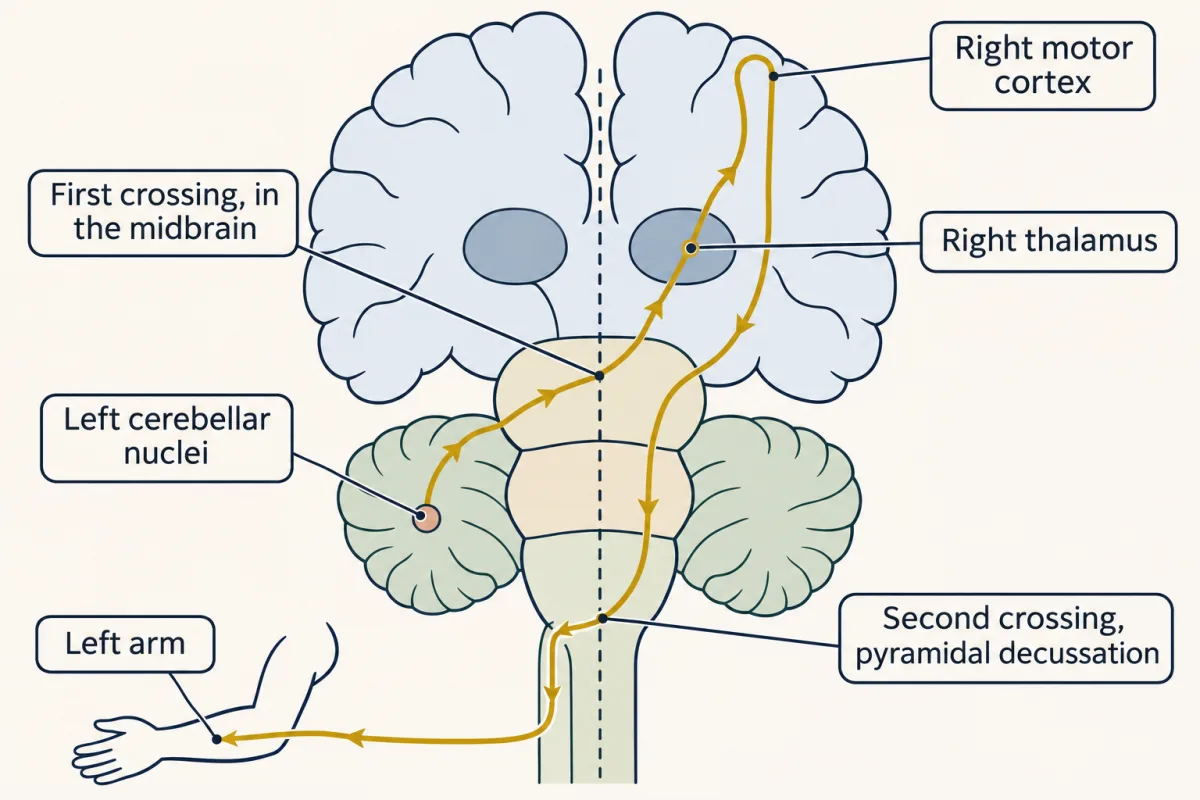
Output from the left cerebellar nuclei crosses in the midbrain to the right thalamus and motor cortex, then crosses back at the pyramidal decussation, so a left cerebellar lesion usually disturbs the left arm. AI-generated illustration -
Going deeper
Where this lesson fits
Before thisReview first
- Motor Units, Reflexes and LocomotionThis course · Lesson 15
You need the basics of reflexes and motor pathways from there to read the lesion signs and the side they appear on.
- Integration, Inhibition and NeuromodulationThis course · Lesson 7
Purkinje inhibition of steadily firing nuclear neurons uses the inhibitory-input ideas taught there.
After thisStudy next
- Memory SystemsThis course · Lesson 22
Eyeblink conditioning, a cerebellum-dependent form of learning, is taken further there.
- Designing a Causal Circuit ExperimentThis course · Lesson 28
It takes further the design of causal tests, like the one asking what drives cerebellar adaptation.
- Plasticity, Networks and ConsolidationThis course · Lesson 23
It takes further how plasticity in networks stores learned changes over time.
Suggested by an AI model from the lessons themselves, then checked. How we use AI