Biology Together · Unit 5: Animal bodies, homes and adaptations
The Camouflage Hunt
Rewritten on : new text and film. Your notes and highlights stay, but the text around them may have moved.
Why are so many animals brown or green? A hungry-bird game lets a child find out which colours stay hidden.
Three real-life stories behind this activity, about 2 minutes aloud, or read them below.
The film, 3 minutes, and the safety notes, for the grown-up to look at before the activity.
The hands-on part, done with a child: about 30 minutes.
Pause when the reading reaches a film, and offer to play it. Saved on this device.
Watch the film now, or keep listening
That is the end of the reading
This idea at other levels
An activity for ages 5 to 10 about natural selection. Next, for an older child: Natural Selection in Action (grade 7).
See every levelHide the levels
Natural selection
Living things that fit their surroundings leave more offspring, so helpful inherited traits become more common.
Taught at four levels: ages 5 to 10, grade 7, high school and college core.
College, the core · the level you chose
How to Test an Evolutionary Explanation
Daphne Major's 1977 drought shows selection; the breeder's equation predicts the offspring shift.
Ecology and Evolution · about 17 min · film 3:20 · 3 practice questions
Natural Selection in Ecological Context
Relative fitness of moth morphs, stabilizing galls, disruptive sticklebacks and the widowbird tail.
Ecology and Evolution · about 17 min · film 3:19 · 3 practice questions
High school · the level you chose
Poaching in Gorongosa raised tuskless females from 18.5 to 50.9 percent.
Biology · about 40 min · film 3:49 · Virginia BIO.7b
Natural Selection and New Species
Variation, inheritance, unequal offspring: a drought sorts the finches.
Biology · about 40 min · film 3:33 · Virginia BIO.7c, BIO.7d
Grade 7 · the level you chose
Hunt moths on clean and sooty bark, then read the real counts.
Life Science · about 40 min · film 3:32 · Virginia LS.11 a
Ages 5 to 10 · the level you chose
The Camouflage Hunt · this lesson
Be the hungry bird: which yarn worms get eaten last?
Biology Together · about 30 min · film 2:51 · Virginia 2.7 a, 3.4 b, 3.4 a
Play the ladder · 5 films, about 18 min, from grade 7 to college core. Each film waits for you to press play.
Next door to natural selection
- AdaptationsAn adaptation is what selection leaves behind.Nearest lesson: Fur, Feathers and Scales (ages 5 to 10)
- MutationWhere the differences that selection sorts come from.Nearest lesson: Mutations and Variation (grade 7)
Also at grade 7: Predators and Prey
Short versions inside this lesson
The grade 7 version · about 1 minute to read
In grade 7 Life Science, this game becomes a model of natural selection. Students hunt pale and dark "moths" on clean and sooty bark, then read real counts of peppered moths from England. They learn why an inherited trait that helps animals survive and have young becomes more common over many generations. They also study how predators and prey change each other's numbers.
The plainest version · about 1 minute to read
Some animals have colours that look like the place where they live. A green katydid on a green leaf is hard to see. That is called camouflage. A bird hunting for food finds the easy-to-see animals first. The ones that blend in are more likely to live and have babies, and the babies often have the same colours.
Find an idea: every idea, searchable
Which lessons teach an idea, and the notes on each level, were written by AI models from the lessons and checked by a second model. A person has not yet read every one. How we use AI
About this activity what is in it
Builds on:Fur, Feathers and Scales (read)Why these?
Rewritten on : new text and film. Notes and highlights stay, but the text around them may have moved.
Before you start
- Hands-on time
- About 30 minutes
- Where
- Indoors or outdoors
- Ages
- 5 to 10, with an easier and a harder version below
- Grown-up
- Stay with your child the whole time. You cut the yarn, lay out the worms, keep time, and help count them all back at the end.
What you need
- Yarn in four colours: green, brown, red and yellow (or another bright colour)
- Scissors for the adult, to cut 20 pieces about 5 cm long, 5 of each colour
- A patch of lawn about 2 metres by 2 metres, marked at the corners with 4 shoes or short, blunt sticks
- A second background: bare dirt, a rug, or a few sheets of newspaper
- A timer or phone
- A small cup for each 'bird' to drop worms into
- Paper and crayons, or the printed observation sheet below
Virginia science standards SOL 2.7 aSOL 3.4 bSOL 3.4 a
In this activity. You scatter coloured yarn "worms" on a patch of grass, and your child plays a hungry bird with 30 seconds to find them.
The film
 ▶ Watch The Camouflage Hunt: Parent Guide · 2:51
Read the transcript of “The Camouflage Hunt: Parent Guide”
Film transcript: The Camouflage Hunt: Parent Guide
Why are so many animals brown or green while others stand out? In this thirty-minute game, your child plays a bird hunting yarn worms. You can see which colors are harder to find when you change the background. What does your child get out of this exercise? They practice making a prediction before testing it. They look closely across a busy patch and sort their finds by color. Then they check what changes on a new background. Cut the yarn yourself into twenty pieces, each about five centimeters long. Make five green, five brown, five red, and five yellow. Mark out a lawn patch about two meters on each side. Use four shoes or short, blunt sticks.
Stay with your child and check the patch for hazards first. Choose a spot away from roads. Hunt in shoes and use only soft yarn. Keep it away from children under four. Call nine one one if choking. Keep pets indoors, find all twenty pieces, and wash hands afterward. Show your child one worm of each color. Ask, "If you were a bird, which color would you find first?" Write down their guess. While they turn away, scatter all twenty worms on top of the grass. Say go. Give your child thirty seconds to put worms in the cup, one at a time. Red and yellow usually go first. Green and brown are often left. Record the count for each color and recover every piece.
Play three rounds, then total the counts by color. For the next hunt, choose bare dirt or a patterned rug. Before you scatter the worms, ask your child, "Which color do you think will hide best here?" Write down their guess. Take a moment to make your own prediction.
Scatter the same worms and run another thirty-second hunt. Count by color and find every leftover worm. Check your guesses. Which colors were found least often on each background? Brown often hides well on brown dirt. When a color blends into the background, it can be harder to spot. Close by asking, "Which worms would still be alive at the end of the day?" Real animals can pass their colors to their young. If animals with a matching color survive more often and have more young, that color can become more common.
Before you start
- Hands-on time
- About 30 minutes
- Where
- Indoors or outdoors
- Ages
- 5 to 10, with an easier and a harder version below
- Grown-up
- Stay with your child the whole time. You cut the yarn, lay out the worms, keep time, and help count them all back at the end.
What you need
- Yarn in four colours: green, brown, red and yellow (or another bright colour)
- Scissors for the adult, to cut 20 pieces about 5 cm long, 5 of each colour
- A patch of lawn about 2 metres by 2 metres, marked at the corners with 4 shoes or short, blunt sticks
- A second background: bare dirt, a rug, or a few sheets of newspaper
- A timer or phone
- A small cup for each 'bird' to drop worms into
- Paper and crayons, or the printed observation sheet below
Virginia science standards SOL 2.7 aSOL 3.4 bSOL 3.4 a
The big idea
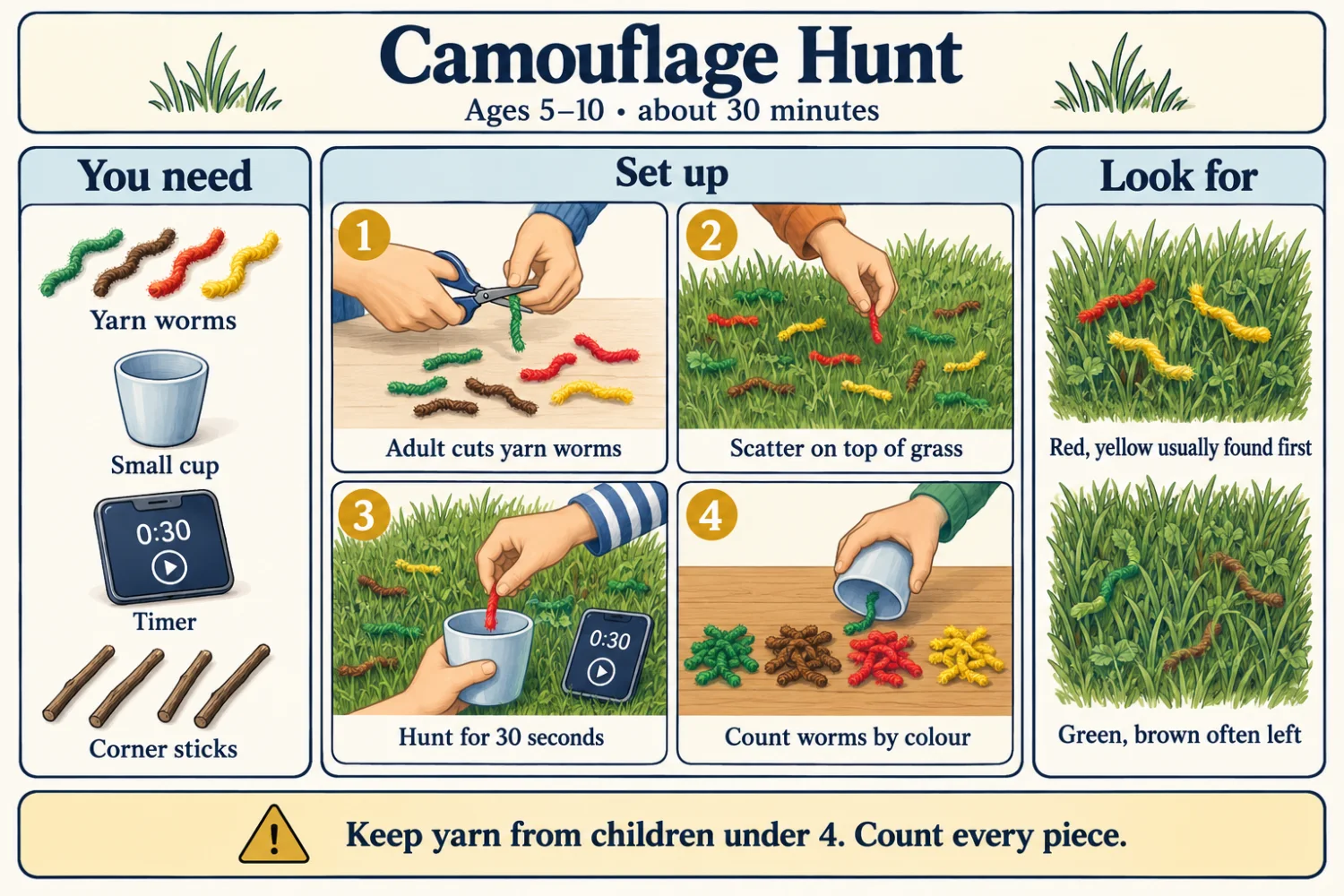
Your child plays a hungry bird in this 30-minute game. They look for yarn worms and count which colours they find. Then they change the background to see which colours are harder to spot.
Say it together: “Some animals have colours like the place where they live. That match is called camouflage. A colour hides an animal only when it matches its background.”
Ask your child to spot a grasshopper in tall grass, and they soon see why it is hard. Camouflage is any colour or pattern that helps an animal blend in so predators pass it by.
In this game, your child is the hungry bird. Yarn worms that blend into the grass are harder to spot. Change the background to see whether a different colour hides best. Hidden worms survive, and real survivors have young like them—the start of how a population (a group of the same kind of living thing in one place) changes over time.
What to do
- Make the worms and try one look first. An adult cuts 20 yarn pieces about 5 cm long: 5 green, 5 brown, 5 red, and 5 yellow. Show your child one worm of each colour before you put any on the lawn.
- Predict before you hunt. Ask, “If you were a hungry bird, which colour would you find first? Which would you miss?” Write down the guess.
- Set the scene. While your child turns away, scatter all 20 worms on top of the marked lawn patch, not pushed under the grass.
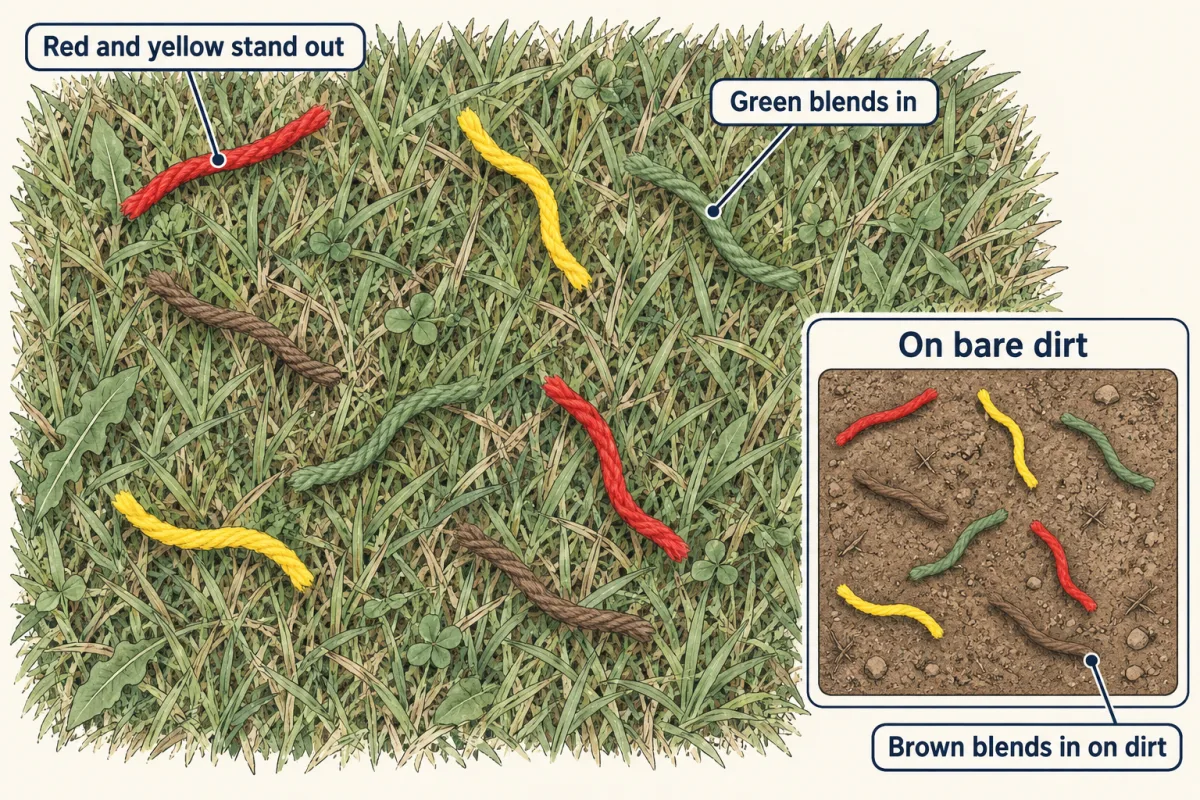
- Hunt for 30 seconds. Give one rule: pick up worms one at a time into the cup. Say, “Ready, bird? Go!” and start the timer. Notice what happens: red and yellow usually go first, while green and brown are often left. How many remain depends on the grass and patch size.
- Count, record, and check. Tip out the cup, sort by colour, count each pile, and fill in the table. Compare with the guess. For example, if you find all the red and yellow worms and just one green worm, record Red: 5, Yellow: 5, Green: 1. Count the brown worms you found and fill in their row. Then find every leftover worm until all 20 are back.
- Repeat twice more. Play two more rounds on grass. Three rounds give a fairer answer than one. Add up the counts across rounds for each colour.
- Change the background—predict, then check. Move the 20 worms to bare dirt, a rug, or newspaper. Ask, “What do you think will happen here? Which colour will win now?” Write the guess, then hunt and count. On brown dirt, brown often wins; on a busy-patterned rug, the winner can surprise you.
- Close with two debrief questions. Tie back to the opening lines:
- “Which colours were hardest to find on each background, and what do you notice about how they matched?”
- “Which worms would still be alive at the end of the day, and what would their babies look like?” Say the Say it together lines once more.
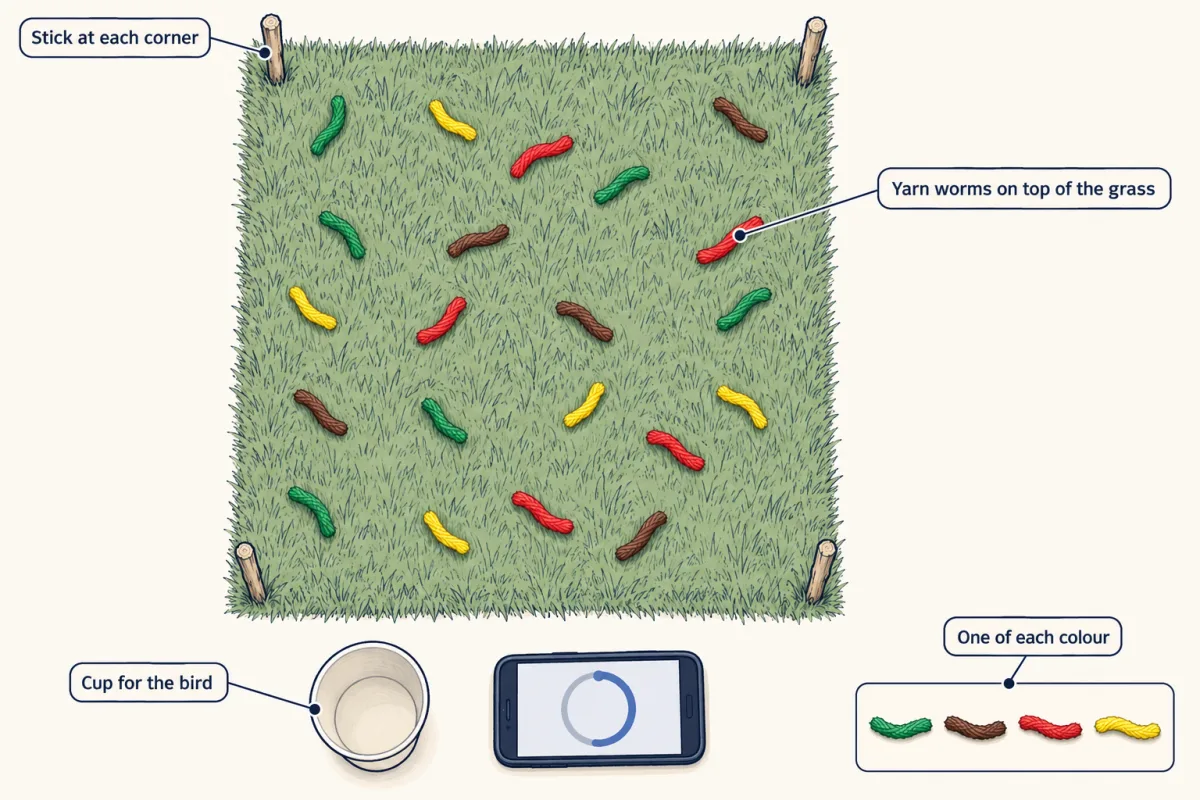
With a class, give each group of four its own patch and its own 20 worms, and add the group totals on one board.
Questions to ask while you do it
Ask your child to guess first, then check.
- “Which colour do you think you’ll find first? Why?”
- “I wonder which worms a real bird would miss on our grass.”
- “What do you think will happen if we play on the dirt instead?”
- “If the hidden worms have babies the same colour, what will the next group of worms look like?”
- “Can you think of a real animal near our house that is hard to see? Where does it live?”
- “Why might some animals be bright and easy to see?”
What children often think
-
A child might say “Animals pick their colour so they can hide.”
You could try Ask, "Could the yarn change colour when it saw you coming?" Then ask where a baby animal’s colour comes from. Most animals are born with their colours, mostly like their parents. The ones that happen to match their home are more likely to survive.
-
A child might say “The green worms were smart. They hid.”
You could try Ask, "Did the green worms move?" Nothing moved; only the colour was different. Some real animals do help themselves hide by keeping still, like a fawn lying quiet in tall plants. Its spotted coat does the rest.
-
A child might say “Green is the best colour for an animal.”
You could try Play on brown dirt or a red rug and see which colour wins now. A colour only hides an animal when it matches the place. A green insect sitting on a tree trunk is easy to spot.
-
A child might say “Bright colours are always bad for an animal.”
You could try Ask why a bee or a monarch butterfly might be bright. Some animals sting or taste bad. A bright colour can be a warning that birds learn to avoid after one bad mouthful.
Why it works
Many predators hunt by sight. In the game, a worm’s colour sets how likely it is to be spotted. Worms with less contrast against the background get found less often, just as camouflaged animals do.
Over many generations, that difference can change a population. Animals pass traits such as colour to their young. When well-matched animals survive more often and have more young, the matching colour slowly becomes more common in the group. No single animal has to change. Scientists call this process natural selection. One well-known case is the peppered moth in England, where darker moths became more common for a time on soot-darkened trees.
Camouflage is one strategy. Its opposite is warning colour: bright colours on animals that sting or taste bad. A monarch butterfly carries toxins from the milkweed it ate as a caterpillar. Many birds that eat one get sick and learn to avoid that pattern.
Easier and harder
Ages 5 to 7
Use two colours only—10 green and 10 red—and one background. Keep it to one or two rounds. Skip the table: have your child line up the found worms in two rows, one per colour, and ask “Which row is longer?” Then draw a bird and the worm it missed.
Ages 8 to 10
Play three generations. After each hunt, gather the worms still in the grass: these are the survivors. Each survivor “has one baby”: add one new piece of that colour, then scatter the survivors and babies together and hunt again. Keep a tally of every piece you add, and at the end find every piece, including the extras. Record each generation in a table and make a bar graph of how many of each colour remain. Ask how the population changed even though no worm changed colour.
If it doesn’t go as planned
- Found all 20 quickly: The patch is too small or the grass is too short. Make the patch bigger or cut the time to 15 seconds.
- No worms found: Try shorter grass or give a longer time.
- Green and red found equally: Check that the worms lie on top of the grass, not tucked under it. A tie can also be chance, so write it down and play again. Ask your child if the red and green yarn look alike to them. If they do, record that observation too.
- A piece is still missing: Search the patch again on your hands and knees in good light. Keep pets and young children off the patch, and keep the mower away, until you find it.
Observation sheet
Observation sheet
The camouflage hunt
NameDate
Write how many worms of each colour the bird found.
| Colour | Round 1 | Round 2 | Round 3 | Total found |
|---|---|---|---|---|
| Green | ||||
| Brown | ||||
| Red | ||||
| Yellow |
I think this colour hid best because:
stemhop.com · Biology Together
For teachers: Virginia standards
Virginia’s grade 2 standard (SOL 2.7 a) asks children to see camouflage as one way animals survive. Grade 3 (SOL 3.4 a, 3.4 b) adds that a population, a group of the same kind of living thing in one place, can change over a long time. This game gives younger learners a hands-on start on both ideas.
The three stories, told aloud Side Hops: three stories that go with this lesson Side Hops
Three easy ways to talk about camouflage
1:43 · Narration: an AI narrator voice (Kokoro, af_heart).
Read the transcript
Here are three easy ways to keep the camouflage talk going all week, long after the last yarn worm is counted.
First, grab a white winter coat from the closet and hold it up near green grass. Kids get it right away: a coat that disappears in snow pops out on a lawn. Snowshoe hares do that swap for real. Over several weeks in fall, many of them grow a white winter coat in place of their brown summer fur. White fur helps them blend in when there's snow. On bare ground, the same white coat stands out.
Second, when your child guesses that the green worms turned green on purpose, try this line: "Mice don't pick their pajamas. Their fur color comes from their parents." Rock pocket mice make a nice example. On pale rocks, light-colored mice blend right in, while dark mice blend in on dark lava. Neither mouse decided to change color. The ones that match simply get missed more often.
Third, on your next walk together, stop at a rough tree trunk and look with eyes only. Bark is a jumble of gray, brown, and shadow. A little owl called the eastern screech-owl, only about six inches tall, lives in neighborhoods and parks and wears feathers in that same bark pattern. When it feels nervous, it stretches tall and thin, like a stubby branch. You may never spot one, and that is exactly the point.
One coat from the closet, one pajamas line, and one bumpy tree, and your child will start seeing hiding tricks everywhere you go.
The idea underneath them. You scatter coloured yarn "worms" on a patch of grass, and your child plays a hungry bird with 30 seconds to find them.
Your notes
Select any text in the lesson to highlight it or add a note to it. Your highlights and notes are saved in this browser and collected in your notebook.
This browser is not letting the site save anything (a private window or strict privacy settings), so highlights and notes will be lost when you leave the page.
Where this lesson fits
Before thisReview first
- Fur, Feathers and ScalesThis course · Lesson 15
It shows that animal body coverings suit how the animal lives, which this game builds on.
After thisStudy next
- Who Eats Whom?This course · Lesson 21
It shows who eats whom, so your child sees why a hidden animal survives longer.
Elsewhere on the siteFilms, simulations and method films in other courses
- Moths and birdsSimulation · Life Science
Birds hunting moths of different colours on a background shows the same hidden-colour game on a bigger scale.
Suggested by an AI model from the lessons themselves, then checked. How we use AI
Those are the stories. The idea under them is the one the lesson builds.
That is the film. The rest of the activity is the fun part.
The rest of the activity is here when you want it.
Finish line
Test yourself
4 questions
Questions to talk over together.
Next · Lesson 19
Backyard Habitat Hunt
Is anything living in a patch of plain grass? A string square and ten minutes of close looking answer that.
Continue →Rewritten on : new text and film. Notes and highlights stay, but the text around them may have moved.