Biology Together · Unit 7: Seasons and living things
Adopt a Tree
Rewritten on : new text and film. Your notes and highlights stay, but the text around them may have moved.
Does a bare tree die in winter? One tree, visited every month for a year, answers the question.
Three real-life stories behind this activity, about 2 minutes aloud, or read them below.
The film, 4 minutes, and the safety notes, for the grown-up to look at before the activity.
The hands-on part, done with a child: about 30 minutes, then a few quick looks later.
Pause when the reading reaches a film, and offer to play it. Saved on this device.
Watch the film now, or keep listening
That is the end of the reading
This idea at other levels
An activity for ages 5 to 10 about seasonal rhythms. Next, for an older child: Daily and Seasonal Rhythms (grade 7).
See every levelHide the levels
Seasonal rhythms (phenology)
Living things change through the year, cued by day length and temperature, and warming can shift when those changes happen.
Taught at three levels: ages 5 to 10, grade 7 and college core.
College, the core · the level you chose
Global Change: Species on the Move
Nine Dutch flycatcher populations fell 90% where caterpillars peaked early.
Ecology and Evolution · about 22 min · film 3:24 · 3 practice questions
No lesson on seasonal rhythms at high school yet.
Grade 7 · the level you chose
Washington cherry peak-bloom days since 1921 moved earlier after the 1960s, unsteadily.
Life Science · about 40 min · film 3:43 · Virginia LS.8 a
Ages 5 to 10 · the level you chose
Adopt a Tree · this lesson
Visit one tree monthly for a year: bare in winter, buds already waiting.
Biology Together · about 30 min · film 3:34 · Virginia 1.7 c, 1.7 a, K.9 b, K.10 a, 2.7 a
Play the ladder · 2 films, about 7 min, from grade 7 to college core. Each film waits for you to press play.
Next door to seasonal rhythms
- Day length and flowering (photoperiodism)Plants measure night length with a pigment, which is how many of them know it is time to flower.Nearest lesson: Auxin and Plant Hormones: How Plants Steer Growth (a first college course)
- Climate changeWarmer springs move leaf-out and nesting earlier, so timing shifts can be measured year by year.Nearest lesson: Big Changes: Dead Zones, Storms and Climate (grade 7)
Short versions inside this lesson
The grade 7 version · about 1 minute to read
In grade 7 Life Science, students study daily and seasonal rhythms. They learn that day length and temperature act as signals. Similar signals, such as day length and temperature, also help time migration and hibernation in animals, along with food supply and the animal's own body clock. Students also read long records, such as many years of spring bloom dates, and ask whether the timing of events in nature is shifting.
The plainest version · about 1 minute to read
Our tree is alive all year. In spring it grows new leaves, and often flowers. In summer its green leaves use sunlight to make food. In fall, shorter days and cooler weather make many trees drop their leaves. In winter the tree rests. Look closely at a bare twig: small buds are already there, holding next spring's leaves.
Find an idea: every idea, searchable
Which lessons teach an idea, and the notes on each level, were written by AI models from the lessons and checked by a second model. A person has not yet read every one. How we use AI
About this activity what is in it
Rewritten on : new text and film. Notes and highlights stay, but the text around them may have moved.
Before you start
- Hands-on time
- About 30 minutes, then a 15-minute visit about once a month (or once a season) for a year
- Where
- Outdoors
- Ages
- 5 to 10, with an easier and a harder version below
- Grown-up
- Stay with your child at the tree on every visit. You choose the tree, check the trunk and ground before the first visit, and handle any glass hand lens or tweezers.
What you need
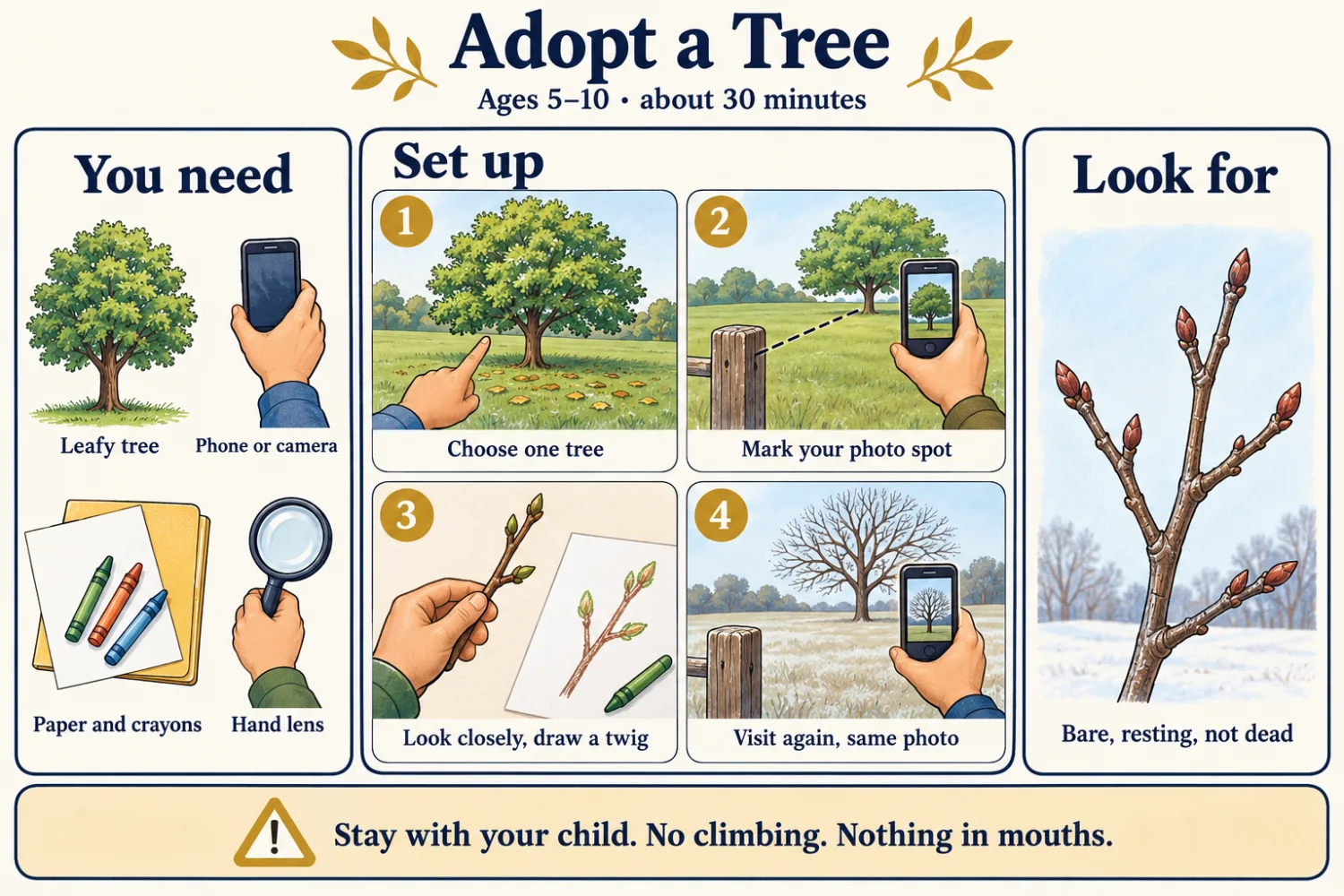
- One tree that loses its leaves in fall (such as a maple, oak, dogwood, tulip poplar or fruit tree) that you can reach safely and have permission to visit
- A phone or camera
- Paper, pencils and crayons, and a folder to keep every visit together
- A hand lens (optional. An adult handles any glass lens. See the safety note.)
- For ages 8 to 10: a ball of string, a ruler or tape measure, and a weather website or app
- Paper and a pencil, or the printed observation sheet below
Virginia science standards SOL 1.7 cSOL 1.7 aSOL K.9 bSOL K.10 aSOL 2.7 a
In this activity. You and your child choose one tree near home or school and visit it about once a month for a year, taking a photo from the same spot and drawing what you see.
The film
 ▶ Watch Adopt a Tree: Parent Guide · 3:34
Read the transcript of “Adopt a Tree: Parent Guide”
Film transcript: Adopt a Tree: Parent Guide
In winter, a bare tree looks dead. It's easy to walk past the same tree and miss its slow changes. Yet one tree, visited through the year, tells a very different story. Adopting one tree slows the year down. Your child practices looking closely and recording slow changes over time. They make a guess, wait, and check it against real evidence. In thirty minutes to start, you set up a whole year. Choose a tree that drops its leaves in fall. Ask permission to visit. Bring a phone or camera, paper, and a pencil.
Stand ten to twenty steps back by a landmark. Take every photo from that same spot, facing the same way. Keep the whole tree in the frame. Before looking closely, let your child predict first. Ask, 'What do you think this tree will look like next month?' Save the guess. Spend about ten minutes looking at bark, a low twig, the weather, and any animals nearby. Your child draws one twig or leaf to save in a folder. Come back about once a month for fifteen minutes, or once each season. Repeat the photo and drawing. Record what you saw. Check the last guess, then compare photos.
Ask, 'Can you find three differences?' Now picture your winter visit. The branches are bare, and your child says, 'Our tree died.' Before you explain, pause for a moment. What do you predict you'll see if you look closely at a bare winter twig?
Look closely at a bare twig. Plump buds wait at the tip and where each leaf joined. Ask, 'I wonder what is inside this bud. What do you think will come out?' The tree is dormant, alive but resting, with next spring's leaves folded inside. Shorter days and cooler weather in fall signal the tree to drop its leaves before winter. Warmer spring days wake those buds. When you finish all four seasons, put one picture from each season in order. Look at the order together and ask what comes next. Stay with your child on every visit. Avoid busy road crossings, storms, and strong wind. Feet stay on the ground, with no climbing. Nothing goes in a mouth, and small acorns, nuts, or stones can choke children under four. Call nine one one if choking.
Check the trunk for poison ivy. Leave fallen nuts alone, especially with a nut allergy. Never taste wild plants, berries, or mushrooms. Look at insects without touching them. Adults handle glass lenses. Keep lenses from focusing sunlight. Never look at the sun through one. Wash hands and check for ticks. By year's end, one ordinary tree becomes your child's calendar. Next winter, look for buds together when the branches turn bare again. Those tiny buds mean spring is already waiting.
Before you start
- Hands-on time
- About 30 minutes, then a 15-minute visit about once a month (or once a season) for a year
- Where
- Outdoors
- Ages
- 5 to 10, with an easier and a harder version below
- Grown-up
- Stay with your child at the tree on every visit. You choose the tree, check the trunk and ground before the first visit, and handle any glass hand lens or tweezers.
What you need
- One tree that loses its leaves in fall (such as a maple, oak, dogwood, tulip poplar or fruit tree) that you can reach safely and have permission to visit
- A phone or camera
- Paper, pencils and crayons, and a folder to keep every visit together
- A hand lens (optional. An adult handles any glass lens. See the safety note.)
- For ages 8 to 10: a ball of string, a ruler or tape measure, and a weather website or app
- Paper and a pencil, or the printed observation sheet below
Virginia science standards SOL 1.7 cSOL 1.7 aSOL K.9 bSOL K.10 aSOL 2.7 a
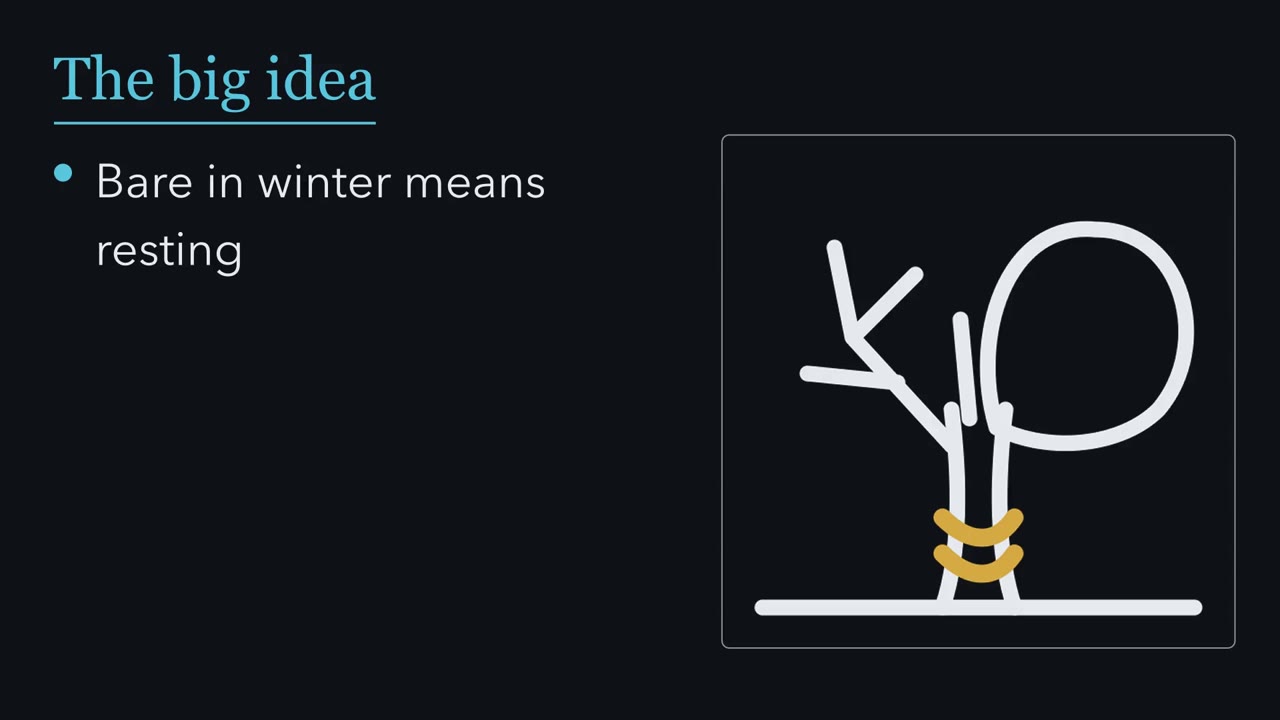
The big idea
Visiting one tree through the year gives your child practice looking closely, recording slow changes, and testing guesses against real evidence. Your child finds out that a bare winter tree is resting, not dead, with next spring’s leaves already waiting in its buds.
Say it together (read aloud): “Our tree stays alive all year. In winter it is resting, not dead. Small buds on the twigs already hold next spring’s leaves.”
Children walk past the same trees daily and rarely see them change. Visiting one tree from one spot slows that down, and the photos and drawings make slow changes clear.
Many Virginia trees—such as maples, oaks, dogwoods and tulip poplars—are deciduous: they lose their leaves mostly in fall and grow new ones in spring. In winter, the tree goes dormant (alive but resting, with most growth paused). Many of next year’s leaves and flowers are already packed inside buds, small wrapped bundles on the twigs, before old leaves fall.
Seasons come in the same order each year. Shorter days and cooler weather in fall start leaf drop; warmer spring days wake the buds.
For teachers (Virginia standards)
In grade 1, children notice budding, growth and losing leaves and link them to temperature and light. Grade 2 adds dormancy.
What to do
- Choose a tree. Check the trunk and ground first. Pick one tree that loses its leaves in fall, not a pine or holly. In fall, look for leaves below it; in winter, look for bare twigs with buds. Say, “This is our tree for the whole year. What should we name it?” With a class, one schoolyard tree works well.
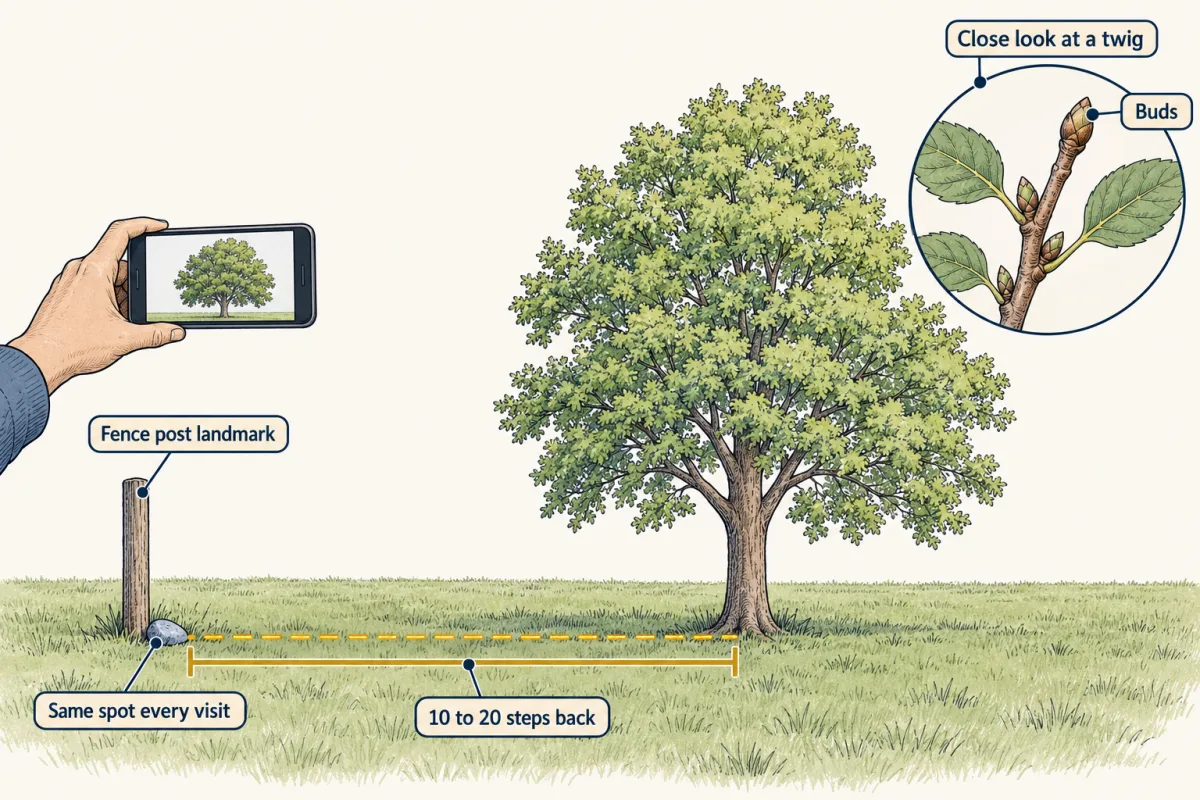
- Mark your photo spot. Stand 10 to 20 steps back so the whole tree fits. Pick a landmark, like a fence post or sidewalk crack. Take the first photo here. Say, “We will stand here and face the same way for every photo.”
- Predict first. Ask, “What do you think our tree will look like next month? What about in winter?” Your child draws or says a guess. Keep it in the folder to check later.
- Look closely. Spend about 10 minutes at the tree. Check the bark, a low twig and a few leaves. Find the buds at the twig tip and where each leaf joins. Ask, “What do you notice?” Your child draws one twig or leaf up close.
- Check weather and light. Ask, “Warm or cold? Do we need a coat? Is it dark by dinnertime?” Was it sunny, cloudy or rainy? Record the weather and light answers in words or simple pictures.
- Look for animals. Watch for birds, squirrels, insects, nests, holes and chewed leaves. Look, don’t touch, and leave animals where you find them. Ask, “Food or shelter—what is this animal using our tree for?”
- Check your guess and return. Visit about once a month for 15 minutes. Check last month’s guess: “What matched? What changed?” Take the same photo, draw the tree, fill in a row, and guess one change for next time.
- Know what to expect. In much of Virginia, buds swell and open in March and April. Leaves are full from May to September. Colors and leaf drop come mostly in October and November, a little earlier in the mountains. Most trees stay bare from December to February, though some oaks and beeches, especially young ones, hold dry brown leaves into late winter. Dates vary by tree and by year.
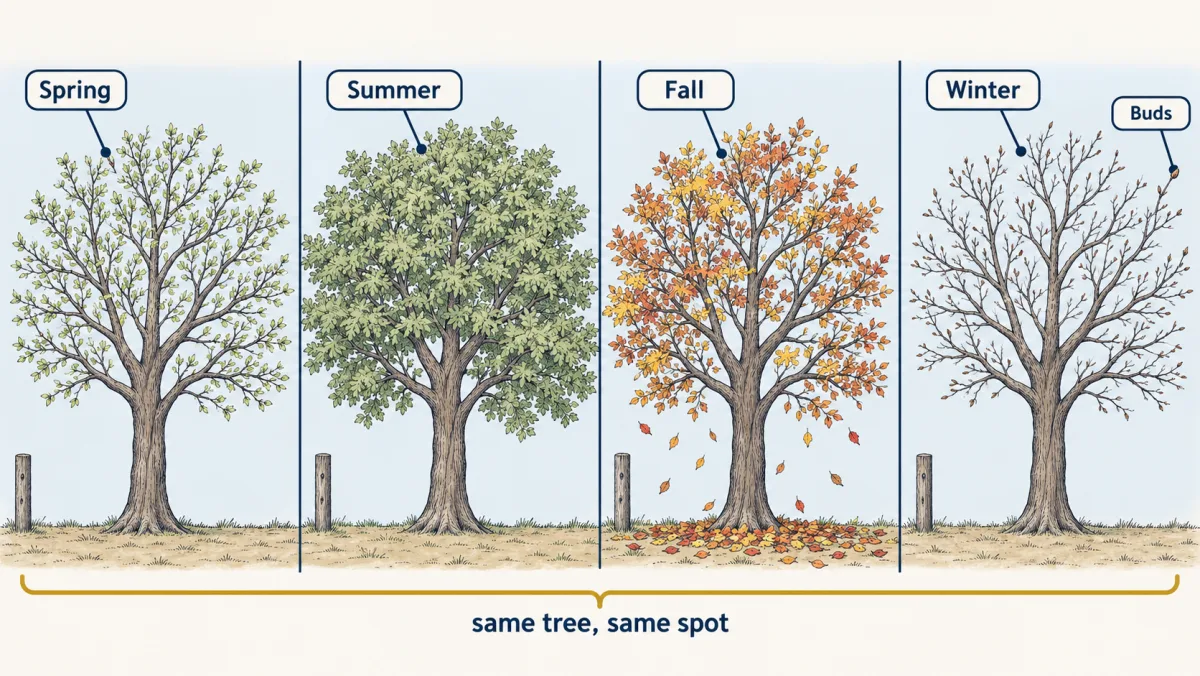
- Make a four-season poster and debrief. Line up one photo or drawing from spring, summer, fall and winter in order. Ask two closing questions:
- “When our tree had no leaves in winter, was it dead or resting? How do you know?”
- “What happens next?” Read Say it together aloud again.
Questions to ask while you do it
Ask your child to guess first, then check.
- “I wonder what is inside this bud. What do you think will come out?”
- “What do you think the tree will look like on our next visit?”
- “Which leaves will change color first, the ones at the top or the bottom?”
- “Is it getting dark earlier or later than last time? What might the tree do about that?”
- “What animals do you think use our tree in winter?”
- “What do you think will happen if we come back on the same day next year?”
What children often think
-
A child might say “The tree died. It has no leaves.”
You could try Look closely at a bare twig together. Find the buds and ask, "What do you think is inside?" Watch the same twig in spring. The tree is resting, not dead, and next year’s leaves are folded inside those buds.
-
A child might say “Leaves fall because it gets cold.”
You could try Cold is part of it. Ask, "Is it getting dark earlier now?" Trees respond to shorter days as well as cooler weather, and many start dropping leaves before the first frost. Check your sheet: when did the leaves start falling, and how cold was it?
-
A child might say “Evergreen trees never lose their leaves.”
You could try Look under a pine tree in the fall. You will often find a carpet of brown needles. Evergreens drop old needles or leaves a few at a time. Pines often drop their inner needles in fall. They always keep enough green ones to stay green all year.
-
A child might say “The tree is the same every time we come.”
You could try Put this month’s photo next to last month’s and ask, "Can you find three differences?" Some changes are slow, like swelling buds. Lining the photos up in a row makes slow changes easier to see.
Why it works
In winter, broad thin leaves cost a tree more than they give. They lose water through tiny pores, and cold or frozen ground makes water hard to replace. Freezing can also damage them. Dropping leaves lets the tree wait out the cold.
As nights grow longer and temperatures fall, the tree stops making chlorophyll, its green pigment, and pulls some nutrients back into the twigs. A band of cells at the base of each leaf stalk, the abscission layer, weakens until the leaf breaks off. A seal forms over the scar. The exact mix of signals differs between kinds of trees.
Buds form in summer and wait through winter, many tightly wrapped in scales. After enough cold, warm spring days start them growing. The tree also feeds and shelters animals year-round: squirrels nest in it, birds eat its seeds, and insects eat its leaves.
Easier and harder
Ages 5 to 7
Visit four times, once in each season. Take the photo, draw the tree, and mark the weather with a picture: sun, cloud, raindrop or snowflake. Add “coat” or “no coat.” Ask your child to describe the tree in one sentence. Write it down. Make the poster with four big boxes, one for each season.
Ages 8 to 10
Visit monthly. At about your child’s chest height, wrap string around the trunk, mark where it meets its end, and measure to that mark in cm (an adult handles any metal tape measure or cutting). Mark the spot so you measure there every time. Trunks grow slowly, so “no change” may be a real result. From a weather site, record the high temperature and hours from sunrise to sunset. In Virginia, day length runs from about 9 and a half hours in late December to almost 15 hours in late June. Graph day length by month, then mark when the leaves changed.
If it doesn’t go as planned
If photos are hard to compare, you likely stood in different spots. Mark your spot with a large painted stone (too big to swallow—never a small stone around children under 4) or a note on your phone. If the tree stays green all winter, it may be an evergreen like a holly or southern magnolia. Keep it as a comparison and adopt a second tree. If you miss a month, just carry on. Even four visits a year show the pattern.
Observation sheet
Here is what two filled-in rows can look like:
| Date | Weather | Leaves | Animals I saw |
|---|---|---|---|
| October | Cool, sunny, coat | Yellow and falling | Squirrel on a branch |
| December | Cold, cloudy, coat | None, plump buds on twigs | Bird perched near top |
Observation sheet
My tree visit
NameDate
Fill in one row each time you visit your tree.
| Date | Weather: warm or cold? sun or rain? | Leaves: buds, green, colors, falling, or none? | Animals I saw |
|---|---|---|---|
One thing that changed since last time:
stemhop.com · Biology Together
The three stories, told aloud Side Hops: three stories that go with this lesson Side Hops
Three easy ways to talk about your tree
1:33 · Narration: an AI narrator voice (Kokoro, af_heart).
Read the transcript
Here are three easy ways to talk about your adopted tree, ones you can keep in your pocket for any visit. First, in fall, when your child spots the first yellow leaves, you can say, "That yellow was hiding in our leaves all summer, and fall just took off the green cover." It is true. The yellow comes from the same color family as the colors in carrots and corn. It sits in the leaf all summer under the green, and when the green fades away, it finally shows. Second, once the branches go bare, bring along a water bottle. Screw the lid on tight and let your child give it a gentle shake. Nothing spills, and the lid takes the bumps. Then find a plump bud on a low twig. Many buds wear tiny scales wrapped around them, and those scales do a similar job, helping keep what is tucked inside from drying out and getting bumped all winter. Third, go on a fingerprint hunt. On a bare maple twig, look just below a bud on the side of the twig for the little mark where a leaf once let go. On many maples it is a tiny V with three dots inside, left by the tubes that once carried water to that leaf. If you visit a different kind of tree, compare the marks: look at their shapes and the little dots inside. Stand with your feet on the ground, look closely, and leave the twigs on the tree. Have fun, and enjoy getting to know your tree together all year long.
The idea underneath them. You and your child choose one tree near home or school and visit it about once a month for a year, taking a photo from the same spot and drawing what you see.
Your notes
Select any text in the lesson to highlight it or add a note to it. Your highlights and notes are saved in this browser and collected in your notebook.
This browser is not letting the site save anything (a private window or strict privacy settings), so highlights and notes will be lost when you leave the page.
Where this lesson fits
After thisStudy next
- Sleep, Travel or Stay?This course · Lesson 26
Your child sees how animals cope with winter, after learning that the tree rests instead of dying.
Suggested by an AI model from the lessons themselves, then checked. How we use AI
Those are the stories. The idea under them is the one the lesson builds.
That is the film. The rest of the activity is the fun part.
The rest of the activity is here when you want it.
Finish line
Test yourself
4 questions
Questions to talk over together.
Next · Lesson 26
Sleep, Travel or Stay?
Where do hummingbirds go in winter, and why does a cardinal stay? A sorting game and a window watch find out.
Continue →Rewritten on : new text and film. Notes and highlights stay, but the text around them may have moved.